

Bridgewater 13F Q1 2026: Ray Dalio’s Firm Boosts Chip Stocks NVIDIA, Broadcom, Micron, TSMC and Exits Software Names Like Salesforce
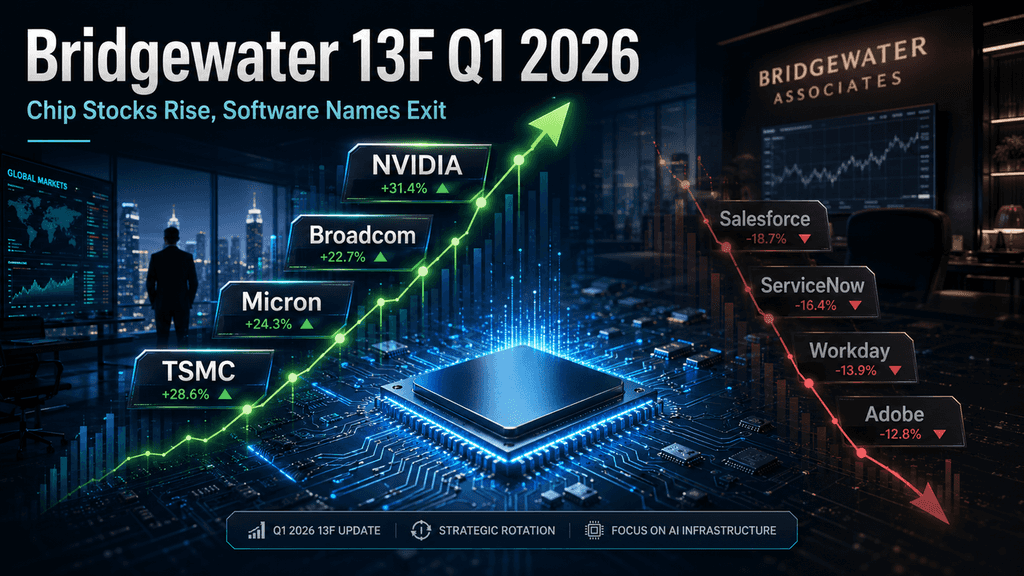
Bridgewater Associates’ Q1 2026 13F filing shows a major portfolio rotation toward AI chip stocks and away from leading software stocks. The hedge fund increased exposure to major semiconductor names including NVIDIA, Broadcom, Micron Technology, and TSMC, while exiting or reducing enterprise software holdings such as Salesforce, ServiceNow, Workday, and Adobe.
The latest Bridgewater 13F filing highlights growing institutional interest in the AI infrastructure trade, including GPUs, networking chips, memory, data centers, and advanced semiconductor manufacturing. Although many investors associate Bridgewater with Ray Dalio, these moves reflect Bridgewater Associates’ portfolio filing, not Dalio’s personal trades, making the report important for investors tracking Ray Dalio 13F, Bridgewater Q1 2026 portfolio, semiconductor stocks, and the shift from SaaS stocks to the AI chip supply chain.
Bridgewater’s Q1 2026 13F Shows a Major Portfolio Rotation
Bridgewater Associates’ Q1 2026 13F filing points to a clear portfolio rotation. The hedge fund shifted more capital into semiconductor and AI infrastructure stocks while reducing exposure to several large-cap software companies. This is important because Bridgewater is one of the most closely watched hedge funds in the world, and its quarterly filings are often used by investors to understand broader institutional positioning.
The most important takeaway from the filing is not simply that Bridgewater bought technology stocks. Instead, the filing suggests a more selective technology strategy. The firm increased exposure to companies that are closer to the physical infrastructure behind artificial intelligence, including GPUs, memory chips, networking semiconductors, and advanced chip manufacturing. At the same time, it pulled back from software names that may face more uncertainty around growth, valuation, and AI monetization.
-
Bridgewater 13F Q1 2026: The filing shows a major shift in the hedge fund’s U.S. equity portfolio.
-
Portfolio value: Bridgewater’s reported U.S. stock holdings were about $22.4 billion, down from about $27.4 billion in the previous quarter.
-
AI chip stocks: The firm increased exposure to NVIDIA, Broadcom, and Micron Technology.
-
New TSMC position: Bridgewater opened a new position in Taiwan Semiconductor Manufacturing Company, also known as TSMC.
-
Software stock exits: Bridgewater exited or reduced positions in Salesforce, ServiceNow, Workday, and Adobe.
-
Portfolio rotation: The move suggests a shift from some SaaS and enterprise software stocks toward AI hardware and semiconductor stocks.
Bridgewater Rotates from Software Stocks to AI Chip Stocks
Bridgewater’s Q1 2026 13F filing shows a clear shift toward AI chip stocks and away from several major software stocks. The hedge fund increased exposure to NVIDIA, Broadcom, Micron, and TSMC, which are tied to AI infrastructure, data centers, memory chips, and advanced semiconductor manufacturing. At the same time, Bridgewater reduced or exited Salesforce, ServiceNow, Workday, and Adobe, suggesting it favored semiconductor companies with more direct AI demand over SaaS names still proving how AI can drive stronger revenue growth.
Ray Dalio’s Firm Boosts AI Chip Stocks: NVIDIA, Broadcom, Micron, and TSMC
Bridgewater’s increased exposure to AI chip stocks was one of the most important themes in its Q1 2026 13F filing. The hedge fund added to several companies that play central roles in the global semiconductor supply chain.
-
NVIDIA: Bridgewater increased its NVIDIA position by about 827,800 shares.
-
Broadcom: The firm increased its Broadcom holding by about 670,000 shares.
-
Micron Technology: Bridgewater added about 586,000 shares of Micron.
-
TSMC: The hedge fund opened a new TSMC position of about 1.077 million shares, representing around 1.62% of the portfolio.
These changes show that Bridgewater’s semiconductor strategy was not focused on just one company. Instead, the firm gained exposure to several parts of the AI chip supply chain: GPU computing, data center networking, memory, and advanced chip manufacturing.
KuCoin has also covered the broader connection between AI chip demand and digital asset markets, including how NVIDIA earnings can influence AI tokens and crypto markets. This type of coverage shows how AI infrastructure has become a cross-market theme, affecting equities, technology sentiment, crypto narratives, and Web3 infrastructure discussions.
NVIDIA: Bridgewater Adds to the AI GPU Leader
NVIDIA remains one of the most important companies in the AI hardware market. Its graphics processing units, or GPUs, are widely used for training and running AI models. These chips are central to data centers, generative AI platforms, cloud computing, and advanced machine learning workloads.
Bridgewater’s increased NVIDIA position suggests the firm continued to see opportunity in the AI computing boom. NVIDIA has become a symbol of the artificial intelligence trade because its chips are used by major cloud providers, AI labs, enterprise customers, and technology platforms. As demand for AI compute rises, investors often view NVIDIA as one of the most direct beneficiaries.
For an SEO-friendly article, NVIDIA is one of the most important keywords to use naturally. Phrases such as NVIDIA stock, NVIDIA AI chips, NVIDIA GPUs, AI infrastructure, and Bridgewater NVIDIA position help the article match search intent from investors following hedge fund filings and AI chip stocks.
Broadcom: AI Networking and Custom Silicon Exposure
Broadcom is another major chip stock that benefited from Bridgewater’s Q1 2026 portfolio rotation. The company has strong exposure to networking chips, custom silicon, connectivity, and data center infrastructure. As AI data centers become larger and more complex, networking becomes increasingly important because advanced AI systems require fast communication between thousands of chips and servers.
Bridgewater’s increased Broadcom position suggests interest in the infrastructure surrounding AI computing, not only the GPUs themselves. While NVIDIA is often the best-known AI chip stock, Broadcom plays a critical role in the broader semiconductor ecosystem. Its products help support the data movement, connectivity, and custom chip needs of large technology companies.
This makes Broadcom a key part of the AI infrastructure stock theme. Investors looking at Bridgewater’s Q1 2026 13F filing should recognize that the firm’s chip-stock bet was not limited to one high-profile GPU maker. It also included companies that support the data center architecture needed for artificial intelligence.
Micron: Memory Chips Become More Important in AI Systems
Micron Technology gives Bridgewater exposure to the memory side of the AI chip market. Artificial intelligence systems require significant amounts of memory, especially for advanced AI servers and high-performance computing workloads. High-bandwidth memory has become especially important because AI models need fast access to large amounts of data.
Bridgewater’s increased Micron holding suggests the firm saw value in the memory portion of the semiconductor cycle. Memory stocks can be more cyclical than some other technology stocks, but they can also benefit strongly when demand improves and supply tightens. AI servers, data centers, and advanced computing workloads have increased investor interest in companies that supply memory chips.
For investors, Micron represents a different type of AI chip exposure than NVIDIA or Broadcom. NVIDIA is tied to GPUs, Broadcom is tied to networking and custom silicon, and Micron is tied to memory. Together, these positions show a broader AI supply chain strategy.
TSMC: Bridgewater Adds the World’s Leading Chip Manufacturer
One of the most notable moves in the filing was Bridgewater’s new position in Taiwan Semiconductor Manufacturing Company, better known as TSMC. The firm reportedly opened a position of about 1.077 million shares, representing around 1.62% of the portfolio.
TSMC is one of the most important companies in the global semiconductor industry. It manufactures advanced chips for many of the world’s largest technology companies. While companies like NVIDIA design chips, TSMC provides the manufacturing capacity needed to produce many advanced semiconductors.
By adding TSMC, Bridgewater gained exposure to the manufacturing backbone of the AI chip industry. This move fits well with the broader theme of AI infrastructure and semiconductor supply chain investment. KuCoin has also reported on the connection between NVIDIA stock momentum and TSMC earnings, showing why investors often watch these companies together when analyzing AI chip demand.
Software Stocks Lose Favor as Bridgewater Exits Salesforce and Other SaaS Names
While Bridgewater increased exposure to chip stocks, the hedge fund also moved away from several major software stocks. The Q1 2026 13F filing showed exits or reductions in enterprise software and SaaS names including Salesforce, ServiceNow, Workday, and Adobe.
This part of the filing is important because it shows Bridgewater was not simply increasing exposure to all technology stocks. Instead, the firm appeared to rotate within the technology sector, favoring semiconductor stocks over certain software companies.
-
Salesforce: Bridgewater exited Salesforce, one of the most widely followed enterprise software stocks.
-
ServiceNow: The firm also moved out of ServiceNow, a major workflow automation and cloud software company.
-
Workday: Bridgewater reduced or exited Workday, a cloud-based HR and finance software provider.
-
Adobe: The hedge fund reduced Adobe, a software leader facing investor questions around AI competition and monetization.
-
SaaS rotation: The move suggests a shift away from some traditional software growth stocks and toward AI infrastructure stocks.
Salesforce and ServiceNow: Enterprise Software Faces Investor Pressure
Salesforce and ServiceNow are two of the biggest names in enterprise software. Salesforce is a leader in customer relationship management, while ServiceNow is a major platform for workflow automation and enterprise digital operations. Both companies are investing heavily in artificial intelligence and automation, but Bridgewater’s 13F filing shows reduced interest in these names during the quarter.
The exit from Salesforce is especially notable because Salesforce is one of the most widely held software stocks. It has a large customer base, recurring revenue, and strong brand recognition in enterprise technology. However, software companies have faced investor pressure around growth rates, margins, valuation, and the real financial impact of AI tools.
ServiceNow is also a high-quality software company, but Bridgewater’s move suggests that even strong SaaS names may have been less attractive than semiconductor companies during the quarter. In a market focused heavily on AI infrastructure spending, investors may prefer companies seeing more immediate demand from data center expansion.
Workday and Adobe: AI Monetization Remains a Key Question
Workday and Adobe also appeared among the software names that lost favor in Bridgewater’s portfolio. Workday is a major provider of cloud-based HR and finance software. Adobe is a leader in creative software, digital media, and document tools.
Both companies have AI strategies, but investors are still watching how AI will affect their business models. For Adobe, AI creates both opportunity and risk. AI-powered creative tools can strengthen its platform, but competition from generative AI tools may also pressure parts of its business. For Workday, AI can improve enterprise productivity and analytics, but investors may want clearer evidence of revenue acceleration.
Bridgewater’s reduced exposure to these names suggests caution toward software companies where AI monetization may take longer to prove. In contrast, semiconductor companies are more directly linked to AI infrastructure spending because they supply the chips and components needed to build AI systems.
What Bridgewater’s Chip-Stock Bet Means for Investors
Bridgewater’s chip-stock bet offers several important lessons for investors. First, it shows that AI infrastructure remains a major institutional investment theme. Second, it highlights the importance of the semiconductor supply chain. Third, it shows that investors may be becoming more selective within the technology sector.
For investors searching for Bridgewater 13F Q1 2026, Ray Dalio chip stocks, NVIDIA Broadcom Micron TSMC, or Salesforce software stock exit, the key message is that Bridgewater’s filing points to a rotation from software to semiconductors.
-
AI infrastructure remains a key theme: Bridgewater’s moves suggest continued interest in companies powering artificial intelligence and data centers.
-
Semiconductor stocks may stay in focus: NVIDIA, Broadcom, Micron, and TSMC are central to the AI chip supply chain.
-
Software stocks may face more selective demand: The exits from Salesforce and other SaaS names show that investors may be more cautious about software valuations.
-
Valuation still matters: AI chip stocks may have strong growth potential, but many also trade at high valuations.
-
13F filings are backward-looking: Bridgewater’s Q1 2026 13F shows what the firm held at quarter-end, not necessarily what it owns today.
AI Chip Stocks Remain a Major Institutional Investment Theme
Bridgewater’s increased exposure to chip stocks reinforces the idea that semiconductor companies remain central to the AI investment cycle. NVIDIA, Broadcom, Micron, and TSMC are not only technology companies; they are key suppliers to the infrastructure behind artificial intelligence.
AI models require enormous computing power. That computing power depends on GPUs, networking chips, memory, servers, data centers, and advanced manufacturing. This makes the semiconductor supply chain one of the most important areas for investors watching the artificial intelligence market.
KuCoin has also discussed how AI infrastructure is becoming important for Web3, connecting GPU supply, compute demand, decentralized AI projects, and blockchain infrastructure. While Bridgewater’s 13F filing is focused on equities, the AI infrastructure theme is now relevant across multiple markets.
Investors Should Watch Valuation, Competition, and 13F Timing
Bridgewater’s chip-stock rotation may be seen as a positive signal for the semiconductor sector, but investors should not treat the filing as a direct buy recommendation. AI chip stocks can be volatile, and many have already attracted strong investor demand.
Valuation is one of the biggest risks. When a sector becomes popular, stock prices can move faster than earnings. Even strong companies can produce weak investment returns if investors pay too much. Semiconductor stocks are also cyclical, meaning demand can rise and fall depending on inventory cycles, capital spending, and macroeconomic conditions.
Competition is another factor. KuCoin has reported that NVIDIA faces risks as Google, Microsoft, and Amazon develop custom AI chips. Another KuCoin report noted that global technology giants are increasing custom AI chip development to manage compute costs and supply-chain risks. These trends could affect the long-term competitive landscape for AI chip companies.
Finally, investors should remember that 13F filings are delayed and backward-looking. A 13F filing shows certain U.S.-listed long equity positions at the end of a quarter. It does not show short positions, many derivatives, non-U.S. holdings, or real-time trading activity after the reporting date.
Why Bridgewater’s Q1 2026 13F Matters
Bridgewater is one of the world’s most closely watched hedge funds, so its quarterly 13F filings often attract attention from investors, analysts, and market watchers. The Q1 2026 filing matters because it shows a clear contrast between two parts of the technology sector: chip stocks gaining favor and software stocks losing favor.
This rotation may reflect a broader market view that AI infrastructure companies have more direct near-term earnings potential than some SaaS businesses. Chipmakers are supplying the hardware needed for AI data centers, while software companies are still proving how AI will translate into faster growth, stronger margins, and better customer spending.
A More Selective Technology Strategy: Not All Tech Stocks Are Equal
Bridgewater’s portfolio changes show that the firm was not simply buying technology stocks across the board. Instead, it appeared to favor companies with stronger exposure to AI hardware and semiconductor demand.
This is an important lesson for investors. The AI boom may benefit many companies, but the biggest winners can change depending on where spending is happening. At one point, investors may favor software platforms. At another point, they may focus more on chipmakers, data centers, and infrastructure suppliers.
In Q1 2026, Bridgewater’s 13F suggests the firm preferred the physical infrastructure behind AI over some software platforms. That does not mean software will not benefit from AI, but it does suggest that the market may be rewarding companies with clearer near-term exposure to AI capital spending.
13F Filings Offer Clues, Not Complete Portfolio Transparency
A 13F filing can help investors understand how major hedge funds are positioning their U.S. equity portfolios. However, it does not provide complete transparency. These filings are useful, but they have limits.
Bridgewater’s Q1 2026 13F should be viewed as a useful signal, not a full investment roadmap. It shows what the firm reported at the end of the quarter, but it does not reveal the full strategy, real-time trades, short positions, hedges, or the reasoning behind every position change.
Investors should use 13F filings as one research tool among many. They can help identify themes, sector rotations, and institutional interest, but they should not replace independent analysis of company fundamentals, valuation, risk, and portfolio goals.
Conclusion
Bridgewater Associates’ Q1 2026 13F filing shows a clear shift toward AI chip stocks and the semiconductor supply chain. The firm increased exposure to NVIDIA, Broadcom, Micron, and TSMC, while reducing or exiting software names like Salesforce, ServiceNow, Workday, and Adobe. For investors, the main takeaway is that Bridgewater’s portfolio rotation highlights strong institutional interest in AI infrastructure, but 13F filings are delayed and should not be treated as direct buy or sell signals.
FAQs
What did Bridgewater buy in Q1 2026?
Bridgewater increased its positions in NVIDIA, Broadcom, and Micron, and opened a new position in TSMC.
Did Bridgewater sell Salesforce?
Yes. Bridgewater reportedly exited Salesforce and ServiceNow, while also reducing exposure to Adobe.
Why is Bridgewater buying AI chip stocks?
The filing suggests Bridgewater is focusing on companies that benefit from AI infrastructure spending, including GPUs, data centers, memory chips, networking chips, and advanced semiconductor manufacturing.
Is this Ray Dalio’s personal portfolio?
No. These trades are from Bridgewater Associates’ 13F filing, not Ray Dalio’s personal portfolio. Ray Dalio founded Bridgewater, so investors often connect the filing with his name.
What is Bridgewater’s Q1 2026 portfolio value?
Bridgewater reported 993 holdings worth about $22.4 billion in Q1 2026.
Are NVIDIA, Broadcom, Micron, and TSMC AI stocks?
They are commonly viewed as AI infrastructure stocks because they support GPUs, networking, memory, and advanced chip manufacturing used in AI systems.
Should investors copy Bridgewater’s 13F holdings?
Not directly. A 13F filing is backward-looking and does not show real-time trades, short positions, or the full investment strategy. Use it as research, not financial advice.
Disclaimer
The information provided on this page may originate from third-party sources and does not necessarily represent the views or opinions of KuCoin. This content is intended solely for general informational purposes and should not be considered financial, investment, or professional advice. KuCoin does not guarantee the accuracy, completeness, or reliability of the information, and is not responsible for any errors, omissions, or outcomes resulting from its use. Investing in digital assets carries inherent risks. Please carefully evaluate your risk tolerance and financial situation before making any investment decisions. For further details, please consult KuCoin’s Terms of Use and Risk Disclosure.