

Why Long-Context AI Matters: Real-World Use Cases Transformed by Extended Context Windows
Introduction
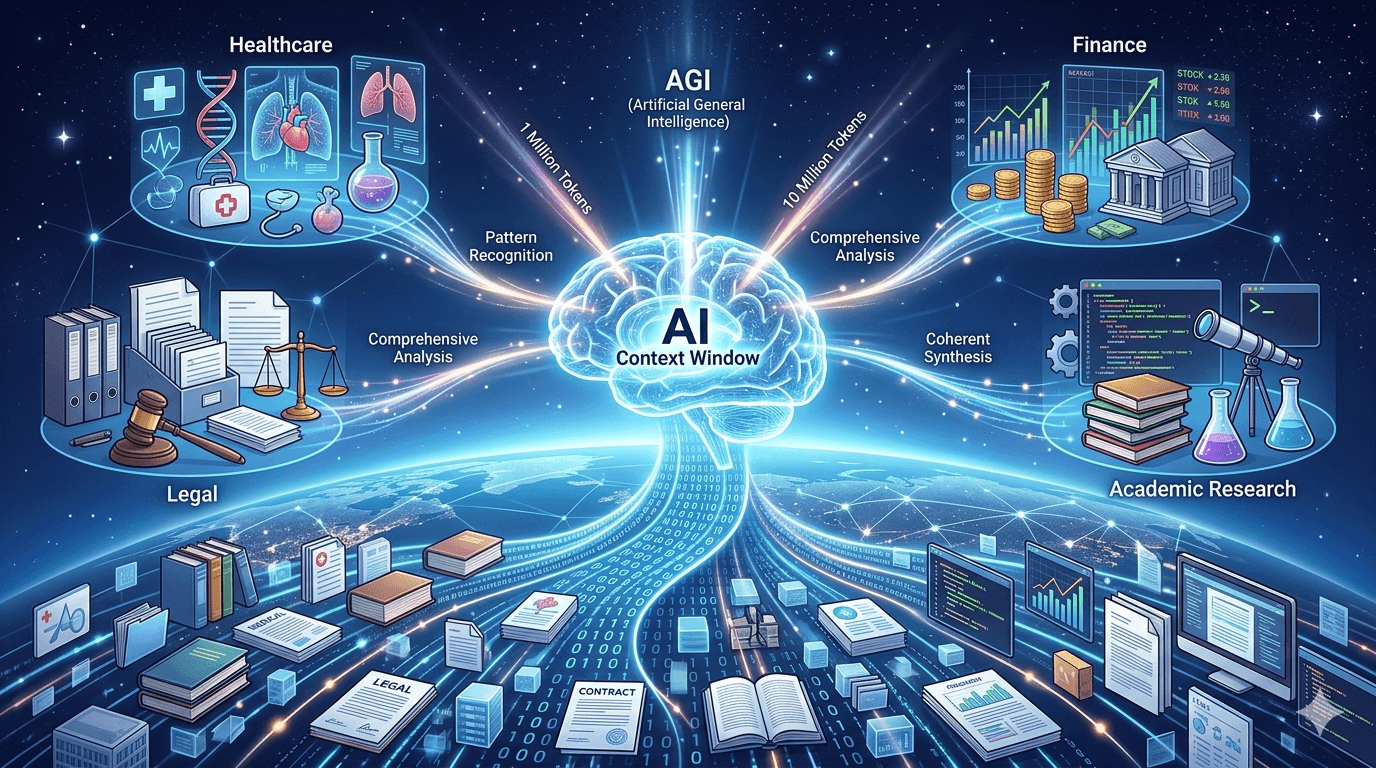
When Anthropic released Claude Opus 4.6 with a 1 million token context window in March 2026, the AI industry took notice. This was not merely a specification upgrade - it was a fundamental shift in what AI systems could accomplish in a single interaction. To put this in perspective, 1 million tokens represents approximately 750,000 words of text, enough to process entire codebases, years of legal documents, or multiple large books in one conversation.
The implications extend far beyond technical achievements. Industries from healthcare to finance to law enforcement are discovering that extended context windows fundamentally change how AI can assist human decision-making. The question is no longer whether long-context AI is useful - it is which industries and use cases will benefit most from this capability.
What Is Long-Context AI and Why It Matters
Traditional AI language models have always faced a fundamental limitation: context window. This refers to the amount of text a model can consider when generating responses. Early models could process only a few thousand tokens - essentially a paragraph or two. This constraint forced developers to chunk information into smaller pieces, losing the ability to see broader patterns or maintain consistency across large documents.
The context window race accelerated dramatically in 2025 and 2026. Claude Opus 4.6 reached 1 million tokens with 90% retrieval accuracy. Gemini 2.5 pushed to 2 million tokens. Even more remarkably, Meta's Llama 4 Scout achieved 10 million tokens in early 2026. These numbers represent qualitative shifts in AI capability, not just incremental improvements.
Understanding why context matters requires grasping how language models work. When an AI generates a response, it considers all previous text in the conversation - every question, every document uploaded, every piece of context provided. Within this context window, the model identifies patterns, maintains consistency, and builds upon previous information. A larger context window means the model can see more information simultaneously, enabling deeper analysis and more coherent responses across complex topics.
The practical implications are profound. Consider a legal professional reviewing a complex merger involving thousands of documents. With a small context window, they must break the review into multiple conversations, losing the ability to cross-reference across documents. With a 1 million token window, they can upload the entire document set and ask comprehensive questions that span all materials. The difference is not incremental - it changes the nature of what becomes possible.
How AI Context Windows Have Evolved
The evolution of AI context windows represents one of the most rapid capability expansions in technology history. Just two years ago, 4,000 tokens represented state-of-the-art. GPT-3.5's 4,000 token window seemed revolutionary. GPT-4 bumped this to 32,000 tokens in early 2023. By late 2024, 200,000 tokens became achievable.
The technical challenges behind these improvements are substantial. Longer context windows require more computational resources and more sophisticated attention mechanisms. Each token requires the model to consider relationships with every other token in the context. This creates quadratic scaling - doubling the context window quadruples the computational requirements.
Several innovations made the 2025-2026 breakthrough possible. Improvements in sparse attention mechanisms allowed models to process longer contexts without proportional computational increases. Better inference optimizations reduced the cost per token. Advances in retrieval systems let models efficiently find relevant information within large contexts.
Market dynamics accelerated competition. The race to offer the longest context window drove rapid innovation. Anthropic's March 2026 announcement of general availability for 1 million tokens marked a watershed moment - the capability became accessible at standard pricing rather than premium tiers.
The competitive landscape continues evolving. Gemini's 2 million token window pushes further. Rumors of 10 million token contexts suggest the race is far from over. Each expansion opens new use cases previously impossible.
Healthcare and Medical Diagnosis
Healthcare represents one of the most promising applications for long-context AI. Medical diagnosis requires synthesizing information from multiple sources - patient history, symptom descriptions, test results, medical literature, and imaging reports. No single piece of information provides a complete picture.
Long-context AI enables comprehensive patient analysis previously impossible. A physician can upload years of patient records, all relevant lab results, imaging reports, and clinical notes. The AI can then identify patterns across this entire history - patterns that might be invisible when reviewing individual records.
Consider the complexity of diagnosing rare conditions. Many rare diseases present with common symptoms, leading to misdiagnosis or delayed diagnosis. An AI with access to the patient's complete medical history, combined with training on medical literature, can identify patterns suggesting conditions that human physicians might not consider.
Beyond diagnosis, long-context AI transforms medical research. Clinical trials generate massive documentation - consent forms, protocols, patient responses, adverse event reports. Analyzing these documents comprehensively historically required teams of reviewers. Long-context AI can process entire trial datasets, identifying patterns and anomalies across all documentation.
Regulatory compliance represents another application. Healthcare regulations span thousands of pages with continuous updates. Compliance teams struggle to stay current. Long-context AI can ingest entire regulatory frameworks along with existing policies, identifying gaps and inconsistencies.
The implications extend to medical education. Training AI on comprehensive medical textbooks,_case studies, and clinical guidelines creates systems that can explain complex medical concepts in context. Students benefit from explanations that pull from multiple sources simultaneously.
Legal Document Analysis and Contract Review
The legal industry generates enormous quantities of text. Contracts, court filings, precedents, and correspondence accumulate into archives that human reviewers struggle to navigate. Long-context AI transforms this landscape.
Contract review represents a primary application. Enterprise contracts span dozens of pages with multiple subsections, exhibits, and amendments. Traditional AI review required breaking contracts into sections, losing cross-references. Long-context AI can process entire contracts, identifying clauses that reference other sections, tracking obligations throughout the document.
Due diligence requires comprehensive analysis. When acquiring companies, legal teams review thousands of contracts, identifying risks across the portfolio. Long-context AI enables analysis that identifies patterns across all documents - recurring risk clauses, unusual terms, relationship patterns between counterparties.
Litigation document review becomes more comprehensive. Class action lawsuits generate millions of documents. Reviewing this volume historically required large teams working over months. Long-context AI can process entire document sets, identifying relevant passages and relationships that human reviewers might miss.
Precedent research transforms from keyword matching to comprehensive analysis. Lawyers can submit entire legal arguments and request analysis of how courts have ruled on similar situations. The AI considers the full context of prior rulings, not just keyword matches.
Regulatory analysis becomes more sophisticated. Financial regulations especially generate massive documentation. Long-context AI can ingest entire regulatory frameworks and analyze how specific business models might be affected.
The efficiency gains are substantial. What previously required teams of reviewers can now be accomplished in hours. This does not replace legal professionals - it amplifies their capabilities by handling the comprehensive analysis that was previously impractical.
Software Development and Codebase Analysis
Software development generates massive codebases - millions of lines across thousands of files. Understanding these codebases historically required extensive documentation or tribal knowledge. Long-context AI changes this dynamic.
Codebase analysis represents a transformative application. Developers can upload entire repositories and ask questions that span multiple files. The AI can identify patterns across the codebase - repeated code, potential bugs, architectural decisions, dependencies.
Bug detection becomes more comprehensive. Traditional static analysis tools identify specific patterns. Long-context AI can understand the broader context, identifying bugs that emerge from interactions between components. A function might be perfectly reasonable in isolation but problematic when combined with specific usage patterns.
Code review benefits from comprehensive analysis. Rather than reviewing individual commits, AI can review entire Pull Requests in context, identifying issues that span multiple changes.
Documentation transforms. New developers can ask comprehensive questions about codebases - questions that previously required conversations with multiple team members. The AI understands the context, providing relevant answers.
Security auditing becomes more thorough. Smart contract auditing for blockchain projects requires understanding entire codebases and their interactions. Long-context AI can ingest entire smart contract repositories, identifying vulnerabilities that span multiple contracts.
The blockchain industry specifically benefits. Smart contracts often interact with DeFi protocols across multiple chains. Understanding these interactions requires processing code from multiple sources. Long-context AI can analyze entire DeFi ecosystems in a single session.
Financial Analysis and Market Research
Financial markets generate continuous streams of data - earnings reports, market data, regulatory filings, analyst reports, news articles. Processing this information comprehensively challenges human analysts. Long-context AI offers new possibilities.
Earnings analysis transforms. Analysts can upload entire earnings calls, transcript by transcript, identifying patterns across quarters that human analysts might miss. Guidance changes, management tone shifts, and strategic pivots become visible across multi-year histories.
Portfolio analysis becomes comprehensive. Asset managers can upload documentation for entire portfolios - positions, risk assessments, and rationale. AI can then identify concentrations, correlations, and risks across the full picture.
Macro analysis benefits from comprehensive data. Understanding markets requires processing decades of data, regulatory changes, and historical events. Long-context AI can process this breadth of information, identifying patterns across market cycles.
Crypto market analysis represents a specific opportunity. Blockchain generates on-chain data, governance discussions, and developer activity across multiple projects. Long-context AI can analyze entire ecosystems, identifying project health indicators that single-metric analysis misses.
Altcoin analysis benefits from comprehensive project review. Evaluating cryptocurrency projects requires assessing whitepapers, code repositories, team backgrounds, and community discussions. Long-context AI can process this comprehensive view, providing deeper analysis than surface-level review.
DeFi protocol analysis requires understanding complex interactions. Major DeFi protocols involve multiple smart contracts, governance mechanisms, and economic models. Long-context AI can analyze these holistically, identifying vulnerabilities or opportunities across the entire system.
Market sentiment analysis becomes more nuanced. Processing complete news archives, social media discussions, and forum posts enables understanding of sentiment evolution that point-in-time analysis misses.
Academic Research and Literature Review
Academic research generates continuous streams of publications. Staying current requires processing thousands of papers annually. Long-context AI transforms how researchers navigate this volume.
Literature review becomes more comprehensive. Researchers can upload body of work across decades, identifying patterns and connections that keyword-based search misses. The AI understands context, recognizing when later work builds on, challenges, or extends earlier findings.
Research synthesis transforms. What previously required months of reading can now be synthesized in hours. Researchers gain comprehensive understanding of fields rather than sampling.
Cross-disciplinary research becomes more practical. Major innovations often emerge from connecting insights across fields. Long-context AI can process literature from multiple disciplines, identifying connections that specialists might miss.
Grant analysis benefits from comprehensive review. Funding agencies can process entire proposal databases, identifying trends, overlaps, and opportunities.
The implications extend beyond research to policy. Policymakers can process comprehensive studies on affected industries, identifying unintended consequences and interactions.
Content Creation and Creative Industries
Creative industries benefit from long-context AI in unexpected ways. Content creation requires understanding tone, style, and consistency across lengthy works.
Screenwriting and long-form content transform. Writers can process entire series bibles, maintaining consistency across episodes. Character development tracked across dozens of hours becomes manageable.
Technical documentation transforms. Comprehensive product documentation can be processed and queried. Users gain comprehensive understanding without navigating multiple sources.
Translation with context becomes reliable. Long-context AI maintains consistency across large translations, resolving ambiguities from context rather than treating each section in isolation.
Gaming represents an emerging application. Game narratives span hundreds of thousands of words. Long-context AI enables NPCs with comprehensive understanding of game worlds and player histories.
The blockchain gaming sector specifically benefits. On-chain games and metaverses generate massive lore and world-building documentation. Long-context AI can process this comprehensively, enabling more sophisticated game mechanics.
The Future of Extended Context AI
The trajectory suggests continued expansion. Rumors of 10 million token contexts push further. The question becomes not whether longer contexts are possible, but what becomes practical as they expand.
Several trends are emerging. Inference costs decrease while capabilities increase. What once required premium pricing becomes standard. Accessibility expands.
Specialized applications emerge. industries developed specific context requirements. Legal might prioritize precise retrieval. Healthcare might prioritize accuracy over breadth.
The competitive landscape drives continued innovation. Each capability expansion enables new use cases. The feedback loop between capability and application accelerates.
For blockchain and crypto specifically, extended context enables sophisticated agent systems. AI agents that track positions across chains, analyze complete protocols, and maintain comprehensive market awareness become possible.
The implications for crypto traders evolve. More sophisticated analysis becomes accessible. Comprehensive protocol research replaces surface-level review. Market analysis incorporates broader data.
Conclusion
Long-context AI represents a fundamental shift in what's possible with artificial intelligence. The ability to process massive amounts of text in single conversations transforms industries from healthcare to legal to finance. Healthcare diagnosis becomes more comprehensive. Legal analysis becomes more thorough. Software development more efficient. Financial analysis more sophisticated.
The rapid evolution from thousands to millions of tokens occurred in just two years. This trajectory suggests continued expansion. What seems impractical today becomes standard tomorrow.
For professionals across industries, the implications are substantial. Those who adopt long-context AI early gain capabilities competitors lack. Those who understand use cases can implement solutions addressing previously impractical problems.
The key insight is capability-based. Long-context AI changes what questions are worth asking. Problems that were previously too complex become tractable.
FAQs
Q: What is considered a long context window in 2026?
A: In 2026, long context typically begins at 100,000 tokens, with 1 million tokens representing the current standard for premium AI models. Claude Opus 4.6 and Gemini 2.5 offer 1-2 million token contexts. Emerging models push toward 10 million tokens.
Q: Why does context window size matter?
A: Larger context windows allow AI to consider more information simultaneously, enabling analysis across larger document sets, maintaining consistency across longer conversations, and identifying patterns that only emerge from comprehensive review.
Q: Do longer contexts always produce better results?
A: Not necessarily. Beyond a certain point, additional context provides diminishing returns. The quality of retrieval within context matters more than raw window size. Additionally, larger contexts increase computational costs.
Q: Which industries benefit most from long-context AI?
A: Healthcare, legal, finance, software development, and academic research benefit significantly. Any field requiring comprehensive document analysis across large datasets sees substantial improvement.
Q: How does long-context AI benefit crypto and blockchain analysis?
A: Crypto analysis requires evaluating projects across whitepapers, code, governance discussions, and on-chain data. Long-context AI enables comprehensive protocol analysis, smart contract auditing, and DeFi ecosystem review in single sessions.