

Why Intel Stock Plunged Nearly 8% Despite a Strong Q2 2026 Earnings Beat
2026/07/27 14:30:00
Introduction
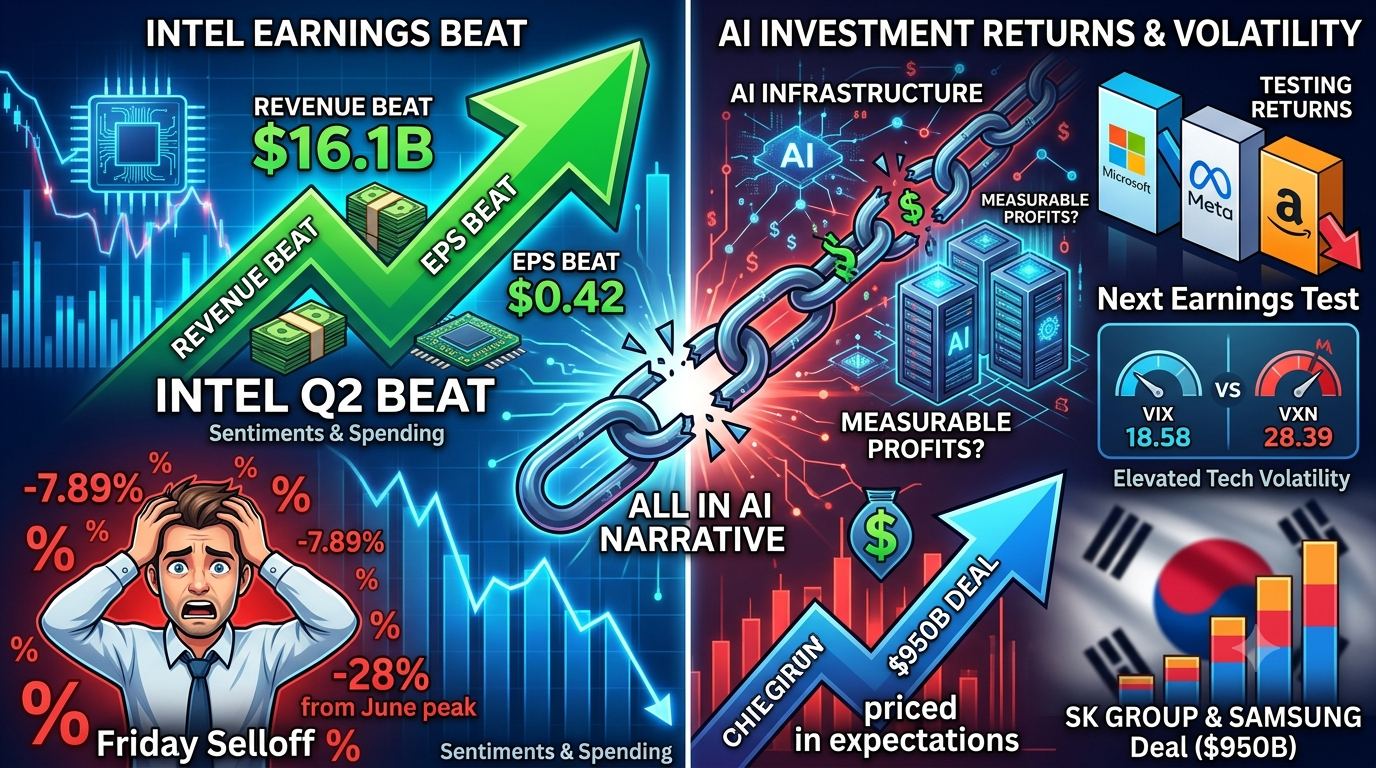
Did a massive earnings beat still fail to protect Intel from a sharp selloff? On last Friday, July 24, 2026, Intel shares closed down 7.89% at $92.32 even after the company reported second-quarter revenue of $16.1 billion—up 25% year-over-year and well above the roughly $14.4 billion Wall Street expected—along with non-GAAP earnings per share of $0.42 that doubled consensus estimates. The drop occurred amid a broader memory-chip sector selloff that saw SK Hynix fall nearly 9%, SanDisk drop nearly 11%, and Micron decline nearly 7%. Markets treated the beat the same way crypto traders often treat meme-coin pumps: any news, positive or not, triggered selling as investors demanded clearer proof of returns on massive AI investments rather than simply more spending.
The “All in AI” story is no longer enough on its own. Investors now focus on whether the hundreds of billions poured into data centers and chips will generate measurable profits. Upcoming reports from Meta, Microsoft, Amazon, and Apple will test that question further. A newly announced $950 billion multi-year supply framework involving SK Group, Samsung, and Nvidia offered little immediate relief because markets already priced in the AI memory shortage and discounted long-term letters of intent stretching to 2030.
Intel’s stock dropped nearly 8% on Friday because investors focused on rising capital spending and broader sector rotation rather than the strong quarterly numbers themselves. After an initial after-hours jump of nearly 13% following the Thursday evening release, the shares reversed sharply during regular trading as details on higher 2026 capital expenditures—now projected above $20 billion—sank in.
Revenue reached $16.1 billion, the strongest growth rate in almost 15 years, with data-center and AI-related sales hitting $6.3 billion. Client computing contributed $8.9 billion. Third-quarter guidance of $15.8 billion to $16.8 billion also topped prior analyst forecasts. Yet GAAP results showed a $2.16-per-share loss, and the jump in planned spending raised questions about near-term free cash flow.
The move mirrored the memory-chip group. SK Hynix ADRs closed down roughly 8.8–9%, Micron fell about 7%, and SanDisk dropped nearly 11% on the same day. The pattern resembled meme-coin volatility in crypto markets: beat expectations and still sell off; meet expectations and sell off; miss and sell harder. Sentiment, not just fundamentals, drove the price action.
How Is the Broader Semiconductor Selloff Affecting Chip Stocks Right Now?
The semiconductor sector is undergoing a valuation reset after a powerful AI-driven rally earlier in 2026. Memory and logic names that led the advance have given back significant gains in July as investors rotate and demand clearer evidence of returns on capital.
Intel itself is down more than 28% from its June 2026 peak near $141, even after a year-to-date gain still exceeding 170% as of the pre-earnings close. Similar pressure hit peers across the memory space throughout mid-July. The selloff reflects profit-taking after rapid runs and growing scrutiny of whether elevated chip prices and capacity expansions will sustain margins once supply catches demand.
This environment leaves little room for error. Positive earnings alone no longer guarantee upside when the market already anticipates continued AI-related volume growth. The same dynamic has appeared repeatedly in crypto markets when highly anticipated token unlocks or partnership announcements fail to move prices higher because the news was already fully priced in.
What Does the $950 Billion SK Group and Samsung Deal Mean for Chip Stocks?
The $950 billion framework announced Saturday, July 25, is unlikely to deliver an immediate sustained rebound because it largely formalizes already-expected trends rather than introducing new upside surprises. South Korean officials stated that SK Group and Samsung Electronics reached multi-year cooperation agreements with U.S. technology firms, including Nvidia, totaling approximately $950 billion. SK’s portion includes plans to supply roughly $750 billion in high-performance memory chips over five years, while Samsung’s share involves about $200 billion.
Much of the figure consists of letters of intent and long-term supply arrangements extending toward 2030 rather than near-term confirmed revenue. Markets have already priced in the structural shortage of AI-grade memory. Restating the consensus in contractual form rarely creates the positive expectation gap needed for a lasting rally. Monday’s session may produce a short-term bounce, yet the core investor question—actual returns on AI infrastructure spending—remains unanswered by these announcements.
Why Are Investors Questioning the “All in AI” Narrative Now?
Investors are shifting focus from pure spending commitments to measurable returns on AI investments because the scale of capital deployment has grown enormous while near-term profitability evidence remains uneven. Big technology companies continue to allocate hundreds of billions of dollars to data centers, advanced chips, and related infrastructure. The market now asks how much of that capital will convert into durable earnings growth.
Intel’s higher 2026 capital expenditure outlook above $20 billion, up significantly from earlier expectations, illustrates the point. Similar scrutiny will intensify when Meta, Microsoft, Amazon, and Apple report results in the coming days. Those reports will reveal whether AI-related cloud and advertising revenue is expanding fast enough to justify the outlays. Until clearer answers arrive, any stock with heavy AI exposure remains vulnerable to sentiment-driven swings, much like the rapid reversals common in meme-coin trading.
What Do Elevated Volatility Levels Signal About Tech Stocks?
Elevated Nasdaq-specific volatility shows that investors remain more nervous about technology and semiconductor names than about the broader market. The CBOE Volatility Index (VIX) closed near 18.58 on July 24, a relatively calm reading for the S&P 500. In contrast, the CBOE Nasdaq-100 Volatility Index (VXN) stood at 28.39, according to Cboe data. The gap highlights concentrated concern around the tech-heavy Nasdaq rather than a market-wide risk-off move.
Higher VXN levels typically accompany periods when options traders price in larger potential swings for growth stocks. Combined with the recent memory-chip and Intel selloffs, the reading suggests that further earnings reports or macroeconomic data could trigger additional sharp moves in either direction. Traders watching semiconductor and AI-related assets should treat the elevated reading as a reminder that position sizing and risk management remain essential.
How to Trade AI and Semiconductor-Related Opportunities on KuCoin?
Traders seeking exposure to the themes driving Intel and the broader chip sector can access a range of AI, semiconductor, and technology-related digital assets directly on KuCoin. The platform lists numerous tokens tied to artificial intelligence infrastructure, computing networks, and decentralized storage or processing projects that often move in correlation with traditional chip-stock sentiment.
KuCoin offers spot trading, futures contracts with flexible leverage, and copy-trading tools that let users follow experienced strategies focused on AI narratives. Funding rates, order-book depth, and real-time charts help manage the same kind of volatility seen in recent semiconductor sessions. Users can also set price alerts and stop-loss orders to navigate rapid swings similar to the 7–11% daily moves recorded by Intel, Micron, and SK Hynix last Friday.
Join KuCoin 9th Anniversary Trading Campaign
KuCoin is celebrating its 9th anniversary with a special platform campaign filled with exclusive rewards, trading activities, and limited-time offers. Don’t miss the chance to participate and enjoy the benefits as the exchange marks nine years of growth and innovation. Visit the official campaign page now:

Conclusion
Intel’s nearly 8% decline on July 24, 2026, despite a clear earnings beat and strong guidance, underscores a market that has grown more selective about AI-related stories. Revenue of $16.1 billion and non-GAAP EPS of $0.42 failed to offset concerns over higher capital spending and a sector-wide rotation that also hit memory names such as SK Hynix, SanDisk, and Micron. The $950 billion multi-year framework between SK Group, Samsung, and major U.S. technology firms, including Nvidia, largely restates already-known supply dynamics and is unlikely to resolve the core debate over returns on AI investment.
Upcoming earnings from Meta, Microsoft, Amazon, and Apple will supply the next major data points. Meanwhile, the divergence between a calm VIX near 18.58 and a more elevated VXN at 28.39 shows that technology-specific risk remains heightened. Investors and traders monitoring these themes should prioritize clear evidence of monetization over narrative alone and maintain disciplined risk management in an environment that continues to reward expectation gaps rather than consensus news.
FAQs
What were Intel’s exact Q2 2026 earnings figures?
Intel reported revenue of $16.1 billion, up 25% year-over-year, and non-GAAP EPS of $0.42, both well above consensus estimates of approximately $14.4 billion and $0.21–$0.22.
Why did memory-chip stocks fall alongside Intel?
The group experienced profit-taking and valuation concerns after strong earlier gains; SK Hynix fell nearly 9%, SanDisk nearly 11%, and Micron nearly 7% on the same day as Intel’s decline.
Is the $950 billion deal expected to boost chip stocks immediately?
Markets are likely to treat it cautiously because large portions consist of multi-year letters of intent rather than near-term revenue, and the AI memory shortage was already widely anticipated.