

The Evolution of Traditional Finance: Origins, Modern Bottlenecks, and the Shift to Decentralization
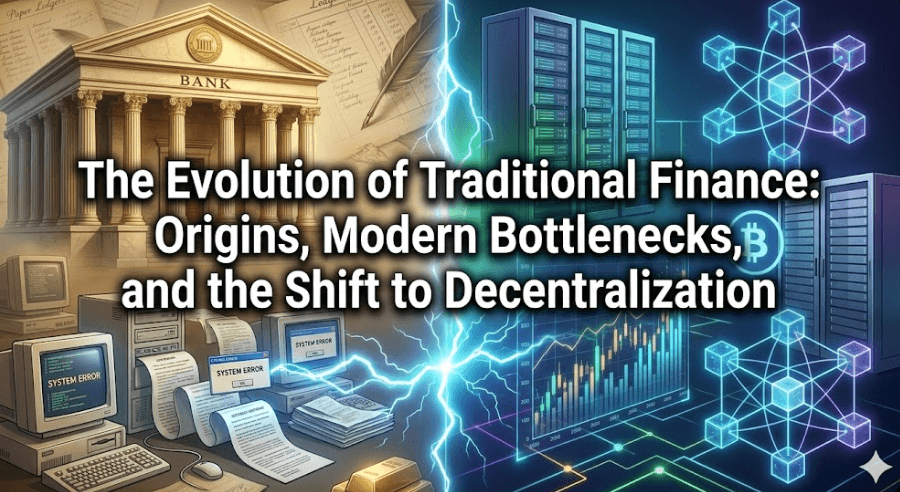
We live in a 2026 digital economy defined by instantaneous global connectivity. We can stream high-fidelity video across the planet in milliseconds and deploy autonomous AI agents with a single click. Yet, when it comes to moving our own capital, sending a cross-border wire transfer can still take up to three business days and incur exorbitant fees. While Traditional Finance (TradFi) unequivocally built the modern world, its underlying infrastructure is fundamentally struggling under the weight of the digital age. To understand why your money moves so slowly, we must examine the architectural foundation of the banking sector.
In this article, we will explore the origins of global banking, dissect the structural bottlenecks of traditional finance currently plaguing the system, and explain why the macroeconomic transition toward decentralized, blockchain-based infrastructure is a mathematical inevitability.
Key Takeaways
-
From Renaissance double-entry ledgers to the modern SWIFT network, traditional finance laid the groundwork for global economic expansion.
-
Today, legacy banking is crippled by outdated T+2 settlement delays, fragmented liquidity, and high cross-border fees.
-
Centralized clearinghouses and intermediaries extract massive fees from consumers while exposing the global system to profound counterparty risks.
-
Blockchain infrastructure solves these legacy inefficiencies, utilizing smart contracts to guarantee instant, borderless, and mathematically verifiable 24/7/365 settlement.
-
Modern investors are actively bypassing traditional banking bottlenecks by transitioning capital into high-liquidity crypto assets via modern exchange gateways.
The Origins of TradFi
Long before digital networks and algorithmic trading, global commerce relied entirely on physical barter, gold bullion, and highly localized credit networks.
The first major evolution in traditional finance history occurred in 15th-century Renaissance Europe, heavily driven by institutions like the Medici Bank.
They popularized double-entry bookkeeping, a revolutionary accounting system that meticulously recorded credits and debits symmetrically across a master ledger. It allowed capital and credit to scale beyond immediate physical trust, creating the foundational architecture of all modern financial accounting.
The Rise of Central Banks and Paper Money
As international trade expanded throughout the 17th century, the logistical nightmare of transporting physical gold became a severe hindrance to economic growth. The establishment of the Bank of England in 1694 marked a permanent, structural shift in the evolution of banking. To fund national interests, the institution became the first to issue permanent, standardized paper banknotes.
Instead of carrying gold, merchants could trade paper notes that represented a claim on the bank's underlying vault reserves. This pivotal moment birthed the modern concept of a central bank acting as the ultimate, centralized guarantor of a nation's currency.
The Fractional Reserve System
This era also formalized the core engine of modern TradFi: fractional reserve banking. Banks realized that not all depositors would demand their physical gold at the exact same time. Consequently, they began holding only a small fraction of deposits in their physical reserves, actively lending out the rest to generate yield.
While this mechanism exponentially accelerated global economic growth by artificially expanding the money supply, it came with a massive hidden cost. It introduced systemic fragility, the reliance on centralized intermediaries, and the severe counterparty risks.
Scaling Global Finance: The SWIFT System and the Digital Era
As the global economy industrialized throughout the 20th century, the localized, paper-based ledgers of early central banks could no longer handle the sheer volume of international trade.
The Bretton Woods Pivot and Pure Fiat
Following World War II, the Bretton Woods Agreement established the US Dollar as the world's primary reserve currency, initially pegged directly to physical gold. However, as global economic pressures mounted, the US officially abandoned the gold standard in 1971.
This decision severed the final link between global finance and physical scarcity. The world officially entered the era of pure fiat currency, money that derives its value entirely from government decree and central bank policy rather than a tangible commodity. Without the physical limitations of gold, capital could theoretically flow faster, but the banking system lacked the infrastructure to route these digital numbers globally.
The SWIFT Network: The Messaging Layer of Global Money
To solve the logistical nightmare of international bank transfers, the SWIFT (Society for Worldwide Interbank Financial Telecommunication) network was established in 1973.
It is a common misconception that SWIFT actually moves money. It does not. SWIFT is simply a highly secure messaging system. When you send a wire transfer from a bank in London to a bank in Tokyo, your bank sends a standardized SWIFT message instructing the receiving bank to credit an account.
Because banks rarely have direct relationships with every other bank on the planet, they must rely on correspondent banking. Your money hops through a chain of intermediary banks, each verifying the transaction, taking a small fee, and updating their individual, localized ledgers before the final recipient sees the funds.
The Illusion of the Digital Era
Beneath the sleek UI of your mobile banking app, the foundational plumbing of global finance is still reliant on this 1970s SWIFT architecture. When you swipe to send money internationally, you are still triggering a multi-day chain of localized ledger updates and correspondent intermediaries. This architectural debt is the precise reason why traditional finance is currently hitting its absolute scaling limits.
Core Bottlenecks Plaguing Traditional Finance
When analyzing why the legacy system is struggling to compete with the digital economy, three critical structural flaws stand out:
T+1 and T+2 Settlement Delays
In the cryptocurrency ecosystem, when you execute a trade, the transaction settles on the blockchain almost instantly, giving you immediate custody of the asset. In traditional finance, buying a stock or moving institutional capital operates on a T+1 or T+2 (Trade Date plus one or two days) settlement cycle.
This means that while the front-end interface shows your trade as "complete," the actual underlying assets and cash take days to physically clear through centralized clearinghouses. During this waiting period, capital is locked and inefficient. More importantly, this delay creates massive systemic risk. If a major institution defaults during that two-day window, the entire chain of pending settlements can collapse.
Exorbitant Cross-Border Remittance Fees
The correspondent banking model, where money slowly hops through a chain of intermediary SWIFT banks, imposes a massive friction tax on global commerce.
According to Q1 2026 data from the World Bank, the global average cost of sending a cross-border remittance remains stubbornly high, often hovering between 5% and 6%. For businesses operating internationally, or for migrant workers sending money back to emerging markets, this fee structure is highly exclusionary.
Fragmented Liquidity and Banking Silos
In the decentralized economy, liquidity is global; a trader in Tokyo accesses the exact same liquidity pool as a trader in London. Traditional finance, however, is heavily siloed.
Capital is trapped within specific national jurisdictions, operating hours, and institutional firewalls. This fragmentation means that global liquidity is constantly fragmented across thousands of disconnected banking databases, requiring immense time, legal friction, and capital to bridge.
The Hidden Tax: Centralized Intermediaries and Counterparty Risk
Because the legacy architecture of the SWIFT system and local banking ledgers is so fragmented, it requires a massive industry of middlemen just to keep it functioning.
However, for the everyday consumer and retail investor, this reliance on centralized intermediaries creates two massive, hidden burdens: rent-seeking fees and counterparty risk.
The Friction Tax of Rent-Seeking Intermediaries
Every time money moves or a traditional asset is traded, it must pass through a toll booth. When you buy stock in a traditional brokerage account, you are not directly interacting with the seller. Your order goes to a broker, who routes it to a market maker, who clears it through a centralized clearinghouse (like the DTCC), before the asset is finally registered by a custodian bank.
Every single one of these intermediaries extracts a fee for their service. While these fees might seem microscopic on a single trade, they act as a massive "friction tax" that compounds over time, siphoning billions of dollars in wealth away from retail investors and into the pockets of centralized financial institutions.
Understanding Counterparty Risk
The most dangerous bottleneck of traditional finance is not the slow speed or the high fees; it is the structural presence of counterparty risk.
When you deposit your salary into a traditional commercial bank, a fundamental legal shift occurs. You no longer own that money. Instead, you own an IOU from the bank. Because of the fractional reserve system we discussed earlier, the bank is actively lending your money out to generate its own yield.
Counterparty risk is the probability that the institution holding your assets becomes insolvent and defaults on that IOU. As global financial crises and localized bank runs have repeatedly demonstrated, when a highly leveraged centralized institution fails, the retail depositor is left waiting for government bailouts or insurance payouts to recover their own capital.
TradFi vs. DeFi
The core of the TradFi vs DeFi debate boils down to a shift in trust: moving away from trusting centralized institutions (which can fail, censor, or extract rent) to trusting immutable, open-source mathematics.
Instant, 24/7/365 Settlement
When you execute a trade or transfer capital on a decentralized network, the smart contract automatically verifies the funds, executes the logic, and permanently updates the global ledger in seconds. Furthermore, blockchains do not have operating hours or bank holidays; global liquidity is accessible 24 hours a day, 365 days a year.
Borderless Remittances Without Intermediaries
By entirely bypassing the correspondent banking model and the SWIFT network, blockchain technology drastically reduces the "friction tax" of cross-border payments.
In DeFi, transferring stablecoins from Sydney to Tokyo is a direct, peer-to-peer transaction. Because there are no intermediary banks taking a cut at every hop, a multi-million dollar transaction can be settled globally in seconds for a fraction of a cent in network gas fees, fundamentally solving the high-cost remittance bottleneck.
Cryptographic Verification Over Counterparty Risk
The most profound shift in the evolution of banking is the move toward non-custodial finance. In the DeFi ecosystem, you do not deposit your funds into a bank that lends them out behind your back. Instead, you hold your assets in a non-custodial Web3 wallet, controlling your own private cryptographic keys.
When you interact with a decentralized lending protocol or exchange, you are interacting directly with transparent, publicly auditable code. The code mathematically guarantees that your assets execute exactly as programmed, requiring zero reliance on the honesty of a traditional broker or custodian bank.
Transitioning to the Digital Economy via KuCoin
For users ready to bypass the friction of the legacy system, platforms like KuCoin act as the critical gateway. Here is a secure, three-step strategy to transition your portfolio into the decentralized economy:
Step 1: The Fiat On-Ramp
The most difficult part of escaping traditional finance is the initial exit. To stop relying on correspondent banks, you must convert your local fiat currency into a digitized, blockchain-native equivalent, such as a stablecoin (like USDT or USDC).
Instead of waiting days for a bank wire to clear, modern investors use high-speed fiat gateways to instantly digitize their cash. By learning how to buy USDT directly with fiat on KuCoin, you effectively swap your traditional bank IOUs for highly liquid, borderless digital dollars, entirely bypassing the SWIFT network's high fees and settlement delays.
Step 2: Accessing Global, 24/7 Liquidity
Once your capital is digitized, you are no longer restricted by banking hours or national borders. You have entered an ecosystem where liquidity flows globally, 24 hours a day, 365 days a year.
From this position, you can easily allocate your capital into a diverse range of digital assets, whether that is purchasing decentralized infrastructure tokens, accumulating Bitcoin as a hard-money reserve, or exploring the tokenized Real-World Assets (RWAs) we discussed previously. All of this capital allocation can be executed instantly on the highly liquid KuCoin Spot Market, where trades settle in milliseconds without traditional brokerage fees.
Step 3: Achieving Sovereign Custody
The ultimate goal of transitioning out of traditional finance is to entirely eliminate counterparty risk. While centralized exchanges are excellent for trading and onboarding, holding your long-term wealth requires cryptographic self-custody.
By withdrawing your funds to the KuCoin Web3 Wallet, you become your own bank. This final step mathematical guarantees your financial sovereignty, ensuring that no centralized intermediary can ever freeze, lend out, or mismanage your underlying capital.
Conclusion
Traditional finance undeniably built the 20th-century global economy, but its reliance on localized ledgers, centralized intermediaries, and the 1970s-era SWIFT network has reached its absolute scaling limit. The friction, settlement delays, and counterparty risks inherent in this system are no longer justifiable in the digital age. The macroeconomic shift toward Decentralized Finance (DeFi) is not just a trend; it is a necessary infrastructural upgrade. By utilizing blockchain technology to execute instant, borderless, and mathematically verifiable transactions, investors can entirely bypass legacy bottlenecks. With secure gateways like the KuCoin ecosystem, transitioning your capital from fragmented banking silos into sovereign digital ownership has never been more accessible.
FAQs
What is the difference between TradFi and DeFi?
TradFi relies on centralized institutions like banks and brokers to manage your money. DeFi uses public blockchains and automated smart contracts to allow peer-to-peer trading without any middlemen.
Why do bank transfers take so long?
International bank transfers rely on the SWIFT network, which requires your money to hop through multiple "correspondent" banks. Each bank must manually verify the transaction and update its localized ledger, causing multi-day delays.
What is counterparty risk in traditional finance?
It is the risk that the centralized institution holding your assets becomes insolvent, goes bankrupt, or defaults on its obligation to return your capital.
How does blockchain solve financial bottlenecks?
Blockchains act as global, decentralized clearinghouses that operate 24/7/365. They use smart contracts to instantly settle transactions peer-to-peer, eliminating settlement delays, intermediaries, and high cross-border friction fees.
How can I easily move money from my bank into crypto?
You can use a secure fiat on-ramp, such as the KuCoin Fiat Gateway, to instantly convert your local currency into digitized stablecoins (like USDT). From there, you can trade globally or withdraw to a non-custodial Web3 wallet.
Disclaimer
This content is for informational purposes only and does not constitute investment advice. Cryptocurrency investments carry risk. Please do your own research (DYOR).