

Proof of Work vs. Physical Extraction: The 2026 Energy Clash Between Bitcoin and Gold
2026/05/14 17:12:00
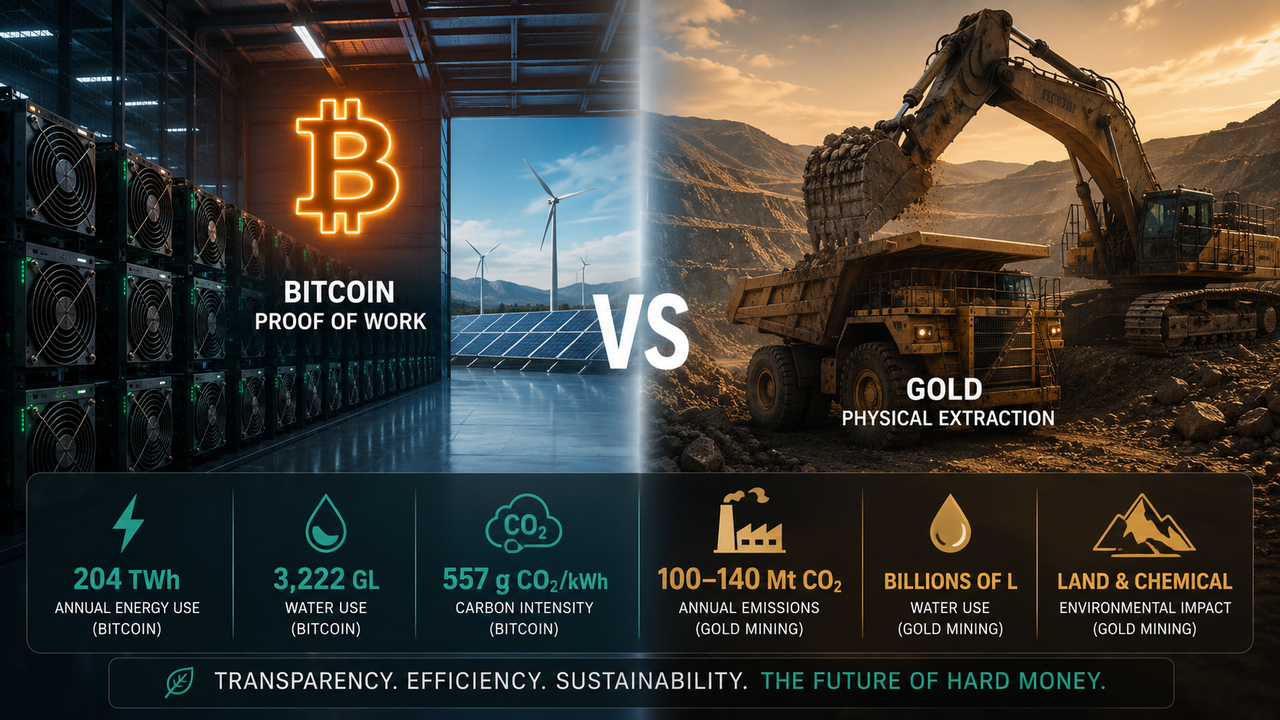
As we navigate the fiscal landscape of 2026, the debate surrounding sustainable investing has shifted from theoretical ethics to hard, data-driven transparency. Investors are increasingly scrutinizing the environmental footprint of "hard money" assets, leading to a fierce ideological and analytical confrontation between the digital hashpower of Bitcoin and the traditional industrial machinery used in gold mining.
This deep dive examines the metrics of Proof of Work vs. Physical Extraction, providing a comprehensive energy analysis to help you understand which asset truly aligns with a green-finance future.
The Sustainability Debate: Why Energy Metrics Matter in 2026
In the current global economy, the "E" in ESG (Environmental, Social, and Governance) is no longer a peripheral concern for institutional portfolios. With the implementation of stricter carbon taxing and mandatory climate disclosures, the energy source and consumption intensity of an asset directly impact its market valuation and regulatory standing.
-
Institutional Mandates: Major asset managers now require real-time carbon tracking for both digital and physical commodities.
-
Regulatory Pressure: The 2026 Climate Accords have placed specific emphasis on industries with high electricity demands, forcing a re-evaluation of Proof of Work.
-
Retail Sentiment: A new generation of "green" investors prioritizes assets that demonstrate a clear path toward net-zero emissions.
The comparison between Proof of Work vs. Physical Extraction is not just about how much energy is used, but the quality of that energy and the long-term ecological "debt" left behind by the production process. To stay ahead of these trends, many traders monitor the latest crypto news to track how energy policies affect market prices.
Bitcoin’s Digital Footprint: Analyzing the 204 TWh Power Demand
Bitcoin’s energy consumption has long been the focal point of environmental criticism. By mid-2026, the network’s annualized energy demand has climbed to approximately 204.44 TWh. This figure is staggering, often compared to the total electricity consumption of mid-sized industrialized nations like Thailand or Poland. This consumption is the direct result of the Proof of Work consensus mechanism, which requires specialized hardware to perform quadrillions of calculations per second to secure the ledger.
Digiconomist Data: Understanding the 913 kWh Per Transaction Cost
According to the latest Digiconomist indices, a single Bitcoin transaction now consumes roughly 913.91 kWh. To put this into perspective:
-
This amount of energy could power an average U.S. household for over 31 days.
-
The carbon footprint of one transaction is estimated at 509.75 kg CO2 equivalent to the emissions of several hundred thousand Visa transactions.
-
While these stats are high, many investors choose to buy Bitcoin as a hedge against inflation, viewing the energy cost as a necessary expense for unparalleled network security.
E-Waste Crisis: The 22kt Impact of ASIC Obsolescence
A significant but often overlooked factor in the Proof of Work vs. Physical Extraction debate is electronic waste. Unlike gold mining equipment, which can be repurposed, Bitcoin mining relies on ASICs (Application-Specific Integrated Circuits).
-
Short Lifespan: ASICs typically become obsolete within 18 to 36 months as more efficient hardware enters the market.
-
Annual Waste: The network generates roughly 21.93 kt of e-waste annually.
-
Comparison: This is equivalent to the small IT equipment waste of the entire Netherlands, creating a recycling challenge that the industry is only beginning to address.
Carbon Intensity: Has Bitcoin Truly Decarbonized?
While the industry claims a shift toward renewables, Digiconomist data suggests that the global average carbon intensity for Bitcoin mining remains around 557 g $$CO_$$/kWh.
-
Coal Dependency: In certain regions, miners still tap into cheap, coal-heavy grids during off-peak hours.
-
Hydropower Seasonality: While hydro is a major source, its availability fluctuates.
-
Methane Mitigation: A bright spot is the rise of flare-gas mining, which captures leaking methane and converts it into security for the network.
Physical Extraction: The Hidden Environmental Cost of Gold Mining
While Bitcoin's energy use is transparently visible on the blockchain, the energy profile of gold’s physical extraction is often obscured by complex global supply chains. Gold mining is an invasive industrial process that involves moving millions of tons of earth to recover tiny fractions of metal. In 2026, as high-grade ore deposits become rarer, the energy required to extract a single ounce of gold continues to rise.
Unlike the centralized data centers of Bitcoin, gold mining impacts are distributed across vast open-pit mines. The environmental cost includes:
-
Land Degradation: Thousands of hectares of forest are removed annually.
-
Chemical Leaching: The use of cyanide and mercury in processing creates long-term toxic liabilities.
-
Infrastructure Build-out: Building roads and housing for mines in remote areas contributes to a massive "embedded" carbon footprint.
Diesel and Dynamite: The Carbon Footprint of Ore Processing
The majority of gold’s carbon footprint comes from the "crush and grind" phase. To extract gold, massive rocks must be pulverized into fine powder.
-
Heavy Machinery: Open-pit mines rely on colossal trucks that consume thousands of gallons of diesel daily.
-
Global Totals: The gold industry is responsible for approximately 100 to 140 million metric tons of $$CO_$$ annually.
-
Inefficiency: As ore grades decline, the diesel-to-gold ratio is worsening, making physical extraction increasingly carbon-intensive.
Water Scarcity: Comparing Mining Waste to Bitcoin’s Liquid Cooling
Water is the silent victim of the Proof of Work vs. Physical Extraction rivalry.
-
Gold’s Thirst: Gold mining consumes billions of liters of water for processing and dust suppression.
-
Bitcoin’s Usage: Bitcoin mining utilizes approximately 3,222 Gigaliters of water annually.
-
Contamination vs. Evaporation: While Bitcoin mining primarily "consumes" water through evaporation in cooling towers, gold mining risks chemical contamination of groundwater.
Proof of Work vs. Physical Extraction: Head-to-Head Data Analysis
To truly compare Proof of Work vs. Physical Extraction, we must look at the efficiency of these systems relative to the value they provide. For a deeper technical breakdown of these consensus models, you can read the KuCoin guide on PoW vs. PoS.
| Metric (2026 Est.) | Bitcoin (Proof of Work) | Gold (Physical Extraction) |
| Annual Energy (TWh) | 204.44 | ~132.00 |
| $CO_2$ Emissions (Mt) | 114.03 | ~125.00 |
| Renewable Share | 55% | 22% |
| Primary Waste | 22kt (Electronic) | ~800Mt (Tailings/Toxic) |
Energy Efficiency per Dollar of Market Capitalization
When we analyze energy use per dollar of market value, the narrative shifts. Bitcoin’s market cap in 2026 has surpassed significant milestones, meaning the "energy cost" of securing $1 billion of value has actually decreased over time as the price rises. In contrast, gold’s energy cost is tied to the physical difficulty of the earth; as the price of gold rises, miners process even lower-grade ore, which increases the energy intensity per dollar of value extracted.
Stranded Energy: Can Bitcoin Mining Outperform Gold in Renewables?
One of the most compelling arguments for Proof of Work over physical extraction is "energy flexibility."
-
Load Balancing: Bitcoin miners can shut down instantly during grid stress, acting as a "virtual battery."
-
Stranded Power: Bitcoin mining can be located at the source of wasted energy—such as remote wind farms where there is no transmission infrastructure.
-
Incentivizing Green Tech: By providing an immediate buyer for "excess" renewable energy, Proof of Work is accelerating the build-out of green grids.
Future Outlook: The Role of PoW in a Green Finance Economy
As we move toward 2030 targets, the transition from physical extraction to digital scarcity appears inevitable, but it must be managed responsibly. The Bitcoin mining industry is currently undergoing a "Green Industrial Revolution," with companies pioneering carbon-capture mining. For those who want to support a more energy-efficient ecosystem, exploring Ethereum staking or other Proof of Stake assets on KuCoin provides a low-energy alternative to traditional mining.
Gold will always hold a place in jewelry, but as a primary store of value, its reliance on destructive physical extraction is a growing liability. The transparency of Proof of Work allows for a level of environmental accountability that the gold industry simply cannot match.
Conclusion
The debate of Proof of Work vs. Physical Extraction highlights a pivotal shift in how we value assets in 2026. While Bitcoin's electricity consumption is high, its ability to integrate with renewable grids and its lack of physical land destruction offer a modern alternative to the ecological toll of gold mining. As data-driven transparency becomes the norm, the efficiency and mobility of Proof of Work provide a compelling case for it being the superior, sustainable store of value for the digital age. By choosing digital scarcity over industrial extraction, we can secure global wealth without compromising the planet's future.
FAQ:
Q: Is Proof of Work more energy-intensive than Gold mining?
A: In terms of raw electricity, Bitcoin (PoW) uses more (approx. 204 TWh vs. 132 TWh). However, gold’s physical extraction generates significantly higher total carbon emissions and toxic waste when accounting for diesel-powered machinery.
Q: What is the main environmental difference between Proof of Work vs. Physical Extraction?
A: The main difference lies in the type of waste. Proof of Work produces electronic waste (ASICs), whereas physical extraction results in massive land degradation and chemical contamination of local water supplies.
Q: Can Bitcoin mining help the environment?
A: Yes. Through Proof of Work, miners can utilize "stranded" energy that would otherwise be wasted. This provides a financial incentive to build out renewable energy infrastructure. You can learn more about this in the KuCoin Blog's energy analysis.
Q: Why does a single Bitcoin transaction use so much energy?
A: The energy isn't "used" by the transaction itself, but by the network to maintain security. High energy consumption in Proof of Work creates a "security wall" that ensures your assets remain safe.
Q: Will Bitcoin ever move away from Proof of Work?
A: Bitcoin remains committed to Proof of Work because it provides the highest level of decentralization. However, users seeking lower footprints often diversify into Proof of Stake coins available on major exchanges.