

Palantir Q2 2026 Earnings Crush Expectations as AI Sovereignty Narrative Strengthens
2026/08/04 10:59:00
Introduction
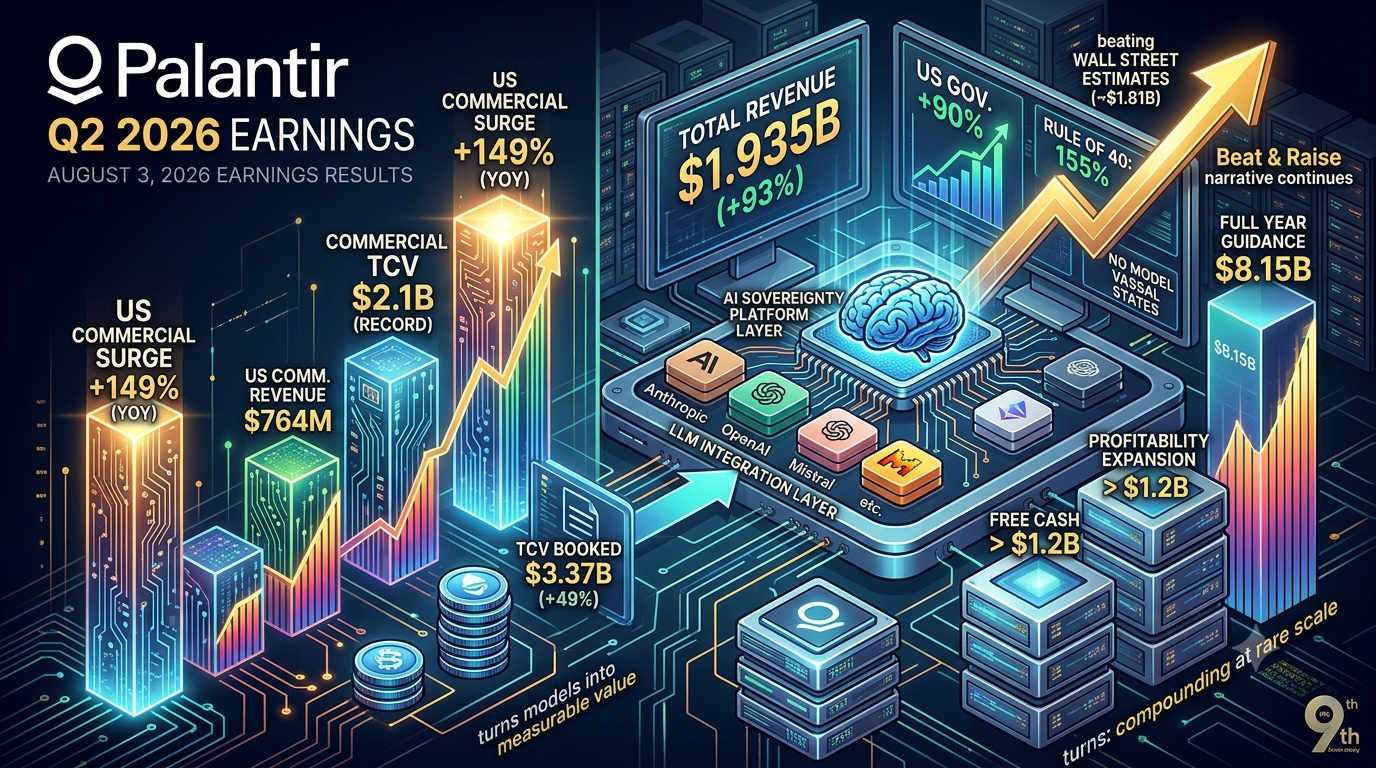
Palantir Technologies delivered one of the strongest quarterly performances in its history, with U.S. commercial revenue surging 149% year-over-year to $764 million and total revenue climbing 93% to $1.935 billion in the second quarter of 2026. These results, announced on August 3, 2026, far exceeded Wall Street estimates of roughly $1.81 billion in revenue and provided fresh evidence that enterprise demand for operational AI remains robust even as chip stocks faced pressure in July.
CEO Alex Karp framed the quarter around “AI sovereignty,” rejecting the idea that large language model providers will displace platforms like Palantir’s, and the stock jumped around 12-14% in after-hours trading. The beat and raised full-year guidance to $8.150–$8.158 billion reinforce that the AI trade narrative continues, particularly for software that turns models into measurable business value rather than pure infrastructure spending.
What Are the Key Highlights of Palantir’s Q2 2026 Earnings?
Palantir posted record results across nearly every major metric, driven by accelerating U.S. commercial and government demand for its Artificial Intelligence Platform. Total revenue reached $1.935 billion, up 93% year-over-year and 19% sequentially, according to the company’s August 3, 2026, release. U.S. revenue alone hit $1.573 billion, a 115% increase, accounting for the bulk of the business.
U.S. commercial revenue was the standout, rising 149% year-over-year and 28% quarter-over-quarter to $764 million. U.S. government revenue grew 90% to $809 million. The company closed 220 deals of at least $1 million, including 98 above $5 million and 73 above $10 million. Total contract value booked reached $3.373 billion, up 49% year-over-year, with a record $2.132 billion in U.S. commercial TCV, up 153%. U.S. commercial remaining deal value stood at $6.238 billion, up 124% year-over-year.
Profitability expanded sharply. GAAP income from operations was $912 million (47% margin), while adjusted income from operations hit $1.194 billion (62% margin). The Rule of 40 score reached 155%. GAAP net income came in at $1.062 billion (55% margin), and both GAAP and adjusted EPS were $0.41. Cash from operations and adjusted free cash flow each exceeded $1.2 billion with 63% margins. Cash, cash equivalents, and short-term Treasuries totaled $9.2 billion.
Management raised full-year 2026 revenue guidance to $8.150–$8.158 billion (implying about 82% growth) and U.S. commercial revenue guidance to more than $3.424 billion (at least 134% growth). Adjusted income from operations guidance moved to $4.889–$4.897 billion. For the third quarter, the company guided revenue to $2.160–$2.164 billion. These numbers, based on Palantir’s official results, show the business compounding at a rate rarely seen at this scale.
Why Does Palantir’s Strong Performance Matter for the Broader AI Trade?
Palantir’s results arrived at a moment when investors were growing cautious about the durability of the AI trade after July’s chip-stock pullback. Semiconductor indexes entered correction territory amid concerns over elevated capital spending by hyperscalers, competition from Chinese memory producers, and questions about returns on massive infrastructure investments. In that environment, evidence of real enterprise adoption and monetization of AI software carries extra weight.
The 149% U.S. commercial growth and raised guidance demonstrate that customers are moving beyond experimentation into production deployments that generate measurable economic value. Unlike pure model providers or chip suppliers, Palantir sells software that integrates and operationalizes large language models inside customer environments. This distinction matters because market focus has shifted from token consumption and training runs toward tools that deliver control, security, and ROI.
The timing also coincides with a busy August earnings calendar. SpaceX is scheduled to report its first post-IPO quarterly results after the close on August 4, 2026, with attention centered on Starlink profitability, launch activity, and AI infrastructure progress following its integration of related businesses. Nvidia and other AI-linked names will follow. Palantir’s beat provides a positive data point that software layers capturing AI value can continue to expand even when hardware sentiment softens. Investors seeking confirmation that the broader AI narrative still has legs found it in these numbers.
How Is Palantir Positioning Against Large Language Model Providers?
Palantir explicitly rejects the notion that frontier model companies will replace its platform. Management positions the company’s software as the integration and management layer that sits above large language models, allowing enterprises to switch providers rather than lock into any single lab. Karp and the team emphasize that customers want control over data, prompts, logic, and decisions so their competitive advantages do not become training material for external models.
In the shareholder letter and earnings commentary, Karp described a “revolution for independence and AI sovereignty.” He stated that customers have “declined to become vassal states of the language labs” and that Palantir enables organizations to keep ownership of their intelligence. The platform is designed so clients can change models as needed while retaining operational control. This framing directly addresses market concerns that traditional SaaS-style AI software could lose relevance as Anthropic, OpenAI, and similar firms expand direct offerings.
The results support the positioning. Rapid U.S. commercial expansion and record commercial bookings indicate enterprises are choosing tools that deliver flexibility and sovereignty rather than pure model access. Palantir argues it transforms tokens into actual economic outcomes, a claim backed by the sharp rise in adjusted margins and free cash flow. This differentiation helps explain why commercial growth accelerated even as broader AI infrastructure spending faced scrutiny.
What Role Does AI Sovereignty Play in Palantir’s Strategy?
AI sovereignty sits at the center of Palantir’s current narrative and product focus. The company argues that organizations increasingly refuse to hand over control of their data and decision processes to external model creators. Demand centers on platforms that keep sensitive operations inside customer security boundaries while still leveraging advanced models.
Palantir’s Artificial Intelligence Platform is presented as the environment that makes this possible. It provides the structure for managing multiple models, enforcing governance, and converting AI outputs into actions and value. Management highlighted events such as Sovereignty Bootcamps that drew broader senior audiences seeking full-stack control rather than isolated model access. The strategy aligns commercial growth with longer-term national and economic priorities around technological independence.
The financial outcomes reinforce the thesis. U.S. commercial revenue growth of 149% and the corresponding guidance raise to at least 134% for the full year show that the sovereignty message resonates with paying customers. High Rule of 40 scores and expanding margins indicate the model scales profitably. By focusing on value creation rather than token volume, Palantir claims alignment with customer incentives that pure model providers may not share.
How to Buy or Trade Palantir and Related AI Assets on KuCoin?
KuCoin offers a straightforward way for users to gain exposure to Palantir and the wider AI theme through spot trading, futures, and other products available on the platform. After completing registration and identity verification, users can deposit funds or convert existing crypto assets and search for PLTR or relevant AI-linked trading pairs. Spot markets allow direct ownership, while futures and derivatives products provide leveraged opportunities for those comfortable with higher risk.
The platform’s interface supports quick order placement, real-time charts, and portfolio tracking, making it practical to react to earnings-driven moves or broader sector shifts. Risk management tools and educational resources help users size positions appropriately. Whether monitoring Palantir’s commercial momentum or positioning around upcoming reports from SpaceX, Nvidia, and peers, KuCoin provides the liquidity and product range needed to participate in the ongoing AI narrative. Always assess personal risk tolerance and market conditions before trading.
Join KuCoin 9th Anniversary Trading Campaign
Now you can trade such semiconductor assets on KuCoin, including Palantir, SpaceX, Nvidia, and others.
KuCoin is celebrating its 9th anniversary with a special platform campaign filled with exclusive rewards, trading activities, and limited-time offers. Don’t miss the chance to participate and enjoy the benefits as the exchange marks nine years of growth and innovation. Visit the official campaign page now:

Conclusion
Palantir’s second-quarter 2026 results delivered clear confirmation that demand for enterprise AI software remains powerful. Revenue growth of 93%, U.S. commercial expansion of 149%, record contract values, and sharply higher profitability show the company converting AI capability into durable economic outcomes. The raised full-year guidance and explicit AI sovereignty positioning further strengthen the case that platforms enabling control and model flexibility can thrive alongside, rather than be displaced by, large language model providers.
These numbers arrived against a backdrop of caution in chip stocks, giving investors a tangible signal that the AI trade continues in software layers focused on operational value. The positive market reaction and the busy August earnings schedule, including SpaceX’s first public report, will provide additional tests of sentiment. Overall, Palantir’s performance supports the view that the narrative around practical, sovereign AI adoption is still expanding. Investors and traders watching the sector now have fresh, high-quality data showing acceleration rather than exhaustion.
FAQs
What was Palantir’s total revenue in Q2 2026?
Palantir reported $1.935 billion in revenue, up 93% year-over-year, according to its August 3, 2026, results.
How much did U.S. commercial revenue grow?
U.S. commercial revenue rose 149% year-over-year to $764 million.
Did Palantir raise its full-year guidance?
Yes. The company raised 2026 revenue guidance to $8.150–$8.158 billion and U.S. commercial guidance to more than $3.424 billion.