

Musk OpenAI Lawsuit 2026: Musk Seeks $150B and Leadership Overhaul Over AI Safety Risks
2026/04/30 14:57:02
Introduction
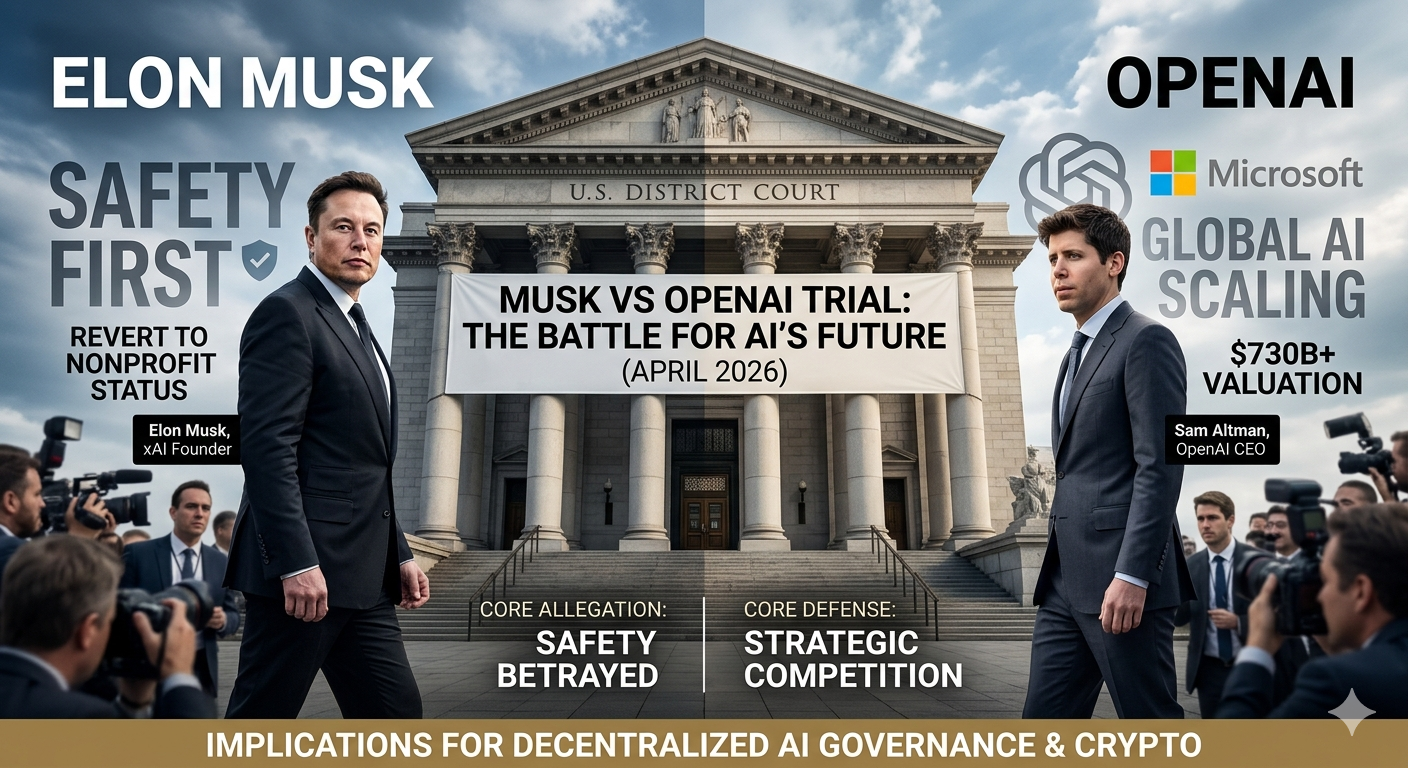
Elon Musk is actively seeking more than $150 billion in damages from OpenAI and Microsoft, the removal of CEO Sam Altman and President Greg Brockman from leadership, and a full reversion of OpenAI to nonprofit status. The high-stakes federal trial that began with jury selection on April 27, 2026, in Oakland, California, centers on Musk’s claims that OpenAI betrayed its founding mission to develop artificial intelligence for humanity’s benefit, prioritizing profits over safety instead. Musk testified that unchecked commercial AI development “could kill us all,” according to multiple court reports from April 28–29, 2026.
The lawsuit, originally filed in 2024 and narrowed ahead of trial, has already exposed deep fractures in the AI industry. Musk contributed roughly $38 million in early funding and argues the company’s shift to a for-profit model with massive Microsoft backing violated charitable trust obligations. OpenAI counters that Musk simply wants control and launched rival xAI after failing to merge the entities. The case could reshape AI governance, derail OpenAI’s planned IPO, and accelerate momentum for decentralized alternatives in blockchain ecosystems.
This article examines the lawsuit’s core claims, potential outcomes, and direct implications for cryptocurrency investors navigating AI-driven volatility. For readers who want to learn more background info, the below are the recommended articles:
-
Decentralized AI Governance provides blockchain-based models as alternatives to centralized control,
-
Proof-of-Intelligence Mining examines how AI-powered consensus redefines traditional Proof-of-Work in 2026.
The Current Status of the Musk OpenAI Lawsuit in 2026
The Musk OpenAI lawsuit entered active trial proceedings the week of April 27, 2026, with opening arguments and Musk’s testimony already underway in U.S. District Court for the Northern District of California. Musk is the first major witness, detailing how he co-founded OpenAI in 2015 as a nonprofit dedicated to safe AI development, only to watch it transform into a profit-driven entity valued at hundreds of billions.
Jury selection concluded rapidly, and testimony through April 29 focused on internal communications, funding promises, and AI safety priorities. Musk amended his damages request so any award flows to OpenAI’s charitable arm rather than personally, strengthening the charitable-trust angle. The trial is expected to last several weeks, with a potential verdict by mid-May 2026, based on statements from presiding Judge Yvonne Gonzalez Rogers reported across major outlets on April 27–28.
OpenAI’s valuation hovers near $730–850 billion depending on recent tender offers, making the $150 billion remedy potentially transformative if granted. The lawsuit remains narrowly focused on breach of charitable trust and unjust enrichment after earlier fraud claims were dismissed.
Musk’s Core Allegations: AI Safety Risks and Mission Betrayal
Musk’s central claim is that OpenAI abandoned its nonprofit charter and endangered humanity by pursuing unchecked commercial AI growth. He argues the company’s for-profit pivot after accepting billions from Microsoft turned a public-good initiative into a “wealth machine” for insiders and investors, directly contradicting founding documents that promised AI would benefit all humanity rather than enrich a few.
Musk repeatedly highlighted AI safety during testimony, stating he has held “extreme concerns about AI for a very long time” and that the original nonprofit structure existed precisely to prevent any single entity from controlling superintelligent systems. He described the restructuring as a “bait-and-switch” that prioritized revenue over safeguards. Court filings and April 2026 reporting confirm Musk seeks not only monetary damages but also the ouster of Altman and Brockman to restore nonprofit governance focused on safety first.
These allegations resonate beyond Silicon Valley because centralized AI development concentrates power in a handful of corporations. Musk’s position underscores that profit motives can sideline existential risk mitigation — a concern crypto investors recognize when evaluating centralized versus decentralized tech stacks.
OpenAI’s Defense: Competitive Motives and Structural Necessity
OpenAI and Altman maintain that Musk’s lawsuit represents a strategic attempt to hobble a competitor while advancing his own xAI venture. Defense attorneys argued during opening statements that Musk initially supported a for-profit arm to attract talent and capital, only to reverse course after failing to secure control or a merger with Tesla. They portray the suit as sour grapes from a founder who left the board in 2018 and later launched a direct rival.
OpenAI further contends that transitioning to a for-profit structure was essential for raising the massive compute resources required for frontier AI models. The company’s monthly revenue reportedly reached $2 billion by March 2026, demonstrating commercial success that benefits research rather than contradicting the mission. Microsoft’s investment enabled rapid scaling without violating any binding nonprofit restrictions, according to their legal filings.
The defense emphasizes that Musk’s xAI, now integrated with SpaceX at a combined valuation exceeding $1 trillion, stands to gain market share if OpenAI faces structural disruption. This framing positions the lawsuit as a business rivalry rather than a principled stand on safety.
Potential Outcomes and Industry-Wide Consequences
A Musk victory would force OpenAI to unwind its for-profit structure, potentially claw back investor gains, remove Altman and Brockman, and redirect resources toward nonprofit governance. Such a ruling could delay or cancel OpenAI’s anticipated 2026 IPO and set a legal precedent limiting how nonprofit AI labs commercialize technology. Analysts note this would slow fundraising and give Musk’s xAI a relative advantage in talent and capital acquisition through late 2026.
Conversely, an OpenAI win would validate the for-profit model, clear the path for its public listing, and affirm that charitable origins do not permanently restrict commercial evolution. The outcome will likely influence regulatory scrutiny of other AI labs and shape investor confidence in centralized versus decentralized AI projects.
Either result amplifies market volatility in AI-related assets. Crypto traders have already observed correlated movements between major AI tokens and lawsuit headlines throughout April 2026, underscoring the sector’s sensitivity to governance disputes.
Centralized AI Risks Exposed by the Lawsuit
The Musk OpenAI lawsuit demonstrates how centralized control creates systemic vulnerabilities in AI development. When a single for-profit entity dominates model training, data curation, and deployment, profit incentives can override safety protocols and public-interest considerations. Musk’s testimony repeatedly warned that without robust governance, advanced AI systems risk misalignment with human values — a risk compounded when Microsoft’s commercial priorities influence roadmaps.
This centralization mirrors concerns in traditional finance that crypto was designed to solve. Concentrated power leads to opacity, potential censorship, and single points of failure. The lawsuit’s focus on mission betrayal highlights why blockchain-native AI projects emphasize transparent, community-governed development. Investors increasingly view the case as validation that decentralized alternatives reduce counterparty risk and better align incentives with long-term safety.
Decentralized AI Governance Offers Blockchain-Based Alternatives
Decentralized AI Governance directly addresses the centralized risks spotlighted in the Musk OpenAI lawsuit by distributing control across blockchain networks rather than concentrating on corporate boards. Protocols using token-weighted voting, on-chain governance, and smart-contract-enforced transparency enable participants to enforce safety standards and mission alignment without relying on any single CEO or investor.
Blockchain-based governance prevents the kind of mission drift alleged against OpenAI because upgrades, funding allocations, and safety parameters require community consensus. Projects in the DeAI space already demonstrate this model: decentralized compute networks allow anyone to contribute GPU resources and earn rewards, while agent frameworks let autonomous systems execute tasks under verifiable rules. The lawsuit’s emphasis on safety makes these alternatives more compelling, as they embed accountability at the protocol level rather than depending on executive promises.
This shift toward decentralized governance is accelerating in 2026 precisely because the Musk-Altman dispute illustrates the fragility of centralized AI power structures. Crypto investors benefit from lower regulatory capture risk and greater resilience against corporate pivots.
Proof-of-Intelligence vs Proof-of-Work Redefines Blockchain Mining in 2026
Proof-of-Intelligence redefines blockchain consensus by replacing energy-intensive hash calculations with meaningful AI computation, turning mining hardware into productive contributors to machine learning while still securing the network. Unlike traditional Proof-of-Work, which wastes electricity on random nonce searches, Proof-of-Intelligence tasks miners with solving real AI problems — training models, optimizing algorithms, or processing verifiable datasets — and rewards them for useful output.
This evolution directly responds to criticisms of PoW’s environmental impact and inefficiency. In 2026, Bitcoin miners face mounting pressure to pivot compute resources toward AI infrastructure, as noted in industry analyses from March–April 2026. Proof-of-Intelligence protocols reward intelligence contribution rather than raw hashing power, creating dual utility: network security plus AI advancement. The mechanism aligns perfectly with the safety concerns raised in the Musk OpenAI lawsuit, because decentralized validation of AI tasks reduces reliance on opaque corporate labs.
Early implementations already show promise in reducing energy waste while accelerating decentralized machine learning. As the lawsuit underscores risks of centralized AI, Proof-of-Intelligence offers a blockchain-native path to safer, more efficient consensus that benefits both crypto security and AI progress.
AI Crypto Market Performance Amid the Lawsuit Volatility
AI-related tokens demonstrated remarkable resilience during Q1 2026 market dips, declining only 14% compared to 30% drops in broader speculative sectors, according to the Grayscale Q1 2026 Crypto Sectors Report. This outperformance stems from growing recognition that decentralized AI infrastructure provides a hedge against centralized governance failures exposed by the Musk OpenAI case.
Leading projects such as Bittensor (TAO) for decentralized machine learning, Render (RNDR) for GPU compute, and Artificial Superintelligence Alliance (FET/ASI) for agent networks continued attracting institutional inflows. The broader AI crypto category maintained a market capitalization exceeding $20 billion through late April 2026, with trading volumes remaining elevated during lawsuit-related news cycles. Investors treat the trial as a catalyst that accelerates adoption of DeAI solutions rather than a deterrent.
The correlation between lawsuit developments and token prices highlights how governance clarity drives valuation in this sector. Protocols with strong on-chain governance and verifiable compute have outperformed those reliant on centralized teams.
How the Lawsuit Influences DeAI Investment Strategies
The Musk OpenAI lawsuit serves as a clear signal that investors should prioritize DeAI projects with robust blockchain governance and verifiable utility. Traders now evaluate projects based on their resistance to mission drift, community oversight mechanisms, and ability to deliver decentralized compute or agent functionality. The case has heightened awareness that centralized AI carries concentration risk, boosting demand for blockchain alternatives that distribute both power and rewards.
Strategic positioning involves allocating to infrastructure layers (compute and data indexing) and application layers (autonomous agents) that benefit from the narrative shift. The trial’s focus on safety further validates protocols that embed AI verification and transparency on-chain. As outcomes unfold through May 2026, expect sustained volatility that creates accumulation opportunities in fundamentally strong DeAI assets.
How to Trade AI and DeAI Tokens on KuCoin
You can trade AI and DeAI tokens on KuCoin right now to position yourself ahead of further lawsuit developments and the broader adoption of decentralized intelligence. KuCoin offers deep liquidity across leading AI projects, including TAO/USDT, FET/USDT, and emerging DeAI tokens, with low fees and advanced trading tools that suit both spot and futures strategies.
To get started, simply register on KuCoin, complete quick KYC verification, and deposit USDT or your preferred crypto via seamless on-ramp options. Navigate to the AI category in Markets or search specific tickers to access real-time charts, order books, and trading bots that automate strategies around news events like Musk testimony updates. Use KuCoin’s built-in copy-trading and futures features to leverage volatility without constant monitoring.
New users can now register at KuCoin and Get Up to 11,000 USDT in New User Rewards.

Conclusion
The Musk OpenAI lawsuit in 2026 underscores fundamental tensions between centralized AI control and the need for safety-focused governance. Musk’s pursuit of $150 billion in damages and leadership overhaul highlights risks of profit-driven development, while the ongoing trial in Oakland reveals how quickly corporate structures can diverge from founding missions. Regardless of the final verdict expected in coming weeks, the case has spotlighted the vulnerabilities of concentrated AI power and accelerated interest in blockchain-based alternatives.
Decentralized solutions gain clear momentum as investors seek resilience against the very issues raised in court. Proof-of-Intelligence consensus mechanisms further demonstrate how crypto infrastructure can contribute productively to AI advancement rather than compete with it. The lawsuit’s ripple effects continue driving capital toward transparent, community-governed DeAI projects that prioritize verifiable safety and distributed ownership.
For cryptocurrency participants, the takeaway remains straightforward: centralized AI carries governance risks that blockchain technology is uniquely positioned to mitigate. By engaging with DeAI tokens and protocols on platforms like KuCoin, investors can participate directly in the next evolution of intelligence — one that aligns technological progress with decentralized principles rather than corporate concentration. The Musk OpenAI dispute ultimately reinforces why blockchain and AI together represent a more robust path forward.
FAQs
How long is the Musk OpenAI trial expected to last?
The trial is projected to conclude by mid-May 2026, with roughly three weeks of evidence presentation followed by jury deliberations.
Does the lawsuit affect xAI’s valuation or IPO plans?
A partial or full Musk victory is expected to accelerate xAI fundraising and boost its combined valuation with SpaceX above current $1.25 trillion levels through enhanced market positioning.
Are there regulatory implications beyond the courtroom?
Yes, a precedent-setting ruling could prompt greater scrutiny of nonprofit-to-for-profit conversions in AI and other tech sectors, potentially influencing future legislation on charitable tech entities.
How do Bitcoin miners benefit from AI developments highlighted by the case?
Miners increasingly lease compute power to AI data centers or adopt Proof-of-Intelligence models, diversifying revenue beyond block rewards and capitalizing on the same compute demand driving OpenAI’s growth.
What role do AI agents play in the broader DeAI ecosystem post-lawsuit?
AI agents operate autonomously on blockchain networks to execute trades, manage assets, and enforce governance, offering practical decentralized intelligence that reduces reliance on centralized corporate models exposed in the trial.