

Circle Executive: MiCA Blocks EU Access to Most Major Stablecoins – Only USDC, EURC, and USDG Comply
2026/08/11 15:21:00
Can MiCA Protect European Users Without Cutting Them Off From Global Stablecoin Markets?
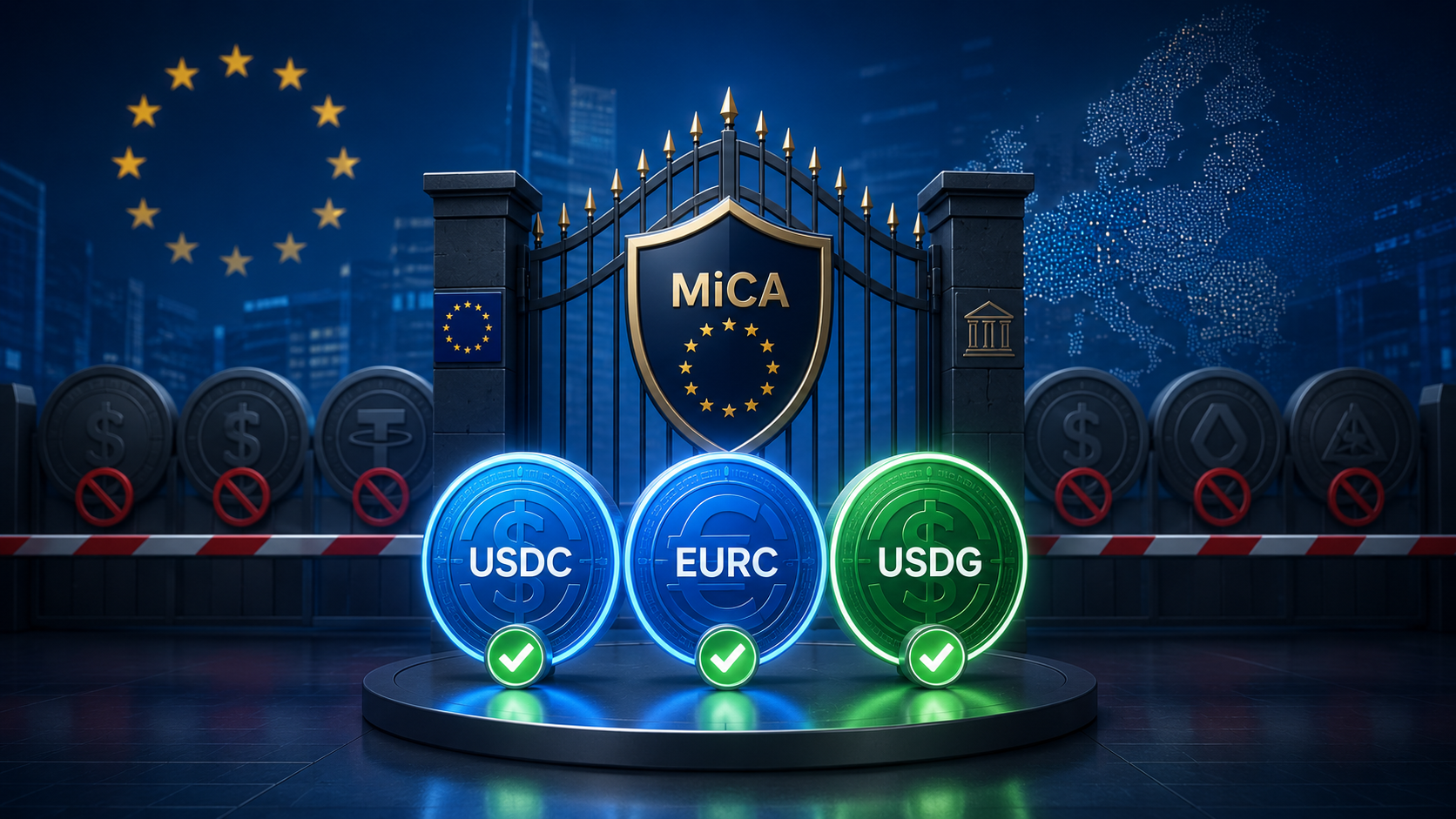
Patrick Hansen, Circle’s senior director for EU strategy and policy, has drawn attention to a structural limitation in the European Union’s Markets in Crypto-Assets framework. After the final transition deadlines passed and MiCA took full effect for both issuers and crypto-asset service providers, only three of the world’s fifty largest stablecoins by market capitalization satisfy the regulation’s requirements for electronic money tokens. Those three are USDC and EURC, both issued by Circle under French authorization, and USDG, issued under a Paxos-linked structure that holds European authorization. Hansen has noted that roughly thirty-five regulated e-money tokens from twenty-one entities now appear on the relevant registers, yet the bulk of global stablecoin activity remains outside the perimeter.
This leaves European Economic Area users either without the consumer protections MiCA was designed to provide or without straightforward access to the most widely used dollar-denominated tokens on regulated platforms. The observation, repeated in public comments around late July 2026, shows the tension between the regulation’s protective intent and the practical reality of market liquidity and user demand. Full MiCA enforcement has successfully licensed a growing set of local electronic money tokens while simultaneously restricting regulated access to the majority of the world’s largest stablecoins, concentrating compliant options around a small group of issuers and prompting calls for a review that improves competitiveness and global coordination without weakening core safeguards.
How Full MiCA Enforcement Reshaped Stablecoin Availability After July 2026 Deadlines
The July 1, 2026 deadline marked the end of transitional arrangements for crypto-asset service providers across EU and EEA member states. From that point, authorized platforms could offer only MiCA-compliant electronic money tokens to clients in the region. Circle had prepared years earlier by securing electronic money institution authorization from France’s Autorité de Contrôle Prudentiel et de Résolution for both USDC and EURC. This passporting right allowed the tokens to be issued and redeemed under a single license valid across the bloc. USDG achieved comparable status through Paxos Issuance Europe, supervised by Finland’s Financial Supervisory Authority. Other large dollar stablecoins did not obtain equivalent authorization. As a result, regulated exchanges adjusted their offerings, removing non-compliant pairs for EEA users while retaining the three compliant names.
Hansen described the outcome as a significant gap: the framework succeeded in creating a supervised local market yet left the majority of top-fifty tokens outside its protective scope. Market data from the period showed volume migration toward the remaining listed options on major platforms, confirming that the enforcement action produced measurable shifts in accessible liquidity rather than abstract policy effects. Reserve composition rules under MiCA contributed directly to the limited set of compliant large-cap tokens. Significant e-money tokens face requirements that a substantial share of reserves be held in deposits at EU-licensed credit institutions, alongside full segregation, regular attestations, and unconditional redemption at par. These standards differ from reserve practices common among some global issuers that emphasize short-term government securities held primarily outside the EU.
Circle structured separate reserve arrangements for its euro and dollar products to satisfy the jurisdictional distinctions, publishing attestations that detail holdings at systemically important institutions and other qualifying deposits. The same transparency obligations apply to USDG under its Finnish authorization. Issuers unwilling or unable to restructure reserves and obtain local authorization remained outside the regulated perimeter. Hansen’s assessment underscored that approximately thirty-five tokens from twenty-one issuers demonstrate genuine institutional interest and operational momentum within the EU, yet the absence of most high-volume global names means EEA users operating on regulated venues have a narrower set of options than their counterparts elsewhere. This configuration has practical consequences for payments, trading pairs, and on-chain settlement that rely on deep liquidity.
Reserve Requirements That Determined Which Large Stablecoins Could Qualify
MiCA classifies fiat-referenced stablecoins as electronic money tokens when they reference a single official currency. Authorization as a credit institution or electronic money institution established in the EU is mandatory. For tokens that meet significance thresholds based on holder numbers, market capitalization, transaction volume, or other criteria, additional prudential rules apply, including the proportion of reserves that must sit in EU bank deposits. Circle met these conditions for USDC and EURC through its French entity, maintaining distinct reserve pools that satisfy both the EU rules and parallel requirements in other jurisdictions. USDG followed a parallel path via its European issuance vehicle.
Public reserve reports released in early August 2026 by Circle detailed the composition as of the prior reporting date, showing full backing and the required deposit allocations. These disclosures form part of the ongoing transparency obligations that licensed issuers must fulfill. The combination of authorization, reserve location rules, and disclosure standards created a high bar that only a handful of large-cap tokens cleared. The practical effect of the reserve location rule has been to favor issuers prepared to maintain substantial European banking relationships and to accept the associated operational costs. Hansen has pointed out that local implementation is functioning as intended for the authorized entities, with more issuers and broader currency coverage appearing on the registers over successive months.
At the same time, the rule has left the majority of the top fifty stablecoins outside the supervised market. Users who wish to remain fully within the regulated environment are therefore limited to the compliant set. Those who hold non-compliant tokens may continue to do so on a peer-to-peer or non-regulated basis, but they forgo the redemption rights, segregation protections, and supervisory oversight that MiCA attaches to authorized electronic money tokens. The resulting market structure concentrates regulated liquidity among the three named tokens while the broader global stablecoin ecosystem continues to operate under different regulatory regimes.
Practical Consequences for EEA Users Seeking Access to Major Dollar Stablecoins
European Economic Area residents who trade or hold stablecoins through authorized crypto-asset service providers now encounter a short list of fully compliant options among the largest global names. USDC remains available for both trading and direct redemption via Circle’s European channels that support SEPA and SEPA Instant transfers for eligible customers. EURC provides a euro-denominated alternative with the same regulatory status. USDG supplies an additional dollar-referenced choice under its own European authorization. Platforms adjusted pairings accordingly after the July deadline, redirecting activity that previously involved non-compliant tokens.
This shift has concentrated order-book depth and on-chain volume among the remaining listed assets on regulated venues. Hansen characterized the situation as one in which EU users are either unprotected when using non-compliant tokens or cut off from the liquidity and utility of the broader market when they stay within regulated channels. The limitation extends beyond simple listing status. Institutional users seeking custody, settlement, or payment solutions that incorporate stablecoins must also navigate the same compliance boundary. Integrations announced by traditional financial market infrastructures in the period surrounding enforcement have focused on the authorized tokens, reinforcing their position in regulated flows.
Retail and professional users who require deep secondary-market liquidity for hedging, arbitrage, or routine transfers therefore face a constrained menu when they elect to operate exclusively inside the MiCA perimeter. The gap is structural rather than temporary under current rules: without a recognition mechanism for foreign-regulated stablecoins that meet equivalent standards, the set of large-cap compliant tokens is unlikely to expand rapidly. Hansen has argued that the forthcoming review of the framework offers an opportunity to address this disconnect while preserving the consumer-protection gains already achieved for local issuers.
Circle’s Dual-Issuance Model and Its Role in Maintaining Fungibility
Circle implemented a dual-issuance structure for USDC that allows the same token to be issued under both its United States arrangements and its French electronic money institution license. Tokens remain fungible across the global supply, while reserves allocated to European customers are held in compliance with MiCA requirements. EURC is issued exclusively through the French entity, with all corresponding reserves located and managed under EU rules. This design required coordination with authorities on both sides of the Atlantic and has been presented by the company as a practical solution that preserves the utility of a single global token while satisfying local supervisory expectations.
Monthly and periodic attestations continue to document the reserve composition for both products. The model has enabled Circle to retain listings on regulated European platforms after other major dollar stablecoins lost that status. The dual structure also supports redemption pathways that differ by residency. Eligible EEA residents can redeem both USDC and EURC directly with the European issuer under the conditions set out in the applicable white papers and terms. Non-EEA residents face more limited direct redemption options for certain tokens.
These operational details form part of the transparency package that accompanies MiCA authorization. By maintaining fungibility while segregating the regulatory treatment of reserves, Circle has avoided a fragmented token landscape in which European and non-European versions of the same asset would trade at different prices or require separate conversion steps. The approach has been cited in industry commentary as one reason the two Circle tokens retained practical relevance for European users after the enforcement deadline. It simultaneously illustrates the operational complexity that other large issuers would need to replicate if they sought comparable authorization.
USDG’s Path to European Authorization and Market Positioning
USDG, issued under the Global Dollar Network and through Paxos entities, secured electronic money token status via Paxos Issuance Europe under Finnish supervision. This authorization places the token on the same compliant footing as USDC and EURC among the top-fifty cohort. Reserve management for the European issuance incorporates the required local deposit elements while the broader product continues to operate under additional licenses in other jurisdictions. The token’s design emphasizes partner revenue sharing and institutional distribution channels, distinguishing its commercial model from pure issuer-retained yield structures.
Availability on regulated European platforms followed the authorization, adding a third large-cap option for users seeking MiCA-compliant dollar exposure. The presence of USDG alongside the two Circle tokens prevents a complete concentration of regulated large-cap supply in a single issuer group. Market participants evaluating counterparty and operational risk now have a limited but plural set of choices within the authorized perimeter. Attestations and white-paper disclosures for USDG follow the same transparency standards applicable to other electronic money tokens. The token’s multi-jurisdictional licensing has been presented by its issuer as a deliberate strategy to meet the highest available regulatory bars rather than the lowest common denominator.
In the context of Hansen’s comments, USDG’s inclusion in the short list of top-fifty compliant stablecoins demonstrates that the MiCA pathway is navigable for issuers prepared to establish European entities and adjust reserve placements accordingly. It also underscores that the barrier is not insurmountable for well-capitalized and operationally sophisticated firms, even if most of the largest global names have so far chosen not to take that route.
Local Electronic Money Token Growth Versus Global Liquidity Concentration
ESMA’s interim registers and successive updates from industry observers show a steady increase in the number of authorized electronic money token issuers and the variety of currencies they cover. By mid-2026, the figures stood near twenty-one issuers and thirty-five tokens spanning euro, dollar, and several other official currencies. French, Dutch, Luxembourgish, and other national competent authorities have contributed to the expansion. Many of the newer tokens are euro-denominated and issued by banking or specialized electronic money institutions with established European footprints.
This local activity demonstrates that the regulatory framework is attracting capital and operational commitment inside the bloc. Hansen has described the momentum as real and has projected further entry by large European corporations over the subsequent twelve months. Despite this growth, the aggregate market capitalization and on-chain volume of the newly authorized local tokens remain modest relative to the largest global stablecoins. EURC has captured a substantial share of the euro-denominated segment after earlier competitors exited or scaled back, yet the absolute size of the euro stablecoin market is still a fraction of the dollar stablecoin market.
The concentration of regulated large-cap liquidity in USDC, EURC, and USDG therefore continues to shape user experience on authorized platforms. Traders and payment providers who require the deepest order books and the broadest set of counterparties find those attributes primarily in the three compliant names. The coexistence of a growing local issuer base and a narrow set of large-cap compliant tokens is the dual reality Hansen has emphasized that implementation is succeeding for domestic participants, while the original ambition of bringing the bulk of global stablecoin activity under EU supervision remains unfulfilled.
Exchange Listing Adjustments and Observed Volume Migration Patterns
Major platforms operating under MiCA licenses adjusted their stablecoin offerings in the weeks surrounding the July 2026 deadline. Non-compliant tokens were removed from trading pairs available to EEA users, while USDC, EURC, and USDG retained or expanded their presence. In some cases, platforms explicitly replaced certain pairs with USDC equivalents to maintain continuous market access. On-chain and exchange volume data from the subsequent period indicated a redirection of activity toward the remaining listed assets. The shift was most visible in spot markets and in the stablecoin pairs used for crypto-to-crypto trading. Institutional order flow that must remain inside regulated channels followed the same pattern.
These mechanical adjustments produced a measurable concentration of regulated European stablecoin liquidity. The volume migration has commercial implications for issuers and for the platforms themselves. Issuers of compliant tokens benefit from the redirected flow without necessarily having altered their own product features. Platforms that previously relied on a broader set of stablecoin pairs must now manage thinner books or additional conversion steps for users who still hold non-compliant tokens outside regulated venues.
Peer-to-peer and decentralized venues remain available for non-compliant assets, yet they operate without the supervisory protections and redemption guarantees attached to authorized electronic money tokens. The net result is a bifurcated market structure inside the EEA: a supervised segment centered on three large-cap names plus the growing roster of local tokens, and an unsupervised segment that continues to accommodate the remainder of global supply. Hansen’s public remarks framed this bifurcation as a significant gap relative to the regulation’s stated goal of bringing global stablecoin markets under EU oversight.
Institutional Custody and Settlement Integrations Favoring Compliant Tokens
Traditional financial market infrastructures have begun incorporating the authorized stablecoins into custody, clearing, and settlement services. One prominent example is the addition of USDC to a major global custodian’s digital asset platform, enabling institutional clients to store, transfer, mint, and burn the token under regulated conditions. Parallel explorations by European exchange and clearing groups have focused on USDC and EURC for potential use in trading, clearing, and collateral management. These integrations reinforce the practical utility of the compliant tokens beyond simple exchange listings.
They also create network effects that further concentrate institutional activity around the authorized set. USDG has likewise been positioned for institutional distribution through its partner network. The preference for compliant tokens in institutional workflows is a direct consequence of fiduciary and regulatory obligations that govern banks, custodians, and market infrastructures. Entities subject to EU supervision cannot readily integrate non-authorized electronic money tokens into client-facing or proprietary systems without creating compliance exposure.
As a result, the three top-fifty compliant stablecoins have become the default options for any stablecoin-related service that must remain inside the regulated perimeter. This institutional layer amplifies the market-structure effects already visible at the retail and exchange level. Over time, the accumulation of custody, payment, and settlement links around the authorized tokens may further entrench their position even if additional large-cap issuers later obtain authorization. The pattern illustrates how regulatory status translates into durable commercial advantage once infrastructure providers make irreversible integration decisions.
Calls for a MiCA Review Focused on Competitiveness and Recognition Mechanisms
Hansen has argued that the scheduled review of MiCA provides an opportunity to close the identified gap. He has suggested three priorities: improving the competitiveness of EU-regulated stablecoins so they can scale beyond local payment use cases, strengthening coordination with other major regulatory regimes, and developing a formal recognition pathway for foreign-regulated stablecoins that meet equivalent standards. The European Commission opened a public consultation in mid-2026 seeking input on whether the current framework remains fit for purpose, with a comment period extending into the autumn.
The consultation covers a range of topics, including the treatment of multi-issuance arrangements and the conditions under which non-EU tokens might be admitted. Industry participants, including Circle, have contributed views that emphasize the need to bring a larger share of global activity inside the supervised perimeter. A recognition regime, if designed carefully, could allow tokens already supervised under rigorous frameworks elsewhere to operate in the EU without requiring full local re-issuance, provided equivalence criteria are satisfied.
Such an approach would expand the set of large-cap options available to European users while preserving the core protective elements of MiCA. It would also reduce the incentive for activity to migrate to non-regulated channels. Local issuers would still benefit from preferential treatment in certain contexts, yet the overall market would gain depth and resilience. Hansen’s comments position the review as a chance to convert the current dual reality, successful local implementation paired with limited global coverage, into a more coherent supervisory architecture. The outcome of the consultation and any subsequent legislative adjustments will determine whether the set of top-fifty compliant stablecoins remains narrow or expands in the coming years.
Euro-Denominated Stablecoin Dynamics Under the Same Framework
EURC has emerged as the largest euro-denominated stablecoin by market capitalization within the MiCA-compliant segment. Growth accelerated after earlier euro tokens exited or scaled back their European offerings. Reserve management for EURC is conducted entirely under French authorization, with euro deposits at licensed institutions satisfying the applicable deposit-share rules. Other euro tokens issued by banking groups and specialized electronic money institutions have also obtained authorization, contributing to a more diverse local supply than exists on the dollar side among large-cap names.
Aggregate market capitalization of MiCA-compliant euro stablecoins has expanded substantially year-over-year, although absolute levels remain far below those of the major dollar tokens. The euro segment illustrates both the successes and the limitations of the current framework. Local issuance is viable and is attracting traditional financial institutions. At the same time, the overall euro stablecoin market is still developing the depth and cross-border utility that characterize the largest dollar products.
Hansen has noted that the real value proposition for locally issued tokens lies in cross-border payments and tokenized trade rather than in competing solely within an already well-served domestic payments market. Achieving that scale will require both continued local innovation and greater interoperability with global liquidity. The review process may influence how euro tokens interact with dollar tokens and with recognition regimes for foreign assets. For the present, EURC’s leading position within the euro category, combined with USDC’s role as the primary large-cap dollar option, defines the practical menu available to regulated European users.
Transparency and Attestation Practices Among the Compliant Issuers
Authorized electronic money token issuers are required to publish white papers that meet detailed technical standards and to provide ongoing disclosures on reserves, governance, and redemption mechanisms. Circle has released updated MiCA-aligned white papers for USDC and EURC and continues to publish reserve composition reports. These reports break down holdings across categories such as deposits at systemically important institutions and other qualifying bank deposits. USDG follows parallel disclosure practices under its European authorization.
The frequency and granularity of these reports exceed the transparency levels historically associated with some non-compliant global stablecoins. Users and counterparties can therefore verify backing and operational status with greater confidence when dealing with the authorized tokens. The disclosure regime serves both protective and competitive functions. It reduces information asymmetry between issuers and holders, supporting the redemption-at-par guarantee that is central to the electronic money token definition. It also allows market participants to compare reserve quality and operational resilience across the small set of large-cap compliant options.
Over successive reporting cycles, consistent high-quality disclosure can reinforce trust and attract additional institutional adoption. The same standards apply to the broader group of local electronic money tokens, creating a baseline of transparency across the regulated European stablecoin market. Hansen’s remarks implicitly rest on this foundation: the tokens that have cleared the MiCA bar are subject to ongoing supervisory and public scrutiny that non-compliant tokens avoid. That scrutiny is one of the tangible benefits that remain available to users who choose to stay inside the regulated perimeter.
Market Implications for Liquidity, Innovation, and Cross-Border Flows
The concentration of regulated large-cap stablecoin supply has implications for liquidity provision, product innovation, and the efficiency of cross-border value transfer. Market makers and liquidity providers operating on authorized platforms must allocate capital across a narrower set of high-volume tokens, potentially increasing the cost of maintaining tight spreads during periods of stress. Developers building payment or settlement applications that must remain compliant face a limited choice of base assets, which can constrain design options. Cross-border flows that rely on dollar stablecoins for settlement now route primarily through the three authorized names when they touch regulated European entities. These frictions are the practical counterpart of the protective perimeter MiCA has established.
At the same time, the clarity provided by full enforcement has encouraged infrastructure investment around the compliant tokens. Custody integrations, payment-rail pilots, and institutional product launches have proceeded with greater confidence once the regulatory status of the underlying assets was settled. Local euro tokens continue to experiment with use cases tailored to European payment systems and capital-market infrastructure.
The net effect is a market that is safer for participants who remain inside the perimeter and more fragmented for those who need access to the full spectrum of global stablecoin liquidity. Hansen’s call for a review that improves competitiveness and global alignment seeks to reduce that fragmentation without discarding the safeguards already in place. The balance struck in the coming legislative cycle will shape whether European users continue to operate with a constrained large-cap menu or gain broader regulated access while retaining the protections MiCA was designed to deliver.
FAQs
What exactly did the Circle executive state about the number of compliant stablecoins?
Patrick Hansen stated that of the top fifty stablecoins by market capitalization, only USDC, USDG, and EURC currently meet MiCA requirements as regulated electronic money tokens. He simultaneously noted that approximately thirty-five regulated e-money tokens have been issued by twenty-one entities across the EU, indicating that local authorization activity is progressing even while the largest global names remain largely outside the framework. The comments were made in the context of the completed transition to a full MiCA application for both issuers and service providers.
Why have most major stablecoins not obtained MiCA authorization?
The regulation requires issuers of electronic money tokens to be authorized as credit institutions or electronic money institutions established in the EU and to meet specific reserve, transparency, and redemption standards. For significant tokens, a meaningful portion of reserves must be held in deposits at EU-licensed banks. Some global issuers have judged the operational and structural changes required to meet these conditions to be incompatible with their existing reserve models or commercial priorities and have therefore not pursued authorization. The result is that their tokens cannot be offered by regulated platforms to EEA clients.
How does MiCA treat redemption rights for compliant stablecoins?
Holders of authorized electronic money tokens have a legal right to redeem at par value from the issuer at any time. The issuer must maintain the operational capacity and reserve composition necessary to honor that right. White papers and ongoing disclosures set out the practical procedures, eligibility criteria, and any residency-based distinctions that apply. These rights form a core consumer-protection element that is available only for tokens that have completed the authorization process.
What has happened to non-compliant stablecoins on European regulated platforms?
After the final transition deadlines, authorized crypto-asset service providers may no longer offer non-compliant electronic money tokens to clients in the EEA. Platforms have therefore removed trading pairs involving those tokens for EEA users. Holders may still possess the tokens and may transfer them on a peer-to-peer basis or through non-regulated channels, but they do so without the supervisory protections and issuer redemption guarantees that attach to authorized tokens.
Is there any pathway for additional large-cap stablecoins to become compliant?
Issuers can still apply for electronic money institution or credit institution authorization in an EU member state and structure their reserves and disclosures to meet the applicable standards. The process requires time, capital, and operational adaptation. A recognition regime for foreign-regulated tokens that meet equivalent standards has been discussed as a possible future addition through the MiCA review, but no such regime currently exists. Until either individual authorizations or a recognition mechanism expand the set, the list of top-fifty compliant tokens remains limited to the three identified by Hansen.
How has the euro stablecoin market evolved under MiCA?
EURC has become the largest euro-denominated stablecoin within the compliant segment after earlier competitors reduced or exited their European offerings. Additional euro tokens issued by banks and specialized institutions have also obtained authorization, producing a more diversified local supply. Aggregate capitalization of the compliant euro segment has grown markedly on a year-over-year basis, yet absolute levels remain substantially smaller than those of the major dollar stablecoins. The framework has therefore supported local issuance while the broader euro market continues to develop depth.
Disclaimer: This content is for informational purposes only and does not constitute investment advice. Cryptocurrency investments carry risk. Please do your own research (DYOR).