

Hermes Agent vs OpenClaw: Which Open-Source AI Agent Wins in 2026?
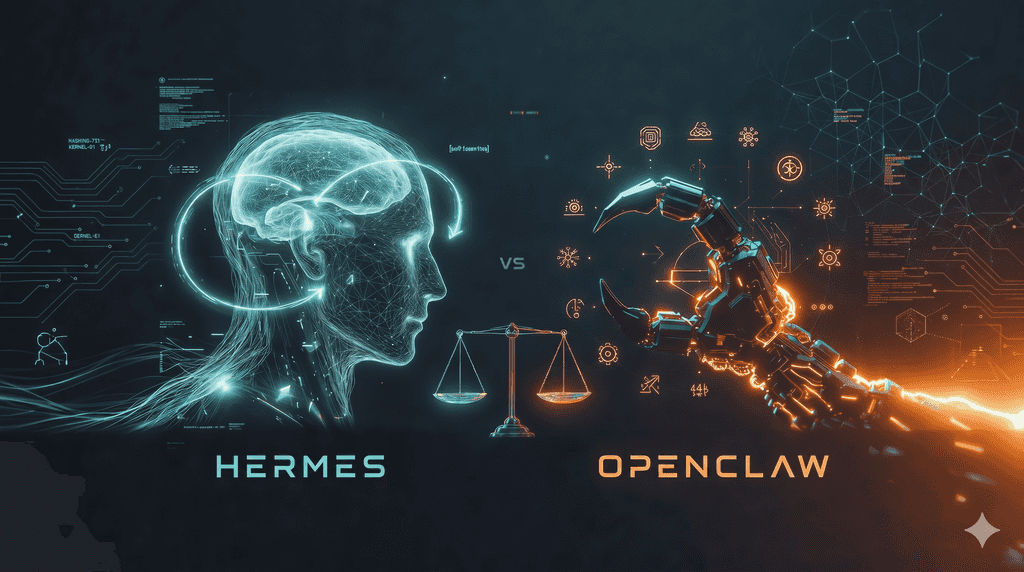
As we enter 2026, the"Agentic AI revolution has moved beyond simple chat interfaces into the realm of fully autonomous, self-improving runtimes. In the open-source community, a fierce rivalry has emerged between the established gateway-centric power of OpenClaw and the disruptive, learning-first architecture of Hermes Agent.
For cryptocurrency traders who employ automated, complex market strategies, choosing the right framework is no longer just a technical preference, it is a decision that dictates the speed, memory, and autonomous execution of their entire trading stack.
Summary
This comprehensive analysis compares the two leading open-source agent frameworks of 2026: OpenClaw and Hermes Agent. We examine the fundamental architectural differences between OpenClaw’s "Gateway-First" multi-channel infrastructure and Hermes Agent’s "Learning-First" autonomous runtime.
By evaluating their performance in complex coding, memory retention, we provide a definitive guide for developers and traders looking to deploy the most capable AI agents in today's high-volatility market.
Thesis
The primary purpose of this article is to dissect why the market is witnessing a significant shift from static, skill-based assistants toward autonomous runtimes. While OpenClaw offers unparalleled ecosystem breadth and team governance, Hermes Agent’s "Closed Learning Loop" and superior memory defaults represent the next evolution of personalization.
Key Takeaways
-
OpenClaw functions as a communication gateway for routing across 50+ channels, while Hermes Agent acts as a unified runtime that autonomously generates and refines its own skills.
-
A standout feature of Hermes Agent is its ability to learn from past trajectories, creating persistent skills that improve task completion rates over time without human intervention.
-
OpenClaw maintains a dominant lead in sheer scale, with over 345,000 GitHub stars and a library of 5,700+ community-built skills for instant deployment.
-
Both agents now utilize the Model Context Protocol and Agent Communication Protocol, allowing them to function as a coordinated multi-agent team.
The Origins of Hermes Agent and OpenClaw
OpenClaw
OpenClaw emerged in late 2025 as a viral phenomenon within the decentralized AI space. Originally nicknamed the "Lobster" by its early community, the project utilized the lobster emoji to symbolize its core technological breakthroughs: "molting" (the ability for agents to autonomously upgrade their own smart contracts) and "claws" (the ability to securely grip and fetch off-chain data).
What started as a meme-tech movement on Crypto Twitter quickly evolved into a massive infrastructure project.
By April 2026, OpenClaw has secured its position as the most-starred software project on GitHub in the AI category, boasting over 345,000 stars. Its developer-first approach allowed it to build a staggering ecosystem of 5,700+ community skills.
Hermes Agent
Launched in February 2026 by the internet-native collective Nous Research, Hermes Agent was built to solve the "static skill problem." The developers at Nous Research believed that an agent shouldn't just follow pre-written files; it should learn from its own experiences.
Hermes Agent was designed from day one as an autonomous runtime. While it lacks the decade-spanning connectivity of OpenClaw, it focuses on "Cognitive Depth." Since its launch, it has seen an explosive growth to 64,000+ GitHub stars, driven by a community that values deep personalization over broad integration.
In early April 2026, the project reached a major milestone with the release of its v0.8.0 update, which introduced a seamless migration tool for disgruntled OpenClaw users who are looking for a more secure and autonomous alternative.
For those tracking market sentiment, the "OpenClaw vs. Hermes" debate is more than a tech feud—it's a leading indicator of where the next wave of decentralized AI capital is flowing. You can stay updated on the latest AI-token trends by visiting the KuCoin Blog.
Architectural Comparison
The industry is split between platforms that prioritize reach (where the agent can go) and those that prioritize resonance (how much the agent remembers and improves).
OpenClaw: The "Gateway-First" Control Plane
OpenClaw’s architecture is built around a central Gateway, a high-performance, always-on control plane that serves as a universal router for AI interactions.
SOUL.md & The Behavior Layer: At the heart of every OpenClaw instance is a
SOUL.md file. This acts as the agent’s "identity blueprint," defining its personality, core constraints, and mission. It is a top-down approach where the developer dictates behavior.The Pipeline: Inbound messages from over 50 channels (Telegram, Slack, etc.) hit the Gateway, are routed through the Pi Agent Runtime, and then dispatched to various local or cloud-based tools.
Modularity: Its strength is its plug-and-play nature. If you need a new integration, you simply drop a new Skill (defined by a
SKILL.md file) into the directory.Hermes Agent: The "Integrated Runtime" Philosophy
In contrast, Hermes Agent rejects the fragmented gateway model in favor of a Unified Runtime. It treats the model, the memory, and the tools as a single, cohesive engine.
The Closed Learning Loop: Hermes’ architecture is built for autonomy. After completing a task, the agent doesn't just stop, it enters a "Reflective Phase" where it analyzes its own performance and updates its procedural memory.
Three-Tier Persistent Memory:
Prompt Memory: Managed via
MEMORY.md and USER.md, providing a persistent "Who am I and who is the user?" snapshot. Episodic Archive: A robust SQLite FTS5 database that stores every past interaction, searchable by the agent for "cold recall."
Procedural Skills: Autonomous generation of markdown files that capture the exact logic needed for repetitive tasks, reducing token costs by up to 40% in high-frequency scenarios.
The 2026 Performance Gap
Data from early 2026 benchmarks shows that while OpenClaw leads in multi-agent orchestration, Hermes Agent leads in contextual survival. In a Long-Horizon Task test, Hermes’ learning loop allowed it to recover from errors 22% more effectively than OpenClaw, which often requires manual intervention to reset its "SOUL" after a logic break.
Skill Ecosystems
OpenClaw: ClawHub
OpenClaw’s greatest asset is its sheer scale. As of April 2026, its dedicated marketplace—ClawHub—has exploded from 5,700 skills in early February to over 44,000 community-built skills. This growth is primarily fueled by the industry-wide adoption of the Model Context Protocol (MCP), with over 65% of new skills essentially acting as wrappers for MCP servers.
Plugin vs. Skill: In OpenClaw, a Skill is a simple
SKILL.md file that teaches the agent a new behavior, while a Plugin is a full npm package for complex logic.The Breadth: Whether you need to manage a DeFi portfolio, automate a smart home via Matter, or coordinate a multi-regional supply chain, there is almost certainly a pre-built ClawHub skill for it.
The Risk: This app store model comes with supply-chain risks. In March 2026 alone, security researchers identified several malicious skills on ClawHub designed to exfiltrate API keys, prompting the community to implement stricter "ClawBox" sandboxing.
Hermes Agent: Autonomous Trajectory Learning
Hermes Agent takes the opposite approach. Instead of asking you to download a skill, it builds the skill for you. Through its Closed Learning Loop, Hermes observes its own successful task completions and abstracts them into reusable Trajectories.
Self-Generated Skills: When Hermes Agent completes a complex 10-step task, such as setting up a cross-chain bridge or a localized KuCoin Trading Bot strategy, it automatically writes a markdown document capturing the exact methodology, logic, and edge cases encountered.
Skill Refining: Unlike OpenClaw’s static skills, Hermes’ skills are "living" documents. If the agent finds a more efficient way to execute a command, it patches the skill file in real-time.
Quality Over Quantity: While Hermes ships with only ~120 bundled skills, its ability to learn your specific environment means it requires far less manual configuration than OpenClaw.
The choice between these two platforms often comes down to your technical needs.
If you are an enterprise user who needs to connect to 20 different proprietary software gateways, OpenClaw’s 44,000+ skills provide the necessary connectivity.
However, for individual power users and developers who want an agent that grows more intelligent and personalized with every prompt, Hermes’ autonomous learning is the superior architectural bet.
Data Insight: A recent developer survey on X suggests that while OpenClaw has more total users, 30% of active developers have migrated to Hermes specifically to avoid the "maintenance fatigue" of manually updating and debugging community-written plugins.
The MCP & ACP Standard
MCP: The Universal Agent-to-Tool Connector
The Model Context Protocol (MCP) has effectively won the agent-to-tool war of 2026. Created by Anthropic and now governed by the Linux Foundation, MCP provides a standardized client-server interface that allows agents to access external data and tools without custom "glue code."
OpenClaw’s Approach: OpenClaw treats MCP as a resource layer. Most of its 44,000+ community skills are now wrappers for MCP servers. This allows an OpenClaw agent to instantly connect to a local filesystem, a Google Drive server using a single, unified JSON-RPC interface.
Hermes Agent’s Approach: Hermes takes an "MCP-First" stance. It features a native configuration block for MCP servers in its core runtime. This integration allows Hermes to treat external tools as native capabilities, reducing the latency typically associated with third-party plugin wrappers.
ACP: The Social Fabric of Autonomous Agents
While MCP handles tools, the Agent Communication Protocol (ACP) governs how agents talk to each other. You might have a Research Agent analyzing sentiment and an "Execution Agent" placing orders.
OpenClaw (The Orchestrator): OpenClaw excels at using ACP to manage a Swarm of agents. Its gateway-centric design is perfect for routing tasks between specialized sub-agents, using ACP's REST-based framework to ensure stateful messaging across a distributed team.
Hermes (The Specialist): Hermes uses ACP to delegate high-level reasoning to other agents when it encounters a task outside its learned trajectory. Its implementation focuses on Secure Delegation, ensuring sensitive credentials.
Interoperability Benchmarks
| Feature | Model Context Protocol (MCP) | Agent Communication Protocol (ACP) |
| Primary Goal | Connecting Agents to Tools/Data | Connecting Agents to other Agents |
| Dominant Use Case | Querying Order Books | Delegating Risk Analysis to a sub-agent |
| Hermes Support | Native, High-Priority | Collaborative / Delegation-based |
| OpenClaw Support | Extensible via Skills | Orchestration / Swarm-based |
Performance Benchmarks
Cognitive Autonomy
Hermes Agent’s greatest performance strength is its Cognitive Autonomy. According to internal benchmarks released by Nous Research in April 2026, an agent using self-generated skills completed complex research and code-execution tasks 40% faster than a fresh, non-learning instance.
The Secret: Hermes front-loads context. By injecting precisely recalled "procedural memory" into the prompt, it achieves a "one-shot" task completion rate that is significantly higher than its competitors.
Latency: While the initial reasoning phase can take slightly longer due to context density, the FTS5-powered memory retrieval has a median latency of just 10ms over 10,000+ entries, ensuring that the agent doesn't "stutter" when reaching for past experiences.
Execution Speed
OpenClaw, built on a mature TypeScript/Node.js stack, remains the king of raw throughput and "Ping-to-Action" speed.
Latency: In multi-channel environments, OpenClaw maintains a median response latency of under 1.2 seconds, outperforming Hermes by nearly 30% in high-frequency routing scenarios.
Token Efficiency: OpenClaw is far more conservative with its context window. By utilizing a Selective Memory pipeline, it consumes ~1,800 tokens per turn compared to the 8,000+ tokens Hermes might consume when front-loading a complex trajectory.
The Verdict for Traders
If you are running high-frequency sentiment analysis and various social feeds, OpenClaw’s throughput is unmatched. However, if you are tasking an agent with Deep Work, Hermes Agent’s cognitive autonomy will save you hours of manual re-prompting.
Leveraging AI Agents for KuCoin Market Analysis
OpenClaw: The Sentiment Sentinel
Because OpenClaw excels at multi-channel integration, its best application on KuCoin is Sentiment Aggregation.
-
The Workflow: You can deploy an OpenClaw instance to monitor 50+ Telegram Alpha groups, the KuCoin News feed, and X simultaneously.
-
The Execution: Using its Gateway-First design, OpenClaw can summarize the "market mood" and push a high-priority alert to your mobile Discord or Signal the moment a specific volatility trigger (like a sudden BTC whale move) is detected.
Hermes Agent: The Strategy Architect
Hermes Agent is better suited for the Deep Work of trading. Its Closed Learning Loop allows it to study your specific trading history on KuCoin and refine your execution logic.
-
Autonomous Backtesting: You can task Hermes with analyzing the last three "Short Squeezes" on KuCoin and generating a "Squeeze Survival Skill." This skill is a markdown-based strategy that the agent loads whenever it detects similar price action in the current order book.
-
Personalized Strategy Refinement: Unlike a static bot, Hermes "learns" from your manual trades. If you consistently close long positions too early, Hermes’ User Modeling will nudge you with data-backed suggestions to adjust your KuCoin Trading Bot parameters for better profit retention.
The Technical Bridge: Connecting via MCP
You can connect these agents to the KuCoin API using the Model Context Protocol (MCP).
-
Direct Execution: By exposing a secure MCP server to your agent, it can query real-time K-line data, check your margin ratio, and even place limit orders.
-
Hybrid Orchestration: The Pro setup involves using OpenClaw as the Eyes and Hermes as the Brain.
Conclusion
The battle between Hermes Agent and OpenClaw isn't a zero-sum game, it’s an evolution of choice. If you value a massive ecosystem of pre-built tools and community support, OpenClaw remains the undisputed king of the "Gateway" era. However, if you are looking for a true AI Employee that grows more intelligent, remembers your preferences, and autonomously refines its own skills, Hermes Agent is the superior architectural choice for the future.
As decentralized AI continues to merge with decentralized finance, the ability to deploy these agents locally will be the differentiator for sovereign trader.
FAQs
Can I run Hermes Agent and OpenClaw on the same server?
Yes. In fact, many 2026 setups use the Agent Communication Protocol (ACP) to allow them to work together. You can host both on a standard $5-10 VPS or a local WSL2 environment without conflict.
Is it safe to give my KuCoin API keys to an open-source agent?
Safety depends on your Sandbox configuration. Always use KuCoin API keys with "Trade" and "View" permissions enabled, but "Withdraw" permissions strictly disabled. Use Hermes’ native Docker backend for the highest level of security.
Does Hermes Agent require a high-end GPU?
Not necessarily. While it can run local models, most users connect Hermes to providers like Nous Portal or OpenRouter to access massive models like Hermes 4 405B, while the agent runtime itself runs on minimal CPU resources.
How do I migrate my existing OpenClaw setup to Hermes?
Hermes Agent (v0.8.0+) includes a built-in
hermes claw migrate command. This tool scans your existing OpenClaw directory, converts your SOUL.md into a Hermes personality, and migrates your .md skills into the Hermes Skill System.Which agent is better for beginners?
OpenClaw is generally more beginner-friendly due to its Gateway GUI and massive library of 44,000+ ready-to-use skills. Hermes Agent is designed for Power Users who want to build a deep, long-term relationship with a self-improving AI.
Disclaimer:This content is for informational purposes only and does not constitute investment advice. Cryptocurrency investments carry risk. Please do your own research (DYOR).