Can Bitcoin Layer 2 Develop? Current Development Status of Related Projects
Can Bitcoin Layer 2 Develop? Current Development Status of Related Projects
Introduction
Bitcoin Layer 2 is no longer just a theory. By 2026, the real question is not whether Bitcoin L2 can develop, but which types of Layer 2 solutions are actually gaining traction and how mature they are.
In simple terms, Bitcoin Layer 2 includes systems built on top of Bitcoin to make transactions faster, cheaper, and more useful. These solutions also aim to expand what Bitcoin can do, from payments to smart contracts and digital asset applications.
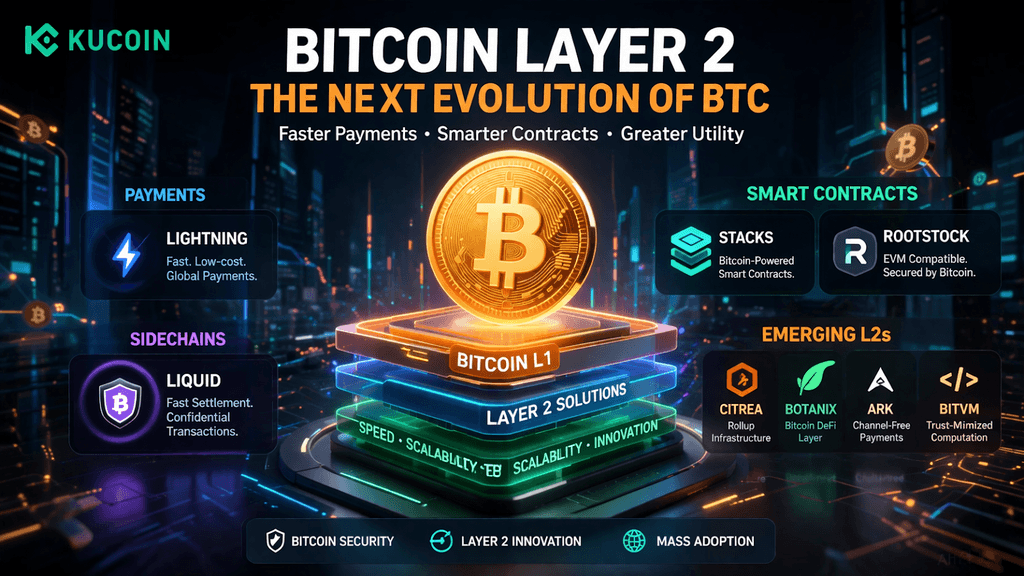
The space is not unified. Bitcoin L2 now includes several different models, such as Lightning for payments, Liquid for faster settlement, Rootstock and Stacks for smart contracts, and newer projects like Citrea, Ark, Botanix, and BitVM-related designs. Each takes a different approach and operates with different tradeoffs.
That is why Bitcoin Layer 2 should not be viewed as one single market moving at one speed. Some parts, especially payments, are already mature. Others, especially programmable and more trust-minimized systems, are still developing. To understand the sector properly, it is important to look at the current status of each major project rather than treating all Bitcoin L2s as the same.
Why Bitcoin Layer 2 Can Develop
Bitcoin Layer 2 can develop because Bitcoin’s base layer is not built to handle every use case efficiently. Users want faster transactions, lower fees, better privacy, and more ways to use BTC in applications such as payments, trading, and digital assets. That demand creates space for second-layer solutions.
Another reason is flexibility. Bitcoin does not need to add every feature directly to Layer 1. Secondary systems can still be useful if they stay connected to Bitcoin through settlement, bridging, reserve models, or shared infrastructure. This is why different Layer 2 models can exist at the same time.
The sector is also growing because development has already moved beyond one single idea. Lightning proved the payments use case, while projects like Stacks, Rootstock, and Liquid expanded Bitcoin’s utility in other directions. Newer projects such as Citrea, Botanix, Ark, and BitVM-related systems show that Bitcoin Layer 2 is still evolving and widening into new areas.
Current Development Status of the Main Bitcoin Layer 2 Projects
The current development status of Bitcoin Layer 2 projects shows a market that is active, diverse, and moving at different speeds. Some networks, especially Lightning, are already mature and widely used in real-world applications, while others are still building out their infrastructure, user base, and long-term security model. This makes Bitcoin Layer 2 less of a single category and more of a growing ecosystem made up of payment solutions, smart-contract platforms, sidechains, and newer experimental designs.
Lightning Network: the most mature Bitcoin Layer 2
Lightning remains the clearest proof that Bitcoin Layer 2 can work in the real world. It is already the most established Bitcoin scaling solution, with years of live use behind it and continued development focused on making the network more secure, efficient, and reliable. Recent updates to Lightning infrastructure show that the ecosystem is no longer in an experimental phase. Instead, it is operating as production-grade payment infrastructure that continues to improve over time.
Its biggest strength is also its clearest limitation. Lightning is highly effective for fast, low-cost payments, but it is not designed to be a broad smart-contract platform. Even so, that narrower focus is part of the reason it has matured faster than many other Bitcoin Layer 2 models. It solved a specific problem and kept refining that solution. In terms of real-world maturity, Lightning still sits at the top of the Bitcoin Layer 2 sector.
Stacks: one of the most advanced Bitcoin-linked platforms
Stacks is one of the strongest examples of Bitcoin Layer 2 development expanding beyond simple payments. It has moved into a more advanced stage with major milestones such as the Nakamoto upgrade and the launch of sBTC-related functionality. These developments have helped position Stacks as one of the leading platforms for bringing smart contracts, applications, and DeFi-style activity closer to Bitcoin.
What makes Stacks important is that it is trying to unlock a broader economic role for Bitcoin. Rather than focusing only on transaction speed or fee reduction, it aims to make BTC more useful inside app ecosystems and programmable environments. That gives it a much wider scope than Lightning, but it also means the project faces more debate around architecture and trust assumptions. Still, in terms of live progress and ecosystem maturity, Stacks is one of the most developed Bitcoin-linked platforms operating today.
Liquid: live and established, but federated
Liquid is one of the oldest and most operational Bitcoin secondary networks. It is already live and has long been used for faster settlement, asset issuance, and confidential transfers. That alone makes it one of the most established projects in the broader Bitcoin Layer 2 conversation.
At the same time, Liquid is better understood as a federated sidechain-style system than as a purely trust-minimized Bitcoin-native Layer 2. This distinction matters when comparing it with newer architectures that aim for stronger decentralization or tighter Bitcoin alignment. However, from a practical standpoint, Liquid is clearly not a concept-stage project. It is functional, usable, and proven in its own niche, especially for users and institutions that value fast settlement and digital asset capabilities.
Rootstock: mature smart-contract infrastructure
Rootstock is one of the longest-running programmable environments linked to Bitcoin. It has built its role around offering EVM-compatible smart contracts while staying connected to the Bitcoin ecosystem. Because of that, Rootstock has become one of the more mature options for developers who want a familiar programmable environment tied to Bitcoin rather than Ethereum.
Although it may not receive the same level of attention as newer Bitcoin rollup or bridge narratives, Rootstock remains important because it is already live, maintained, and actively improving. It is not competing on novelty alone. Its value comes from durability, usability, and a clear developer-oriented model. That places it among the stronger incumbents in the Bitcoin-linked infrastructure landscape.
Citrea: an important early-mainnet milestone
Citrea represents one of the clearest signs that newer Bitcoin-linked execution layers are beginning to move from theory into live deployment. By reaching mainnet, it has crossed an important threshold that separates it from many projects that remain in whitepaper, testnet, or research mode. That alone makes Citrea one of the more significant recent developments in the Bitcoin Layer 2 space.
Still, Citrea should be viewed as an early-mainnet project rather than a fully mature network. It has credibility because it has shipped, but it is still in the stage where real adoption, sustained liquidity, and long-term resilience need to be proven. Its importance lies in showing that Bitcoin-based lending, trading, and execution-layer ambitions are no longer purely conceptual. They are starting to become live products.
Botanix: live, but still proving itself
Botanix has also moved beyond the idea stage by launching mainnet and entering live operation. This gives it a stronger status than projects that are still only talking about future capabilities. A live network with real ecosystem activity always carries more weight than a roadmap alone, and that is one reason Botanix is increasingly part of serious Bitcoin Layer 2 discussions.
However, Botanix is still relatively early in its lifecycle compared with older and more established networks such as Lightning, Liquid, or Rootstock. It now faces the more difficult challenge of proving durability over time. That includes demonstrating security, stable infrastructure, sustained user activity, and long-term relevance. So while Botanix is clearly live and expanding, it is still in the stage of earning its place among the more mature systems.
Fedimint: meaningful but specialized
Fedimint is an important part of Bitcoin’s second-layer development story, but it serves a more specialized function than many other projects in the space. Rather than trying to become a broad smart-contract or DeFi platform, Fedimint focuses on community custody, privacy, and bitcoin transactions using a mix of e-cash, Lightning, and on-chain tools.
That narrower focus does not make it less relevant. In fact, it gives Fedimint a distinct role within the ecosystem. It addresses practical needs around shared custody and privacy-preserving transactions that other Bitcoin Layer 2 systems are not directly targeting. The key point is that Fedimint is live and meaningful, but it should not be evaluated by the same standards as platforms trying to become Bitcoin’s main application layer.
Ark: promising, but still developing
Ark is one of the more interesting Bitcoin-native approaches because it aims to make off-chain bitcoin transactions easier, cheaper, and more accessible without requiring users to handle Lightning channels directly. That makes it especially notable from a user-experience perspective, since usability has long been one of the main challenges in Bitcoin scaling discussions.
At the same time, Ark is still in active development. It has moved beyond vague theory and into serious technical design and implementation work, but it has not yet reached the level of maturity seen in more established live systems. For now, Ark is best described as promising and technically important, but still in the building phase rather than the battle-tested phase.
BitVM: highly important, but still early
BitVM is one of the most important ideas in the future of Bitcoin scaling because it opens the door to more expressive off-chain computation and potentially more trust-minimized bridge models without requiring major changes to Bitcoin itself. From a research and design perspective, it has become one of the most influential concepts in recent Bitcoin infrastructure discussions.
But strategic importance is not the same as operational maturity. BitVM is still early, and the surrounding infrastructure is not yet ready to be treated as mainstream production technology. It has moved beyond pure theory, but it remains in a stage where implementation, testing, and hardening matter more than adoption claims. Its long-term significance could be very large, but its present status is still that of an emerging rather than mature technology.
What the Bitcoin Layer 2 Landscape Looks Like Right Now
The Bitcoin Layer 2 market is clearly developing, but it is developing at different speeds depending on the use case and architecture. Lightning, Liquid, and Rootstock are among the most mature and operational systems in the current landscape. They are already live, actively maintained, and useful in real-world settings.
Stacks also belongs near the front of the sector because it is clearly live and increasingly important for Bitcoin-linked programmability. It is more advanced than many newer entrants, even if it still faces ongoing debates about structure and trust assumptions. Fedimint is also live, but it fits into a more specialized segment focused on privacy and community custody rather than broad application infrastructure.
Citrea and Botanix represent a newer generation of Bitcoin-linked projects that have already reached mainnet and moved beyond theory. That is a meaningful milestone, but they are still in the phase where long-term resilience, adoption, and liquidity must be proven. Ark and BitVM, meanwhile, are among the most interesting projects from a future-design perspective, especially for those focused on more Bitcoin-native or more trust-minimized approaches. However, both remain earlier-stage compared with the most established live networks.
Bitcoin Layer 2 is no longer just a developing idea. It is already a live and expanding ecosystem. The main difference is that not all projects are equally mature. Some are already proven infrastructure, some are live but still early, and some are important future-facing designs that are still being built.
Conclusion
Bitcoin Layer 2 can absolutely develop, and the strongest proof is that it already has. The mistake is assuming that this development looks like one neat stack with one clear winner. It does not. Bitcoin’s Layer 2 ecosystem is heterogeneous. It contains payment infrastructure, sidechains, smart-contract environments, community-custody systems, and newer rollup- or BitVM-related architectures that are all moving at different speeds.
The payment side is the most mature. Lightning is the clearest production-grade example of Bitcoin Layer 2 success. The programmable side is real and getting stronger, with Stacks, Rootstock, Citrea, and Botanix all showing that BTC-linked application ecosystems are no longer hypothetical. The custody- and privacy-focused side is also meaningful, with Fedimint offering a live but more specialized model. Meanwhile, Ark and BitVM point toward what a more Bitcoin-native and potentially more trust-minimized future could look like, even though both remain earlier in their lifecycle.
Frequently Asked Questions
1. What is Bitcoin Layer 2?
Bitcoin Layer 2 refers to systems built above Bitcoin’s base layer to improve speed, reduce transaction costs, expand functionality, or add new use cases such as faster payments, asset issuance, privacy, or smart contracts. The category includes several different models rather than one standard design.
2. Is Lightning the only real Bitcoin Layer 2?
No. Lightning is the most mature and most proven Bitcoin Layer 2 for payments, but it is not the only live system. Liquid, Rootstock, Stacks, Fedimint, Botanix, and Citrea all represent active second-layer or Bitcoin-linked infrastructure, though they differ in design and trust assumptions.
3. Which Bitcoin Layer 2 projects are the most mature in 2026?
Among the projects covered here, Lightning, Liquid, and Rootstock appear to be the most mature operationally. Stacks is also advanced and live, especially after milestones such as the Nakamoto upgrade and sBTC progress.
4. Which Bitcoin Layer 2 projects are newer but already live?
Citrea and Botanix are two of the clearest examples of newer Bitcoin-linked projects that have already launched mainnet and entered the live ecosystem stage.
5. Are BitVM and Ark already mature?
Not yet. Both are important from a technical perspective, but Ark is still in active implementation, and BitVM is not yet considered production-ready. That puts both in the earlier-stage category compared with Lightning or Liquid.
6. Is Fedimint a smart-contract Bitcoin Layer 2?
Not in the same sense as Stacks or Rootstock. Fedimint is better understood as a protocol focused on community custody, privacy, and bitcoin transactions through e-cash, Lightning, and on-chain tools. It is part of Bitcoin’s broader Layer 2 story, but it plays a more specialized role.
7. What is the biggest challenge for Bitcoin Layer 2 going forward?
The biggest challenge is not whether Bitcoin Layer 2 can exist. The real challenge is whether the sector can balance usability, liquidity, security, and acceptable trust assumptions. The field is clearly developing, but it is still divided between mature payment systems, growing programmable layers, and earlier-stage trust-minimized designs.
Disclaimer: This article is for informational purposes only and does not constitute financial advice. Always do your own research before buying any cryptocurrency.