

Bitcoin Outlook 2026: How Ordinals Work and Bitcoin Price in May
2026/04/30 15:21:02
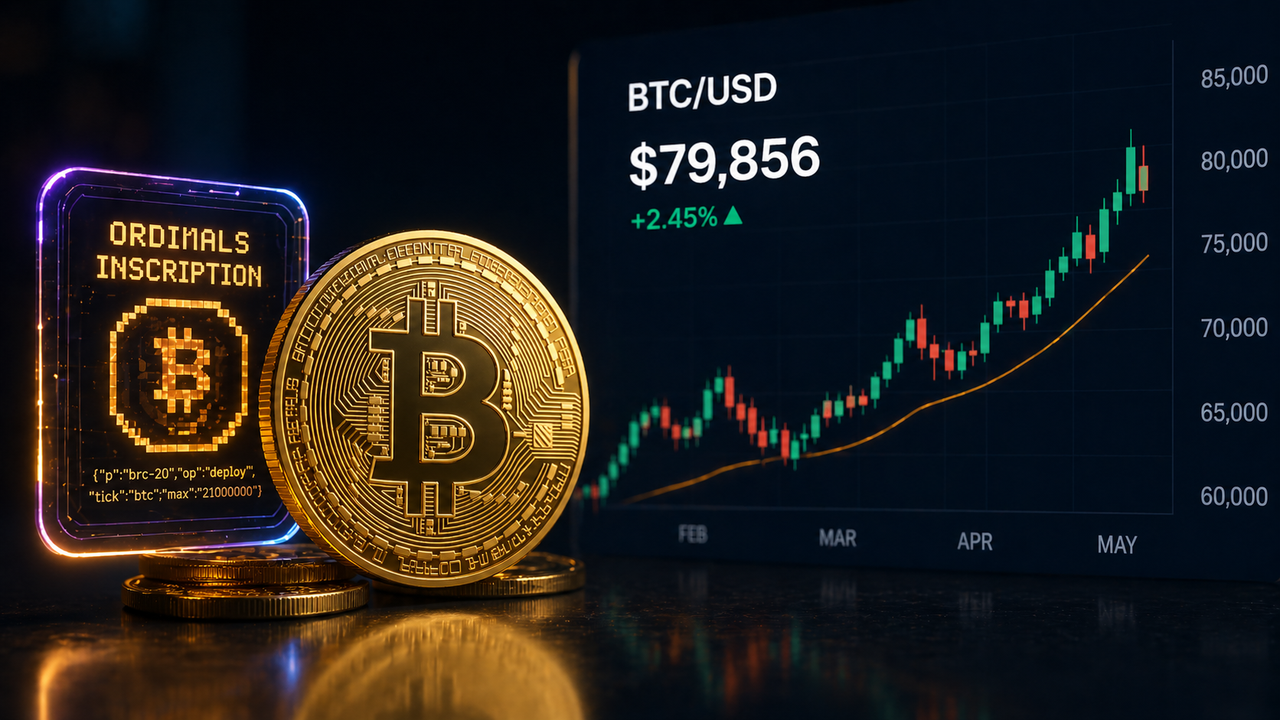
The Bitcoin landscape has shifted dramatically in 2026, evolving from a passive store of value into a vibrant ecosystem of decentralized applications and digital artifacts. As institutional adoption reaches unprecedented levels through spot ETFs, the introduction of the Ordinals protocol has redefined the network's utility. Understanding these technical shifts is now essential for every crypto investor.
In this comprehensive guide, we analyze How Ordinals Work and the specific factors driving the Bitcoin Price as we head into the high-stakes month of May.
Key Takeaways
-
Technological Shift: The Ordinals protocol has transformed Bitcoin's smallest unit, the Satoshi, into a unique vessel for data, enabling NFTs and tokens directly on-chain.
-
Market Sentiment: As of late April 2026, Bitcoin is consolidating near the $80,000 mark, with technical indicators suggesting a volatility expansion in May.
-
Institutional Influence: Spot Bitcoin ETFs now command a significant portion of the circulating supply, creating a "supply shock" that acts as a price floor.
-
Infrastructure Maturity: Specialized wallets like Xverse and UniSat have become the industry standard for managing complex UTXO-based assets safely.
Unlocking the Protocol: How Do Ordinals and BRC-20 Work on Bitcoin?
The Bitcoin network was originally designed for peer-to-peer electronic cash, but the "Taproot" upgrade of 2021 inadvertently opened the door for much more. By 2026, the Ordinals protocol has matured from a niche experiment into a multi-billion dollar economy.
Beyond Transactions: The Rise of Ordinals and Satoshi Inscriptions
At the heart of this revolution is the concept of "Ordinals Theory." This theory assigns a specific number to every one of the 2.1 quadrillion Satoshis (sats) in existence, based on the order in which they were mined. Once a sat is numbered, it can be "inscribed" with data—such as images, text, or even software.
Unlike traditional NFTs on Ethereum, which often store metadata on centralized servers (IPFS or AWS), Bitcoin Ordinals are "Digital Artifacts." This means the data is stored permanently and immutably within the Bitcoin witness data itself. If the Bitcoin network exists, the inscription exists.
The BRC-20 Framework: Using JSON Data to Create Fungible Tokens
Following the success of image-based inscriptions, developers introduced the BRC-20 standard. This is a clever hack that uses JSON (JavaScript Object Notation) text inscriptions to simulate the functionality of fungible tokens.
By inscribing specific commands like "deploy," "mint," and "transfer," users can create tokens that look and act like Ethereum's ERC-20 tokens but reside entirely on the Bitcoin blockchain. While BRC-20s lack smart contract logic, their simplicity and the security of the Bitcoin network have made them a favorite for meme coins and community-driven projects in 2026.
Indexers & Infrastructure: How the Ecosystem Tracks Assets Off-Chain
Because Bitcoin's base layer does not "know" that a specific satoshi is a BRC-20 token, the ecosystem relies on Indexers. These are off-chain databases that watch the blockchain, read the JSON inscriptions, and keep a ledger of who owns what.
-
Centralized Indexers: Faster and easier to use, often provided by exchanges.
-
Decentralized Indexers: Community-run nodes that ensure no single entity can manipulate the token balance.
-
Verification: Modern platforms now use "cross-indexing" to ensure that all data is consistent across different providers, preventing the double-spending of inscriptions.
Bitcoin vs. Ethereum: Why Inscriptions Differ from Smart Contracts
It is vital to distinguish between a Bitcoin inscription and an Ethereum smart contract. Ethereum tokens are managed by a self-executing piece of code. In contrast, Bitcoin BRC-20 tokens are essentially "scribbles" on a Satoshi that we all agree represent a certain value.
-
Immutability: Bitcoin inscriptions are generally harder to change or delete once confirmed.
-
Cost: Inscribing on Bitcoin can be significantly more expensive during periods of high congestion.
-
Simplicity: Bitcoin tokens are less prone to "smart contract hacks" because there is no complex code to exploit.
Market Forecast: What is the Bitcoin Price in May 2026?
Predicting the Bitcoin Price requires a blend of on-chain data, technical analysis, and an understanding of the current macroeconomic environment. As we transition into May 2026, the market is at a pivotal "make-or-break" point.
Chasing $80,000: Current Market Momentum Heading into May
As of April 29, 2026, Bitcoin is trading in a tight range between $77,500 and $79,800. The $80,000 level is not just a psychological barrier; it is a heavy resistance zone where significant "short" positions are clustered. A decisive daily close above $80,000 would likely trigger a "short squeeze," propelling the price rapidly into the mid-$85,000s. Technical indicators like the RSI (Relative Strength Index) show that Bitcoin is not yet overbought, suggesting there is still "fuel in the tank" for a May rally.
The ETF Multiplier: How Institutional Inflows Dictate Price Floors
In 2026, the influence of Spot Bitcoin ETFs (like BlackRock’s IBIT and Fidelity’s FBTC) cannot be overstated. These funds have shifted the market dynamics from retail-driven speculation to institutional accumulation.
-
Daily Absorption: ETFs are currently absorbing roughly 8x the daily amount of Bitcoin produced by miners.
-
HODL Culture: These institutions rarely "panic sell," which has created a much higher price floor compared to previous cycles.
-
The "Halving" Echo: Two years after the 2024 halving, the supply scarcity is finally being fully felt in the spot markets.
Macro Watch: Fed Policy Shifts and Global Liquidity in Q2 2026
The Bitcoin Price remains sensitive to global liquidity. In May 2026, all eyes are on the Federal Reserve. Rumors of a 25-basis-point rate cut to stimulate a cooling economy are circulating. If the Fed signals a "dovish" pivot, Bitcoin—as the ultimate "hard money" asset—is expected to be the primary beneficiary of a weakening US Dollar. Conversely, if inflation data for April comes in higher than expected, we may see a temporary "risk-off" move where investors flee to cash.
Price Targets: Bullish $95K Breakout vs. Bearish $65K Correction
The consensus for May 2026 is split into two primary paths:
-
The Bull Case: A break above $80,000 leads to a target of $92,000 – $95,000. This would be driven by a combination of a "short squeeze" and a new wave of retail FOMO.
-
The Bear Case: Failure to hold the $75,000 support could result in a "liquidation flush" down to $65,000 – $68,000. This would likely be a "buy the dip" opportunity for institutional players, but painful for leveraged traders.
Strategic Tools: Top Wallets for Ordinals and BRC-20 Assets
Managing assets on Bitcoin requires more than just a standard address. Because How Ordinals Work involves specific Satoshis, you need a wallet that understands "UTXO Management."
Xverse and UniSat: 2026’s Leading Wallets for Asset Management
These two wallets have emerged as the "MetaMask of Bitcoin."
-
Xverse: Known for its user-friendly interface and strong security, it is the preferred choice for mobile users. It offers a beautiful gallery view for your Ordinals and easy swapping for BRC-20 tokens.
-
UniSat: The power-user's choice. It was the first to market with many BRC-20 features and offers an integrated marketplace. In 2026, its "inscribing-as-a-service" remains the fastest in the industry.
UTXO Protection: Safeguarding Your Rare Sats from Accidental Spending
The biggest risk in the Ordinals space is "spending your NFT." In a normal Bitcoin transaction, your wallet picks a "Unspent Transaction Output" (UTXO) to pay for a cup of coffee. If that UTXO happens to contain an expensive Ordinal, it’s gone forever.
Modern wallets now feature UTXO Locking. This automatically freezes any Satoshi that has an inscription or is identified as a "Rare Sat" (e.g., a sat from the 2009 Genesis era), ensuring it remains safe in your vault while you spend your regular BTC.
Layer 2 Expansion: Scaling Bitcoin via Fractal and Stacks Integration
By May 2026, the high fees on Bitcoin Layer 1 have pushed many users toward Layer 2 solutions.
-
Fractal Bitcoin: A "recursive" scaling solution that allows for much faster BRC-20 trading without leaving the Bitcoin security model.
-
Stacks (STX): A smart contract layer that brings DeFi to Bitcoin. Leading wallets now allow you to bridge your BRC-20 tokens to Stacks to earn yield.
The Evolution of Value: Beyond the May Price Action
While the Bitcoin Price in the short term is exciting, the long-term structural changes are what truly matter. Bitcoin is no longer just "Digital Gold"; it is becoming a "Digital Platform."
From BRC-20 to Runes: The Next Generation of Bitcoin Token Standards
The BRC-20 standard, while revolutionary, is inefficient because it creates a lot of "junk" data (UTXO bloat). Entering May 2026, the Runes protocol has largely superseded BRC-20 for high-volume tokens. Runes are more "Bitcoin-native," using the OP_RETURN field to stay lightweight and minimize fees. Investors should watch for the migration of liquidity from old BRC-20 tokens into the newer, more efficient Runes ecosystem.
Institutional Utility: Why "Digital Gold" is Becoming a "Digital Platform"
Wall Street has realized that Bitcoin’s block space is the most valuable real estate in the digital world. Beyond ETFs, we are seeing insurance companies and sovereign wealth funds use Ordinals to notarize legal documents and settle high-value contracts on the most secure ledger ever created. This "Utility Premium" is a new fundamental driver for the Bitcoin Price that didn't exist in previous cycles.
Conclusion
In summary, the month of May 2026 represents a critical juncture for both the technology and the market value of the world's premier cryptocurrency. Understanding How Ordinals Work—from the technical nuances of Satoshi inscriptions to the efficiency of the Runes protocol—is no longer optional for those seeking to maximize their returns. As the Bitcoin Price continues to challenge the $80,000 resistance level, supported by massive institutional ETF inflows and a favorable macroeconomic backdrop, the potential for a breakout toward $95,000 remains high. Whether you are a long-term HODLer or a BRC-20 trader, the Bitcoin ecosystem is proving to be the most resilient and innovative sector in the financial world.
FAQ
Q: Is it safe to buy BRC-20 tokens on a crypto exchange?
Yes, most major exchanges in 2026 have integrated secure indexers. However, for long-term storage, it is always recommended to use a self-custody wallet like Xverse to ensure you truly own the private keys to your inscriptions.
Q: How does the Bitcoin Price usually behave in May?
Historically, May can be a volatile month. While the "Sell in May" adage exists in traditional stocks, Bitcoin often sees a "spring rally" driven by increased network activity and late-Q2 liquidity injections into the crypto markets.
Q: What happens if I accidentally spend an Ordinal?
Unfortunately, if a satoshi inscribed with an Ordinal is sent as a regular transaction fee, it is generally considered lost unless you can contact the miner who processed the block. This is why using a wallet with UTXO protection is mandatory.
Q: Does the growth of Ordinals make Bitcoin slower?
While Ordinals increase the demand for block space, they do not slow down the "speed" of the blockchain. They do, however, increase transaction fees. This is why Layer 2 solutions like Stacks and Fractal are becoming so popular in 2026.
Q: Will Bitcoin Price hit $100,000 in 2026?
Many analysts believe that if the current momentum holds through May and June, a six-figure Bitcoin is almost inevitable by the end of Q3 2026, provided that institutional ETF inflows remain steady and the macro economy avoids a hard landing.