

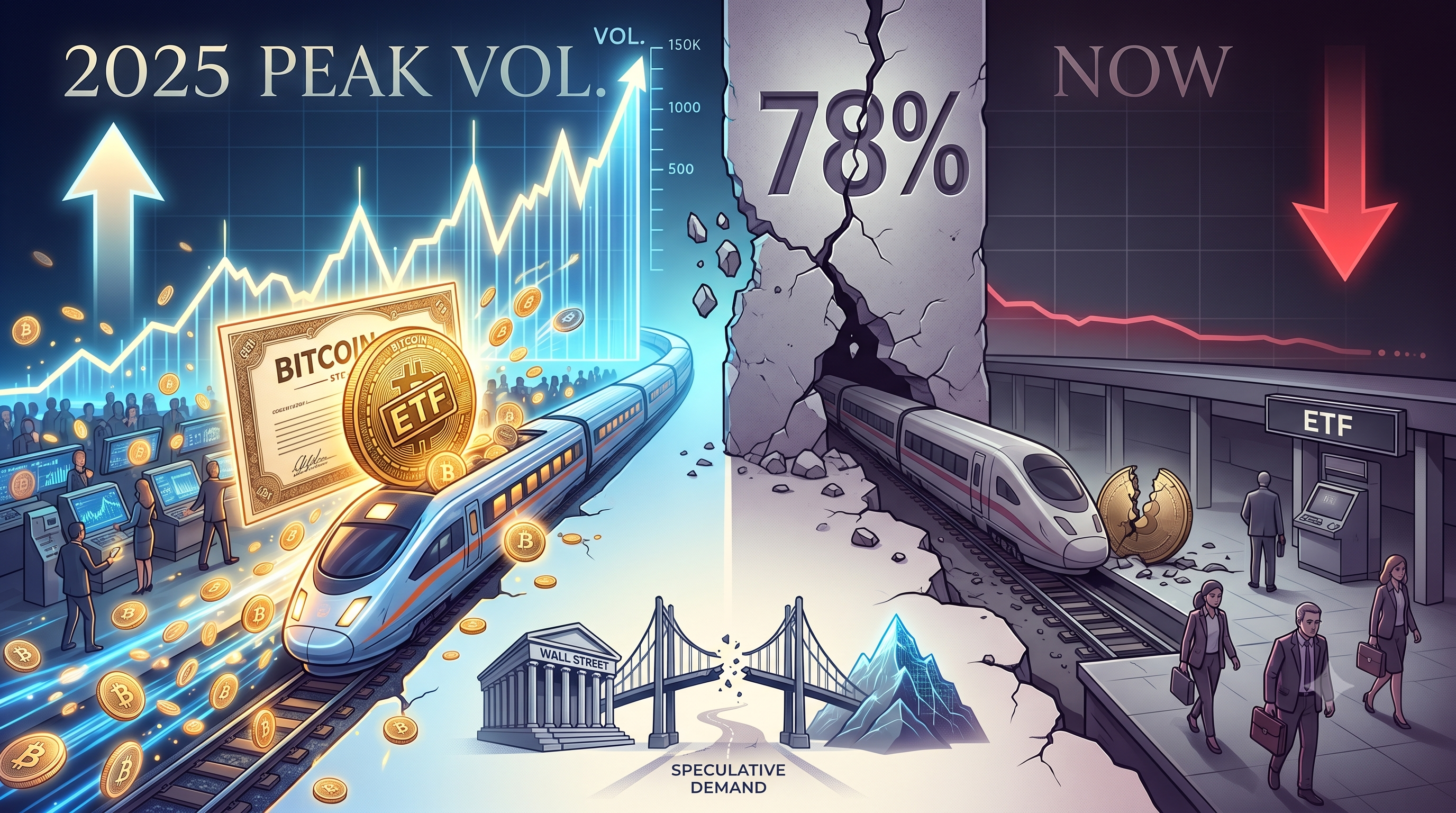
Bitcoin ETF Trading Volume Plummets 78% from 2025 Peak: Traditional Market Speculative Demand Fades Sharply
2026/06/17 12:49:00
Bitcoin ETF Volume and Analysis
The sharp contraction in Bitcoin ETF trading activity marks a notable move in how traditional finance engages with the leading cryptocurrency. What began as explosive enthusiasm following the 2024 approvals has given way to measured caution as broader economic conditions and internal market mechanics reshape participation. This decline shows not just reduced liquidity in ETF shares but a deeper recalibration of speculative appetite in established investment channels. Investors who rushed in during the height of momentum are now exhibiting greater selectivity, influenced by realized gains from previous rallies and a reassessment of risk-reward profiles in volatile assets. The transition highlights the maturing relationship between conventional portfolios and digital assets, where initial novelty gives way to pragmatic evaluation based on performance consistency and macroeconomic alignment.
Report from on-chain analytics firms underscores this evolution, showing how trading patterns have adjusted across multiple traditional access points. As Bitcoin navigates a consolidation phase near current levels, the reduced velocity in ETF share turnover provides insights into changing investor behavior, emphasizing sustainability over rapid turnover. This development carries implications for market structure, liquidity provision, and the broader integration of cryptocurrency within diversified investment strategies employed by wealth managers and institutional allocators worldwide. The 78% plunge in the 30-day moving average of U.S. spot Bitcoin ETF trading volume from $4.4 billion per day in October 2025 to approximately $960 million today underscores a significant fading of traditional market speculative demand, driven by profit-taking, macroeconomic pressures, and a transition toward more selective institutional strategies that prioritize long-term holding over short-term trading.
Glassnode Data Reveals Steep Decline in ETF Liquidity Metrics
Glassnode's recent analysis shows the 30-day moving average of daily trading volume for U.S. spot Bitcoin ETFs falling dramatically from $4.4 billion in October 2025 to $960 million as of mid-June 2026. This contraction represents one of the most pronounced drops in activity since the products launched, pointing to diminished turnover rather than outright abandonment. Lower volumes translate to potentially wider bid-ask spreads during periods of stress and reduced efficiency for large institutional orders, although major funds continue to offer competitive depth compared to smaller alternatives. Market participants note that while assets under management remain substantial, hovering around $80-100 billion across major funds despite recent outflows, the pace of share trading has slowed considerably, reflecting a shift toward strategic positioning. This environment favors patient capital over high-frequency strategies, altering the risk profile for traders seeking quick exposure through regulated vehicles.
Factors such as Bitcoin's price consolidation near $63,000-$65,000 levels after steeper declines earlier in the year contribute to this hesitation, as investors await clearer directional signals amid mixed economic indicators. The data also correlates with broader spot market trends, where exchange volumes have similarly moderated, suggesting a coordinated pullback in leveraged or momentum-driven positions across traditional access points. Additional context from treasury company trading volumes, which fell 49% over a similar period, reinforces the narrative of cooling speculative interest in Bitcoin-related equities. This liquidity recalibration encourages a focus on fundamental metrics like network security, adoption rates, and macroeconomic correlations rather than short-term price action alone.
Context of 2025 Peak Activity and Subsequent Normalization
October 2025 represented the zenith of post-approval euphoria, with Bitcoin reaching highs near $126,000 and ETFs capturing intense inflows alongside elevated trading activity that routinely exceeded several billion dollars daily. Daily volumes surged as retail and institutional flows converged through familiar brokerage platforms, driven by FOMO and strong performance narratives. The subsequent normalization stems from profit realization after substantial gains, coupled with macroeconomic headwinds including interest rate considerations, geopolitical tensions, and risk-off sentiment in equities and other risk assets. As Bitcoin corrected sharply from those peaks, many participants who entered during the frenzy opted to scale back exposure, leading to sustained but lower-intensity activity across the ETF complex.
This phase illustrates the maturation of the ETF market, moving from novelty-driven hype to a more established, albeit quieter, integration within portfolios. Comparative analysis with traditional asset classes shows similar patterns where initial surges in new products eventually stabilize at levels supported by fundamental demand rather than speculative excess. Current volumes, while markedly lower, still exceed pre-2024 benchmarks for crypto exposure, indicating resilience in the underlying infrastructure even as speculative fervor subsides. Furthermore, cumulative trading volumes for U.S. spot Bitcoin ETFs have approached or surpassed $2 trillion since inception, demonstrating the scale of adoption despite the recent slowdown. This historical perspective helps frame the current environment as a healthy consolidation period, where reduced trading activity allows the market to digest prior gains and prepare for potential future catalysts.
Impact on Major Issuers Including BlackRock and Fidelity Products
Flagship offerings like BlackRock's IBIT and Fidelity's FBTC, which dominate assets under management with tens of billions each, have experienced proportional volume reductions while maintaining significant market share in the category. These large funds continue to provide deep liquidity pools relative to smaller peers, yet overall turnover reflects broader caution among participants. Institutional allocators appear to favor strategic accumulation over tactical trading, resulting in steadier but less volatile share activity that supports underlying price stability during quieter periods. For instance, periods of net outflows earlier in 2026 coincided with price weakness, reinforcing a feedback loop where reduced trading amplifies perceived illiquidity signals in certain market conditions.
This dynamic pressures smaller ETFs more acutely, potentially accelerating consolidation toward established names with stronger brand recognition and operational track records. The shift underscores how scale and brand trust influence behavior in a maturing category, with larger issuers better positioned to weather demand fluctuations through diversified investor bases. BlackRock's IBIT, in particular, has consistently led in inflows and trading dominance, capturing a substantial portion of available capital even as total activity declines. Such concentration shows the importance of issuer reputation and product structure in sustaining engagement. Detailed flow data reveals resilience in core holdings despite volume changes, with total Bitcoin held by ETFs remaining a meaningful percentage of the circulating supply.
Broader Traditional Finance Sentiment Toward Crypto Exposure
Traditional market participants, including wealth managers, pension funds, and family offices, have adjusted allocations amid competing opportunities in fixed income, equities, and alternative investments offering more predictable yields. The decline in ETF volumes mirrors a broader reassessment of crypto's correlation with risk assets during periods of economic uncertainty and shifting monetary policy expectations. While dedicated crypto funds maintain exposure, crossover interest from generalist portfolios has tempered, prioritizing diversification benefits and long-term portfolio construction over aggressive outperformance bets on volatile assets. Surveys and flow data indicate a preference for core holdings rather than satellite positions traded frequently, aligning with fiduciary responsibilities and risk management frameworks. This evolution supports Bitcoin's transition toward a store-of-value narrative, appealing to long-horizon investors less sensitive to short-term volume metrics or daily price fluctuations.
Consequently, the market structure evolves to support sustained but less frenetic engagement, fostering deeper integration within traditional asset allocation models. Advisors increasingly emphasize education on Bitcoin's unique properties, such as scarcity and decentralization, to build conviction among clients. The reduced speculative component allows for more measured analysis of how digital assets fit alongside bonds, stocks, and commodities in balanced portfolios. This sentiment move contributes to overall market stability while challenging short-term traders who relied on high-liquidity environments. Natural extensions include using established exchanges for perpetual futures to complement ETF strategies during transitional phases.
Macroeconomic Factors in Dampening Speculative Flows
Persistent inflation concerns, central bank policies, and geopolitical developments have contributed to risk aversion, directly impacting speculative demand channeled through ETFs and related vehicles. Higher-for-longer rate expectations reduce the appeal of non-yielding assets like Bitcoin for leveraged plays, prompting capital rotation toward perceived safe havens or higher-yield alternatives in traditional markets. As equities and other risk assets grapple with these variables, Bitcoin experiences parallel effects, with ETF activity reflecting broader de-risking trends across investor cohorts. Bitcoin's price action around $63,000-$65,000 in June 2026 reflects this equilibrium, where fundamental adoption metrics persist but short-term trading enthusiasm wanes amid uncertainty over Federal Reserve decisions and global growth prospects.
This macro overlay provides critical context for interpreting volume data beyond isolated crypto events, revealing how interconnected financial systems influence digital asset participation. Recent outflows totaling billions during multi-day streaks illustrate sensitivity to these pressures, yet resilient AUM levels suggest underlying conviction among core holders. Analysts point to potential recovery paths tied to easing cycles or positive growth data that could rekindle interest. Understanding these dynamics equips investors to contextualize short-term volume declines within longer-term economic cycles.
On-Chain and Derivatives Market Divergence from ETF Trends
While ETF volumes have contracted sharply, certain on-chain indicators and derivatives open interest reveal pockets of sustained activity among more sophisticated participants who engage directly with the underlying asset. However, the traditional gateway via ETFs shows clearer signs of fatigue among speculative cohorts within regulated channels. This divergence highlights segmented market participation, where direct holders and futures traders operate with different timeframes and risk tolerances compared to ETF users seeking simplified exposure. The reduced ETF turnover may limit arbitrage efficiency between spot and derivatives markets, influencing overall pricing discovery and liquidity transmission across venues. Understanding these layers offers nuanced insight into the health of Bitcoin's ecosystem beyond headline figures, revealing how different investor segments respond to prevailing conditions.
On-chain metrics such as active addresses and transaction volumes provide complementary signals of network utility that persist independently of traditional finance flows. Derivatives markets continue to facilitate hedging and speculation, often with higher leverage options that appeal to experienced traders. This multi-faceted structure strengthens overall resilience, as weakness in one segment does not uniformly impact the entire ecosystem. Investors benefit from monitoring these divergences to inform allocation decisions, potentially incorporating exchange-based tools for a fuller picture of market dynamics.
Institutional Adaptation and Long-Term Holding Patterns
Many institutions have shifted toward buy-and-hold strategies with ETFs, contributing to lower daily trading volumes as positions are established rather than frequently rotated in response to short-term signals. This behavior supports price floors during drawdowns but reduces the velocity of capital flow, promoting greater stability over time. Data on holdings shows ETFs collectively representing a meaningful portion of Bitcoin's supply, around 5-7%, locked in trusted vehicles, signaling confidence in the asset's infrastructure despite muted trading activity. Such adaptation reflects growing comfort with custody solutions, regulatory frameworks, and operational efficiencies that have improved since initial launches.
The long-term orientation aligns with Bitcoin's maturing role as a portfolio diversifier, where volatility is viewed through the lens of asymmetric upside potential over multi-year horizons. Institutions increasingly incorporate scenario analysis and stress testing to evaluate crypto allocations alongside traditional holdings. This evolution may lead to more predictable flow patterns in the future, reducing extreme swings associated with earlier hype cycles. Practical examples include pension funds and endowments gradually increasing exposure percentages as familiarity grows. The current phase tests and reinforces institutional conviction, potentially paving the way for expanded adoption when macroeconomic conditions become more supportive.
Comparative Analysis with Other Crypto Investment Vehicles
Relative to futures-based products or direct spot trading on exchanges, ETFs offered a regulated on-ramp that initially drove exceptional volumes through accessibility and familiarity for traditional investors. The current lull suggests saturation among early adopters within traditional finance, with remaining interest concentrated in specific use cases like portfolio rebalancing or tactical overlays. Other vehicles, including offshore options or decentralized protocols, may capture some displaced activity, though regulatory preferences and compliance requirements keep much capital within ETF wrappers for institutional mandates.
This comparison illuminates the unique role ETFs play in bridging conventional and digital asset markets, providing transparency and investor protections that appeal to fiduciary standards. Direct exchange trading often features higher liquidity in certain pairs and additional features like margin capabilities, offering flexibility that complements ETF holdings. Futures products enable efficient hedging against spot exposure obtained via ETFs. The coexistence of these vehicles enhances overall market robustness, allowing participants to select methods best suited to their objectives and constraints. As volumes normalize in ETFs, cross-venue analysis becomes increasingly valuable for optimizing execution and risk management.
Implications for Bitcoin Price Discovery and Market Depth
Lower ETF trading volumes can influence short-term price discovery by reducing one channel of transparent demand signaling visible to traditional market observers. However, the concentration in major funds preserves core liquidity, mitigating extreme dislocations and supporting orderly trading even during volatility spikes. As speculative demand fades, price movements may increasingly reflect underlying network fundamentals, mining economics, corporate treasury adoption, and global macroeconomic trends rather than retail-driven ETF flows alone. This maturation potentially benefits long-term stability while challenging short-term traders reliant on high liquidity for frequent position adjustments.
Analysts monitor these shifts closely for indications of evolving market regimes, noting how reduced turnover correlates with steadier price action in consolidation phases. The interplay between ETF activity and broader spot markets continues to evolve, with ETFs now accounting for a substantial share of U.S. Bitcoin trading historically. Implications extend to options markets and structured products built around ETF performance. Greater emphasis on on-chain data and developer activity provides alternative signals for price formation. Investors should consider these factors when assessing entry points and portfolio construction in the current environment.
Outlook for ETF Product Innovation and Adoption
Product developers continue exploring enhancements such as options overlays, basket strategies incorporating multiple assets, or improved yield mechanisms to reignite engagement among traditional investors. Success depends on broader sentiment recovery, favorable regulatory developments, and alignment with evolving investor preferences for sophisticated yet accessible products. The infrastructure built around ETFs positions the sector for renewed growth when macroeconomic conditions align favorably with risk assets. Potential expansions into related assets or improved tax treatments could broaden appeal to new demographics, including retirement accounts and international participants.
In the interim, the focus remains on operational efficiency, advisor education, and marketing efforts that highlight Bitcoin's long-term attributes. This period of consolidation tests the resilience of the ETF framework established in prior years while encouraging innovation that addresses current limitations in liquidity and product variety. Industry participants anticipate a gradual recovery in volumes tied to price catalysts and capital inflows. Educational initiatives play a key role in sustaining momentum, helping demystify crypto for hesitant allocators. The outlook remains constructive given the foundational progress achieved to date.
Lessons from Historical Crypto Market Cycles
Past cycles demonstrate that periods of declining volumes often precede renewed accumulation phases as weak hands exit and conviction builds among remaining participants with stronger fundamentals. The current environment echoes elements of previous corrections, where speculative excess gave way to fundamental reevaluation and healthier market structures. Applying these historical parallels suggests the 78% volume drop may represent a healthy reset rather than a terminal decline, provided network metrics, hash rate stability, and adoption trends remain positive over time. Contextualizing the present within longer arcs provides perspective for investors navigating volatility, emphasizing patience and disciplined approaches rather than reactive trading.
Historical data shows Bitcoin's resilience through multiple bear phases, with each recovery cycle building on prior infrastructure developments. Lessons include the importance of diversification, risk management, and focusing on utility growth rather than price alone. Cycles also shows how traditional finance integration evolves incrementally, with setbacks serving as learning opportunities. This framework aids in maintaining composure during volume contractions and positioning for subsequent upturns.
Strategic Considerations for Investors in Current Conditions
Investors evaluating Bitcoin exposure through ETFs should prioritize understanding liquidity profiles of individual funds and aligning time horizons with observed volume trends to optimize outcomes. Dollar-cost averaging or rebalancing protocols may prove more effective than attempting to time entries amid subdued activity and uncertain near-term catalysts. Diversification across access methods, including checking Bitcoin price movements, can complement ETF holdings by offering additional market insights, execution flexibility, and educational resources. Monitoring on-chain data alongside traditional metrics equips participants to make informed decisions in this transitional phase, balancing regulated simplicity with direct market opportunities.
Practical strategies involve setting clear allocation targets, implementing stop-loss or rebalancing rules tailored to personal risk tolerance, and staying informed on macroeconomic developments that influence crypto correlations. Regular portfolio reviews help adjust to changing conditions without overreacting to daily fluctuations. This measured approach supports sustainable participation while mitigating risks associated with liquidity shifts.
Interplay Between ETF Flows and Overall Crypto Ecosystem Health
ETF dynamics interact with exchange activity, DeFi protocols, corporate balance sheets, and mining operations to shape overall ecosystem vitality and development trajectory. The volume contraction in traditional channels encourages innovation elsewhere, such as in perpetual futures, tokenized products, and layer-two solutions that enhance scalability and usability. Platforms facilitating advanced trading options provide avenues for sophisticated risk management that complement spot ETF strategies, creating a symbiotic relationship across market segments. This interconnectedness ensures that while one segment cools, overall development continues, fostering a more robust, multifaceted market structure over time that benefits from diverse participation.
Ecosystem health metrics, including developer contributions and transaction throughput, remain important indicators independent of ETF volumes. Corporate adoption by public companies adds another layer of demand that supports price floors. The interplay promotes resilience, as capital can flow between different vehicles depending on regulatory, economic, or technological factors. Long-term observers note how such dynamics contribute to Bitcoin's antifragile properties, strengthening the network through varied use cases and investor profiles. This comprehensive view aids in understanding why temporary volume dips do not necessarily signal broader weakness.
FAQs
What are the main drivers behind the 78% drop in Bitcoin ETF trading volume?
The primary drivers include profit-taking following the 2025 price peak, macroeconomic risk aversion due to interest rates and global uncertainties, and a natural maturation where early speculative entrants reduce activity in favor of longer-term positioning within portfolios. Glassnode data confirms the move from high-turnover euphoria to steadier participation, with traditional investors recalibrating exposure amid Bitcoin trading near $63,000-$65,000 levels in mid-2026.
How does reduced ETF volume affect liquidity and trading costs for investors?
Lower volumes can lead to modestly wider spreads and potentially higher slippage for large orders, particularly in less prominent funds, though leaders like IBIT retain substantial depth and tight execution. Investors benefit from focusing on high-AUM products during this phase while utilizing supplementary platforms for real-time data. The market remains functional for institutional-scale activity despite the decline from peak levels, with major issuers maintaining operational efficiency.
Will Bitcoin ETF trading volumes recover, and under what conditions?
Recovery likely hinges on positive catalysts such as favorable macroeconomic shifts, renewed corporate adoption, Bitcoin breaking key resistance levels with conviction, or easing monetary policies that boost risk appetite. Historical patterns show volumes rebounding with price momentum and fresh inflows from new participants. Continued infrastructure development and advisor education will support higher sustained activity over time.
What strategies should long-term investors adopt given current ETF dynamics?
Long-term investors should emphasize dollar-cost averaging into established ETFs, maintain diversified portfolios across asset classes, and avoid overreacting to short-term volume fluctuations that may not reflect underlying value. Focusing on Bitcoin's scarcity, network security, and growing institutional acceptance rather than daily trading noise supports disciplined accumulation during consolidation periods. Regular review of allocation percentages ensures alignment with evolving goals and risk profiles.
How do current volumes compare to pre-ETF approval eras?
Even at reduced levels, today's ETF volumes significantly exceed crypto exposure options available before 2024 approvals, representing substantial progress in accessibility and scale. The infrastructure now supports tens of billions in AUM with regulated, transparent access that was previously limited to sophisticated players. The 78% drop is from an extraordinary 2025 peak rather than baseline inactivity, indicating healthy normalization within a much larger overall market ecosystem that includes diverse participation channels.
What role do platforms like KuCoin play amid declining traditional ETF activity?
Platforms like KuCoin offer complementary access through spot markets, perpetual futures, and educational resources on trading strategies, enabling users to engage directly with Bitcoin and diversify beyond ETF vehicles during tempered traditional demand. This flexibility proves valuable for real-time execution, hedging, and exploring advanced features that enhance portfolio management in evolving conditions. Users can seamlessly integrate insights from margin trading strategies with traditional holdings for balanced exposure.
Disclaimer: This content is for informational purposes only and does not constitute investment advice. Cryptocurrency investments carry risk. Please do your own research (DYOR).