

Best Hook Crypto Tokens to Buy: Uniswap v4 vs Hooked Protocol
2026/05/29 16:38:00
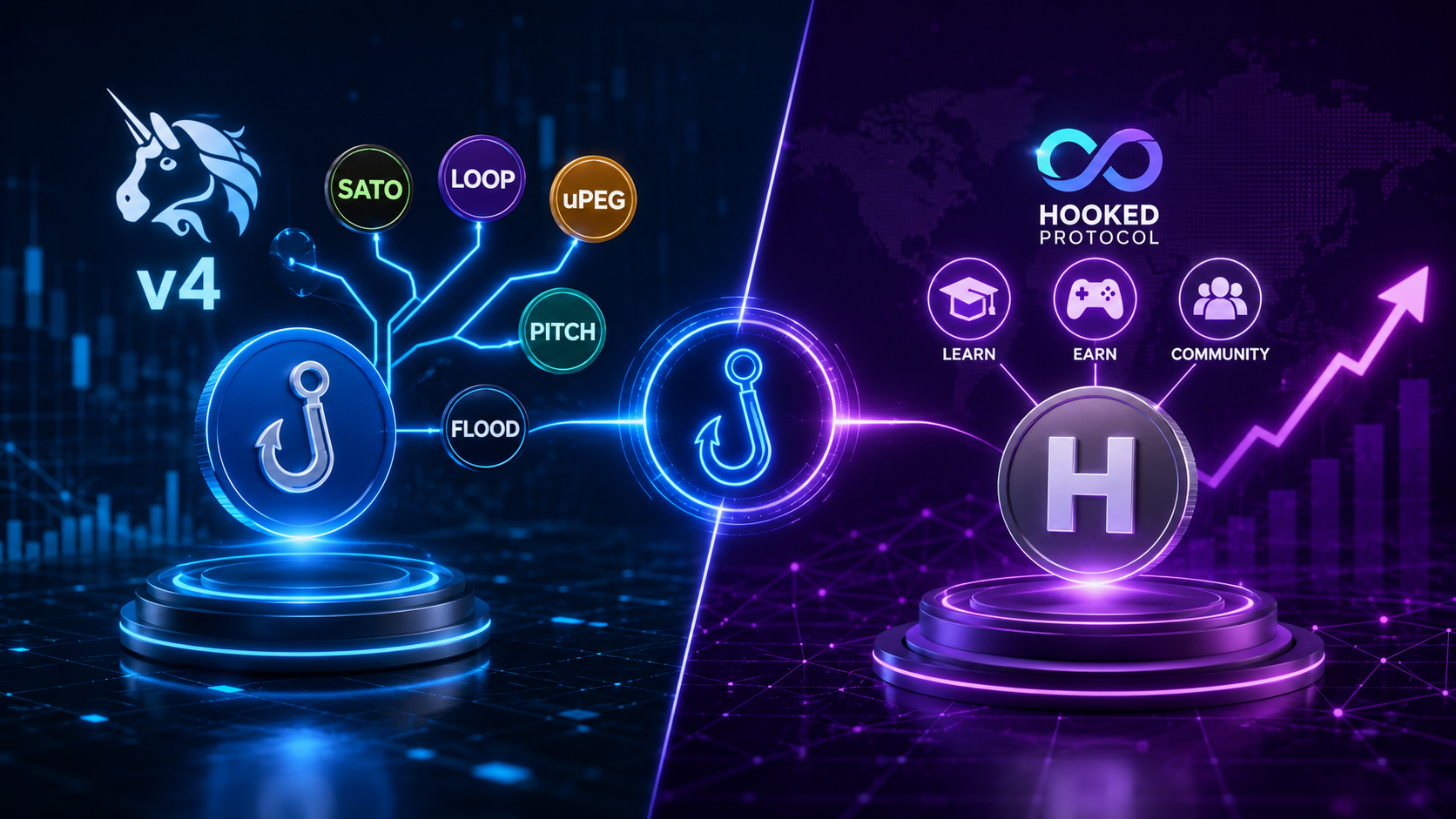
The cryptocurrency market in 2026 is experiencing a fascinating structural shift as retail traders and institutional allocators search for high-growth narratives. Among the most trending but widely misunderstood sectors is the Hook ecosystem, which has recently captivated the decentralized finance world with explosive double-digit and triple-digit daily percentage gains. Navigating this fast-moving space requires distinguishing between fundamentally distinct blockchain architectures and market segments.
In this comprehensive guide, we will break down the best Hook sector options available today, contrasting the algorithmic innovation of Uniswap v4 implementations with the structured educational utility of Hooked Protocol, helping you deploy your capital safely on KuCoin.
Key Takeaways
Before diving into the technical architectures and specific on-chain metrics of individual digital assets, it is helpful to establish a foundational baseline of the ecosystem. The market dynamics governing these assets are fast-moving, making a high-level summary essential for strategic positioning:
-
Dual-Narrative Ecosystem: The term "Hook" currently applies to two completely separate market sectors: Uniswap v4 programmatic liquidity hooks and the Hooked Protocol ecosystem.
-
High-Beta Momentum: On-chain tokens utilizing Uniswap v4 Hook principles, such as SATO and uPEG, have experienced immense capital inflows, making them prime targets for active swing traders.
-
Algorithmic Innovation: New DeFi mechanics, including Lo0p’s localized lending pools with native Loan-to-Value guarantees, are redefining decentralized asset sustainability.
-
Long-Term Utility vs. Short-Term Speculation: While traditional governance tokens like HOOK focus on structured Web3 education and scalable mass adoption, new protocol hooks operate as volatile, high-yield assets.
-
Risk Mitigation Parameters: Successful asset allocation within this vertical requires utilizing tools like GMGN and DEXTools alongside a rigorous auditing framework.
Understanding the Hook Narrative in 2026 Crypto Market
The digital asset space is defined by its evolving terminology, where a single keyword can come to represent completely disparate investment strategies. To successfully navigate the current market landscape, market participants must untangle the technical and conceptual layers that form the broader Hook narrative.
What is Hooked Protocol ($HOOK) and Its Web3 EdTech Ecosystem?
Hooked Protocol emerged as an institutional-grade Web3 gamified social learning platform designed to solve the critical challenge of user onboarding and mass adoption. Backed by top-tier venture capital entities including Binance Labs and Animoca Brands, the project built a robust ecosystem around incentivized learning models.
By utilizing applications like Wild Cash, the platform successfully converted millions of web2 users into active on-chain participants through an innovative "Learn-and-Earn" architecture. The native governance asset, HOOK, serves as the core utility backbone of this ecosystem, enabling gas payment frameworks across specialized application networks, governance voting mechanisms, and access to exclusive platform rewards.
What are Uniswap v4 Hooks and Their Innovative AMM Mechanics?
In stark contrast to a standalone consumer application protocol, Uniswap v4 introduced "Hooks" as a fundamental overhaul of automated market maker architecture. In the v4 paradigm, hooks are external smart contracts that integrate seamlessly with a centralized liquidity repository known as the PoolManager.
These external smart contracts can intercept execution flows at ten highly granular checkpoints during a lifecycle event—such as before or after a swap, or during liquidity modifications. This architectural shift allows developers to design highly customized liquidity pools with features like dynamic fee structures, automated Time-Weighted Average Market Makers (TWAMMs), and localized lending or oracle mechanisms directly embedded within the liquidity pool.
The Core Distinction: Why Investors Confuse These Two Token Sectors
The overlap of the term Hook has created significant semantic confusion across retail trading desks and automated data aggregators. This misunderstanding stems from a shared name applied to two radically different asset classes:
-
Hooked Protocol ($HOOK): Primary category is Web3 EdTech and mass onboarding. It uses a standard ERC-20 governance token architecture where its underlying value comes from platform utility, network fees, and user growth. Its risk matrix includes dilution from unlocks and regulatory updates.
-
Uniswap v4 Hook Tokens: Primary category is decentralized finance (DeFi) infrastructure. It uses algorithmic liquidity tokens or sub-protocols where its underlying value comes from localized pool fees, binding curves, and custom AMM code. Its risk matrix includes extreme smart contract vulnerability and liquidity flight.
Unwary traders executing market buy orders based purely on trending hashtag data frequently mistake algorithmic v4 experiments for updates to the Web3 educational ecosystem, and vice versa.
Top Hook Tokens to Buy in the Uniswap v4 Ecosystem
Driven by raw on-chain volume and an influx of decentralized trading capital, the programmatic Uniswap v4 Hook sector has birthed an array of independent tokens. These assets leverage advanced binding curves and innovative asset-pooling logic to capture market attention.
SATO: The Market Leader Driving the High-Volume Hook Trend
SATO has solidified its position as the undisputed market leader within the speculative v4 Hook landscape. According to recent trading data from on-chain tracking platforms like GMGN, SATO led a widespread market rally by posting an explosive 93% gain within a single 24-hour window. This massive surge propelled its localized market capitalization to peaks exceeding $30 million.
As a primary gauge for retail sentiment within the narrative, SATO’s trading liquidity is heavily dependent on continuous pool binding curves, meaning that every purchase permanently locks an exact portion of base assets into the pool’s underlying reserves. For high-beta narrative traders, SATO is viewed as the primary vehicle for capturing immediate capital inflows entering this structural trend.
LO0P: Revolutionary Hook with 40% LTV Lending Reserves
LO0P represents a major leap forward in merging algorithmic AMM hooks with native lending primitives. Rather than forcing users to sell tokens on the open spot market to realize profits—an action that inevitably sparks negative price momentum—LO0P introduces an embedded borrowing loop.
Users can purchase tokens via a continuous automated binding curve, deposit those tokens back into the pool’s customized hook infrastructure as collateral, and immediately borrow raw base assets up to a strict 40% Loan-to-Value (LTV) limit. This closed-loop financial system mitigates immediate selling pressure while providing active participants with functional capital efficiency directly out of the pool's asset reserves.
uPEG: The NFT-Integrated Hook Token with Explosive Gains
Bringing a unique angle to the narrative, uPEG blends Uniswap v4 infrastructure with non-fungible token fractionalization and sentiment trading. Within a compressed two-week window, uPEG’s valuation surged from absolute infancy to a market capitalization exceeding $34 million, accompanied by regular daily price expansions of over 38%.
The underlying code of the uPEG hook contract interacts directly with floor-price oracles, automating the rebalancing of liquidity pools based on the moving value of underlying digital collectable indexes. This cross-sector appeal makes it a highly favored asset among specialized NFT collectors and decentralized yield optimization funds alike.
PITCH & FLOOD: Emerging On-Chain Gems to Watch Closely
Rounding out the core matrix of this nascent sector are PITCH and FLOOD, two emerging sub-protocols displaying strong micro-structural accumulation patterns. PITCH has demonstrated substantial price elasticity, printing rapid 42% rallies off the back of localized changes in trading pool volume, while FLOOD relies on a proprietary dynamic fee hook that automatically increases fee distribution to liquidity providers when trading volatility spikes.
Both projects serve as classic examples of specialized, early-stage experiments where early positioning can yield dramatic upside, balanced by the constant presence of structural smart contract risks.
Analyzing $HOOK: Is Hooked Protocol Still a Good Investment?
While on-chain traders chase the explosive intraday volatility of new decentralized infrastructure experiments, the original ecosystem asset, HOOK, presents a fundamentally different thesis rooted in macro adoption metrics and platform scaling.
Hooked 2.0 and AI-Driven Web3 Mass Adoption Strategy
The long-term value proposition of Hooked Protocol relies primarily on its transition toward the Hooked 2.0 architecture. This upgraded framework integrates advanced artificial intelligence models with gamified social components to create an immersive digital learning environment. By partnering with leading AI computing networks and scalable Layer-2 scaling chains, the project has introduced a robust on-chain credential certification protocol known as Uni-Certs.
This program incentivizes students across international academic institutions to verify their Web3 knowledge directly on-chain. This focus on verifiable utility changes the asset’s perception from a purely speculative instrument into a critical onboarding network for enterprise and institutional applications.
Tokenomics Check: Managing Periodic Token Unlocks in 2026
A critical variable that any sensible market analyst must account for when managing a HOOK spot position is the schedule of structural token emissions and team unlocks. Throughout 2026, the protocol adheres to a programmatic release schedule designed to distribute tokens to community incentive pools, ecosystem development funds, and early private allocators.
Structural Supply Metric: Periodic major token unlocks introduce predictable supply expansions to the circulating market. Traders must carefully cross-reference these event timelines with broader market demand trends to protect against local dilution and downward price pressure.
Exchange Liquidity: Navigating Post-Delisting Trading Volumes
From a pure market structure perspective, the HOOK token has recently endured significant structural headwinds following strategic spot trading delistings across several major tier-one platforms. These structural changes have naturally decentralized the token’s overall liquidity distribution across alternative international venues:
-
KuCoin Accumulation: Order books show highly consistent institutional accumulation patterns and stable depth across persistent stablecoin pairs.
-
On-Chain DEX Liquidity: Automated market maker pools across native networks have seen a steady increase in wrapped base asset pairings, offsetting some centralized exchange volume drops.
-
Derivatives Volume: Open interest across perpetual contract markets remains highly liquid, enabling active hedging strategies despite shifting spot order book dynamics.
How to Evaluate High-Risk Hook Sector Tokens
Engaging with algorithmic assets and customized AMM pool structures requires an analytical framework that prioritizes capital preservation and deep data validation over social media hype.
Utilizing GMGN and DEXTools for On-Chain Data Analysis
When trading unverified or recently launched smart contracts within the v4 ecosystem, standard centralized exchange tools are entirely insufficient. Advanced practitioners rely heavily on real-time on-chain data scrapers like GMGN and DEXTools to audit live liquidity conditions.
These platforms allow users to inspect the precise distribution of token supply across individual wallet architectures, ensuring that insider addresses or deployment teams do not hold dangerous majorities of the total circulating supply. Furthermore, real-time transaction streams help identify automated front-running bots and MEV clusters that can artificially distort organic price discovery metrics.
Understanding Algorithmic Binding Curves and Liquidity Risks
Many newly launched v4 hook projects utilize mathematical models known as bonding or binding curves to programmatically dictate token pricing based on circulating supply. While this ensures that a pool always maintains a predictable quantity of asset reserves, it creates structural vulnerabilities during periods of market panic.
If capital flight occurs and a critical mass of participants sells back into the curve simultaneously, the mathematical pricing decay accelerates exponentially downwards. This structural feature can result in catastrophic drawdowns if a project fails to transition its liquidity away from the bonding phase and into a permanently locked standard AMM pool state.
Assessing Smart Contract Security and Audit Costs of V4 Hooks
The core promise of Uniswap v4 hooks is the ability to write custom logic to modify pool behavior, but this flexibility introduces an expanded surface area for smart contract exploits. A single logic flaw within a hook’s beforeSwap or afterAddLiquidity checks can expose the entire underlying pool to drainage via reentrancy attacks or flash loan manipulation.
Because auditing highly customized, state-dependent hook logic requires specialized smart contract security engineers, development teams face substantial auditing overhead. Investors must demand thoroughly vetted, public CertiK or Hacken audit reports before depositing significant capital into any active pool experiment.
Trading Strategy: Balancing Long-Term Value vs High-Yield Degens
Constructing a highly optimized digital asset portfolio within this niche requires a clear separation between short-term tactical speculation and structural long-term asset accumulation.
Aggressive Allocation: Capital Outflows into Top V4 Hook Coins
For active risk-tolerant swing traders, allocating a small percentage of discretionary capital into trending v4 hook experiments can yield substantial short-term returns during periods of intense narrative momentum. The tactical execution playbook for this methodology involves identifying assets like SATO or LO0P during the early stages of a volume spike, verifying the smart contract parameters via on-chain scanning tools, and taking structured profits aggressively as the token reaches predefined extensions of its automated binding curve.
Positions within this category must be actively managed and treated as purely speculative instruments with short holding timelines.
Conservative Accumulation: Dollar-Cost Averaging into $HOOK
Conversely, market participants focused on secular growth trends within the Web3 consumer ecosystem should look past short-term trading volatility and evaluate the fundamental scaling metrics of Hooked Protocol. A conservative investment approach involves setting up an automated Dollar-Cost Averaging (DCA) framework to accumulate spot HOOK tokens during phases of localized market consolidation and post-delisting capitulation.
By averaging into the asset class over an extended multi-month window, an investor successfully dampens the impact of localized unlock events while securing a long-term position geared toward the eventual mass adoption of the Hooked 2.0 educational ecosystem.
How to Buy Hook Sector Tokens Safely on Our Exchange
To seamlessly access both the fundamental utility of established web3 infrastructure and the high-performance trading opportunities of the evolving digital asset economy, KuCoin offers an institutional-grade trading environment. To begin trading, users simply navigate to the primary KuCoin spot or derivatives terminal, complete a secure standard identity verification protocol, and fund their secure exchange wallet via a wide range of localized fiat gateways or on-chain deposits.
The advanced KuCoin matching engine ensures deep liquidity, ultra-low execution latency, and razor-thin spreads across major token pairs, including dedicated stablecoin markets for primary ecosystem assets like HOOK/USDT. For security-conscious allocators, the KuCoin platform integrates multi-tier institutional cold storage vaulting alongside real-time proof-of-reserves tracking, giving you complete peace of mind while capitalizing on high-growth market narratives.
Conclusion
The dual expansion of the Hook ecosystem highlights the incredible diversity and innovation defining the modern cryptocurrency landscape. Whether you are actively navigating the volatile, cutting-edge automated market maker hooks of Uniswap v4 with high-yield assets like SATO and LO0P, or building a long-term structural position in the Hooked Protocol ecosystem as it scales via global AI educational initiatives, managing risk remains paramount. By utilizing real-time on-chain data analytics, tracking token emission timelines, and relying on KuCoin's secure, highly liquid trading platform, you can confidently position your crypto portfolio ahead of this high-performing market narrative.
FAQ
Q1: What is the main difference between HOOK and Uniswap v4 Hook tokens?
HOOK is the native governance asset for a Web3 gamified educational platform backed by major venture capital firms. Conversely, Uniswap v4 Hook tokens are localized, algorithmic DeFi tokens that interact with external smart contracts injected into decentralized liquidity pools to alter automated trading, fee structures, and borrowing mechanisms.
Q2: Why did SATO experience a 93% price surge so quickly?
SATO surged 93% due to intense on-chain narrative momentum tracked by data tools like GMGN. Its liquidity model uses programmatic binding curves that lock underlying capital directly into pool reserves with every buy order, accelerating upward price action during periods of heavy retail accumulation.
Q3: How does the LO0P token lending mechanism work safely?
LO0P utilizes a custom v4 hook architecture that lets users purchase tokens through an automated curve and immediately deposit them back into the pool as collateral. Users can then borrow base assets up to a 40% Loan-to-Value limit directly from pool reserves without creating spot market selling pressure.
Q4: Are Uniswap v4 Hook tokens riskier than traditional altcoins?
Yes, v4 hook tokens carry significantly higher risks because they are early-stage, highly volatile financial experiments. They face extreme liquidity fluctuations, downside price drops from bonding curve dynamics, and potential smart contract vulnerabilities if the custom pool code has not been thoroughly audited.
Q5: Where can I securely trade these Hook ecosystem assets like HOOK?
You can trade primary sector assets like Hooked Protocol (HOOK) safely right on the KuCoin exchange platform. KuCoin provides deep order book liquidity, institutional-grade security architecture, and optimized execution speeds across a wide variety of advanced spot and derivatives trading pairs.