

NEAR Price Surges 30% Ahead of June 2026 Dynamic Resharding Upgrade
2026/05/26 14:14:06
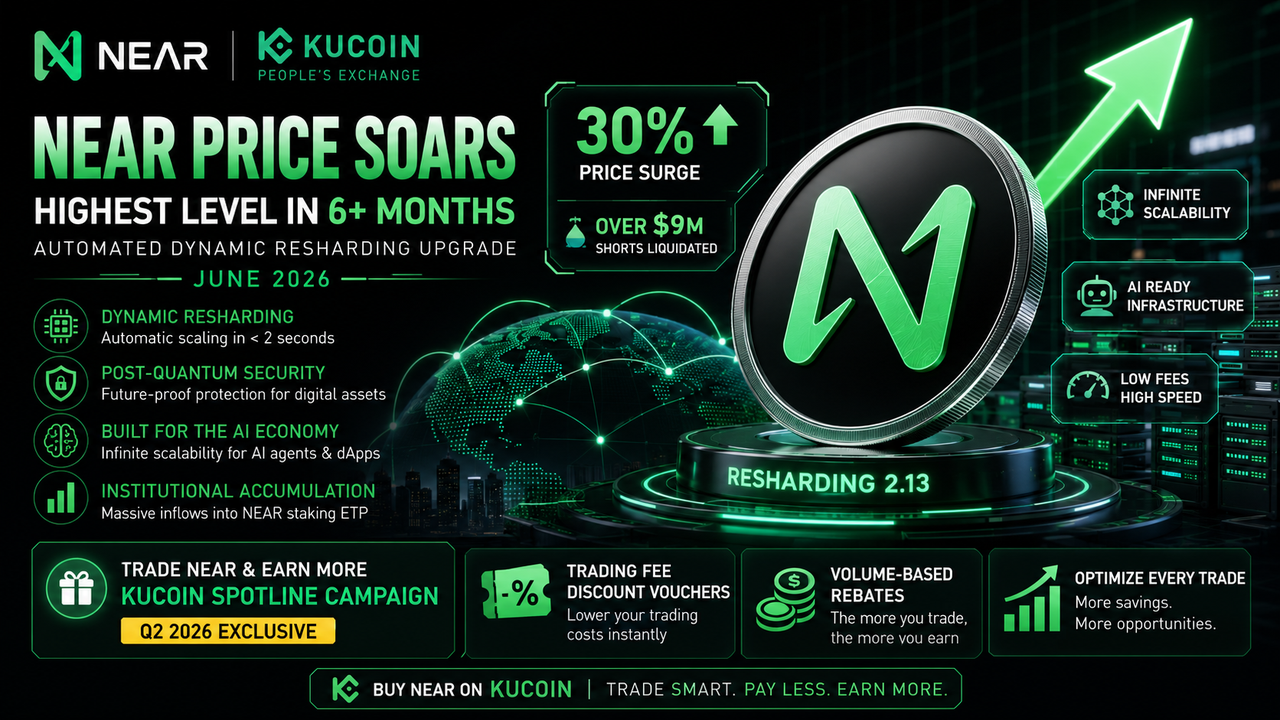
The global cryptocurrency market is closely watching the NEAR price today as a massive wave of buying momentum has pushed the asset to its highest level in over six months. This sudden valuation spike follows the announcement of a groundbreaking network evolution designed to automate the protocol's underlying infrastructure. Traders and institutional investors are rapidly accumulating tokens ahead of the highly anticipated network upgrade slated for next month.
In this comprehensive market report, we will analyze the technical mechanics driving the NEAR price surge and explore how the upcoming June 2026 dynamic resharding upgrade transforms layer-1 scalability. Investors looking to capitalize on this multi-month high can seamlessly monitor the live NEAR/USDT price chart on KuCoin to identify critical entry points before the mainnet deployment.
Key Takeaways:
The recent price velocity behind the asset is not merely a product of speculative retail trading; it represents a structural shift in how the market values high-throughput smart contract platforms. By examining the fundamental and technical data surrounding the network, several critical themes emerge that explain this market outperformance:
-
Automated Infrastructure Scaling: The transition to fully automated capacity management eliminates human bottlenecks, moving the protocol years ahead of monolithic alternatives.
-
Institutional Product Accumulation: Regular, massive inflows into structured investment vehicles indicate that traditional financial institutions are establishing long-term positions in the ecosystem.
-
The Intersection of Web3 and Artificial Intelligence: As decentralized AI applications demand unprecedented execution speeds, the protocol's new scaling architecture positions it as the primary settlement layer for autonomous agents.
-
Derivatives Market Wipeout: A massive short squeeze has amplified upward price momentum, forcing overleveraged bears to buy back spot assets to cover positions on advanced spot trading venues like KuCoin.
What is NEAR Dynamic Resharding? The End of Manual Blockchain Scaling
To comprehend why the NEAR price has captured the market's attention, one must understand the technological leap occurring in June 2026. For years, blockchain networks have struggled with the trilemma of decentralization, security, and scalability, often resulting in network congestion, high transaction fees, or centralized validator sets during times of peak network usage.
Under the manual sharding system, network congestion would require a developer proposal, followed by a governance vote and validator alignment, taking weeks to deploy. Conversely, the new dynamic resharding framework automatically detects state size or congestion limits to trigger an instant deterministic split in less than two seconds.
How Blockchain Sharding Works: Moving from 9 Shards to Infinite Scalability
Sharding is a database partitioning technique that breaks a blockchain down into smaller, more manageable pieces called "shards." Each shard possesses its own state and transaction history, allowing validators to process a fraction of the total network load concurrently rather than forcing every single node to process every single transaction across the entire network.
The protocol’s journey began with a single shard at mainnet launch, subsequently expanding to 4, 6, and eventually 9 shards to handle historical web3 application volume. However, until the 2.13 upgrade, expanding the number of shards required intensive manual engineering, protocol governance voting, and weeks of cross-team coordination among hundreds of independent validator nodes. The June 2026 upgrade changes this entirely by allowing the network to split a single congested shard into multiple new ones hierarchically, deterministically, and automatically in under two seconds when utilization thresholds are breached, laying a foundation for infinite horizontal scalability.
The AWS of Web3: Automating Network Growth Without Validator Votes
By removing human intervention from infrastructure expansion, the network operates less like a traditional blockchain and more like Amazon Web Services (AWS) or Google Cloud Platform. When a mainstream web application experiences a traffic spike, cloud servers automatically spin up new instances to handle the load; this upgrade brings that exact cloud-native elasticity to the decentralized world.
First, the protocol utilizes continuous state monitoring to constantly evaluate the cryptographic size and compute utilization of each active shard. Second, automated split triggers initiate a cryptographic split sequence autonomously if a shard approaches its predetermined resource limit. Finally, zero-downtime execution divides the shard seamlessly without interrupting active user dApps, eliminating the need for manual node operator intervention or governance consensus delays.
Driving the 2026 Rally: Key Catalysts Behind the NEAR Token Price Spike
The macro forces acting upon the asset extend beyond core engineering breakthroughs. A perfect storm of institutional financial products, derivatives market mechanics, and high-profile industry endorsements has caused the NEAR price to aggressively decouple from the broader, consolidating altcoin market. Traders who want to participate in this heavy trading volume can buy NEAR on KuCoin with industry-leading liquidity.
Institutional Demand: The Inflow Surge into Bitwise NEAR Staking ETP
A significant percentage of the buying pressure witnessed over the past week can be traced directly to traditional finance channels. The Bitwise NEAR Staking ETP (Exchange Traded Product) has experienced a dramatic surge in net inflows, reflecting sustained interest from asset managers and institutional allocators who prefer regulated, compliant exposure to web3 assets.
Because these institutional products require physical backing with the native asset, the issuing funds must purchase tokens directly from spot markets, locking them up in staking contracts to generate yield for investors. This institutional supply absorption creates a structural supply shock on global exchanges, amplifying upward price volatility whenever a major announcement hits the wires. While institutions utilize complex ETPs, retail investors can easily maximize their holdings and compounding returns through NEAR Staking on KuCoin Earn to generate passive yield.
The Short Squeeze Effect: Over $9M in Short Positions Liquidated
From a purely technical perspective, the velocity of the 30% price pump was significantly accelerated by a classic derivatives short squeeze. As the asset broke through key multi-month resistance levels, bearish traders who had heavily shorted the token on leverage found themselves caught on the wrong side of the market trend.
Within a 24-hour window, over $9 million worth of leveraged short positions were aggressively liquidated across the market. The massive liquidation of bear positions highlights the high volatility in the derivatives market; professional traders can manage risk or trade ongoing bullish momentum via KuCoin Futures. For those sticking to the spot markets, executing trades during this high-volume period presents an optimized cost-saving opportunity through the active KuCoin Spotline Trading Campaign, where users trading eligible pairs can complete volume milestones to unlock exclusive trading fee vouchers.
Arthur Hayes Backing: Why NEAR is a "Holy Trinity" Altcoin
Market sentiment was further electrified by prominent crypto fund manager and industry veteran Arthur Hayes, who publicly identified the asset as a core component of his "Holy Trinity" of altcoins for the current market cycle. Hayes noted that the project's unique combination of high-speed execution, deep developer engagement, and native cross-chain architecture makes it a standout performer. When high-profile figures within the crypto native landscape validate an asset's long-term value proposition, retail and hedge fund capital frequently responds by shifting allocation out of stagnant layer-1 protocols and into the ascending ecosystem.
The AI Agent Economy: Why Dynamic Resharding is Crucial for AI Blockchains
As artificial intelligence platforms increasingly require decentralized infrastructure to operate autonomously, the project has solidified its reputation as the premiere network for hosting AI models, data pipelines, and intelligent on-chain agents. However, AI workloads present a radically different transactional profile compared to typical decentralized finance applications.
While traditional DeFi applications feature periodic transaction frequencies, autonomous AI agent workloads demand continuous, high-frequency algorithmic loops. DeFi data payloads are typically small, whereas AI workloads handle massive model states and cryptographic proofs. Furthermore, human traffic patterns are relatively predictable, but AI traffic introduces instantaneous, volatile algorithmic spikes. Finally, AI micro-transactions have zero tolerance for gas fee spikes, which would otherwise cause the algorithmic loops to fail entirely.
Handling Unpredictable Traffic: Seamless Scaling for On-Chain AI Workloads
AI agents operate at a scale and frequency that would completely paralyze a standard monolithic blockchain network within minutes. If an array of autonomous agents suddenly detects a profitable cross-chain arbitrage opportunity or a massive data-labeling task, they can instantly generate hundreds of thousands of transactions per second.
Under a legacy architecture, this sudden explosion of traffic would cause gas fees to skyrocket across the entire network, making the blockchain unusable for everyone else. With dynamic resharding, the protocol isolates the sudden surge of AI agent activity into its own newly created shards, preserving flat gas fees and lightning-fast confirmation times for the rest of the web3 ecosystem while giving the AI agents the massive throughput they require.
Confidential Payments and NEAR Intents: Upgrading the AI Infrastructure
To truly empower autonomous AI agents, a blockchain must provide more than just raw speed; it must also offer advanced structural primitives that allow these agents to interact with the world securely. Recent updates to the ecosystem have addressed this by introducing confidential treasuries and advanced transaction intent frameworks.
Confidential payments allow AI agents to manage proprietary funds, settle API fees, and conduct transactions without exposing their underlying strategic data or balance sheets to competitors on a public ledger. Meanwhile, NEAR Intents enable agents to specify a desired financial outcome—such as swapping assets across multiple distinct blockchains—without needing to manually manage the complex intermediate smart contracts or bridging infrastructure required to execute the trade.
Network Upgrade 2.13: Post-Quantum Security Meets Infinite Scalability
While the market's focus has naturally centered on scalability and transaction throughput, the upcoming Network Upgrade 2.13 also contains a quiet cryptographic revolution: the integration of post-quantum secure signatures directly into the protocol's core layer.
As quantum computing technology advances toward critical milestones, the traditional public-key cryptography that secures virtually all modern blockchains faces a theoretical long-term existential threat. A sufficiently powerful quantum computer could eventually reverse-engineer private keys from publicly visible wallet addresses, exposing billions of dollars in digital assets to theft.
The core architecture of Upgrade 2.13 addresses this on two distinct fronts. While the dynamic sharding engine dissolves infrastructure limits via automatic shard splitting and sub-2 second execution, the post-quantum cryptography engine future-proofs digital wealth. It introduces quantum-resistant signatures and state-level security defenses, establishing robust, long-term asset protection.
By embedding quantum-resistant cryptographic signature schemes into the base layer of Upgrade 2.13, the core development team is effectively future-proofing the network against tomorrow's computational threats today. This proactive security posture provides peace of mind to institutional custody providers, sovereign wealth allocators, and enterprise corporations who require decades-long security guarantees before deploying significant capital or proprietary data onto a public decentralized ledger.
Risk Assessment: Is the NEAR Resharding Upgrade Already Priced In?
From an investment and trading perspective, a rapid 30% price expansion raises an important question for market participants: has the market already fully absorbed the value of the upcoming June 2026 upgrade, or does further room for growth remain? In crypto asset markets, the adage "buy the rumor, sell the news" frequently manifests, where an asset rallies strongly ahead of a major technological milestone, only to experience sharp profit-taking and sell-offs immediately after the upgrade successfully deploys.
The upgrade sentiment operates across a specific time horizon. In Phase 1 (the pre-upgrade rally), the current 30% surge is primarily driven by market anticipation and short covers. In Phase 2 (the post-upgrade reality), the asset's long-term valuation will depend heavily on actual on-chain adoption and new AI dApp volume.
To accurately assess the risk profile of entering the market at current valuations, traders must closely monitor on-chain metrics leading up to the mid-June deployment date. If network activity, active developer wallets, and total value locked (TVL) continue to trend upward alongside the token's valuation, it suggests that the price appreciation is backed by organic, structural demand rather than purely speculative momentum. Conversely, if the technical indicators show an overbought condition on daily and weekly charts while on-chain transaction volume remains flat, caution is warranted, as a successful deployment could trigger a temporary capital rotation into other lagging altcoins.
Exclusive Reward: Optimize Your NEAR Trades with the KuCoin Spotline Campaign
As the NEAR price experiences heightened volatility ahead of the June 2026 upgrade, maximizing capital efficiency becomes paramount for spot traders. To welcome the heavy trading volume triggered by the dynamic resharding announcement, platform users can now reduce their operational overhead by participating in the KuCoin Spotline Trading Campaign.
This exclusive 2026 Q2 promotion is specifically engineered to reward active participants in the spot market. By entering the campaign page and opting into the trading milestones, users can unlock tailored incentives designed to offset transaction expenses during periods of high market liquidity.
-
Trading Fee Discount Vouchers: Active participants who reach specific spot trading volume thresholds can claim exclusive spot fee coupons, drastically lowering the cost of adjusting long-term portfolio allocations.
-
Volume-Based Rebates: The campaign structure incentivizes both retail and high-frequency traders, offering escalating rebate percentages as cumulative spot volume expands throughout the quarter.
-
Seamless Optimization: Rather than paying flat execution costs during volatile market swings, registering for the campaign allows traders to lock in a more competitive fee structure directly on the KuCoin Spot Platform.
Conclusion
The recent momentum surrounding the NEAR price clearly reflects the market's deep enthusiasm for the paradigm-shifting dynamic resharding technology arriving in June 2026. By removing the historic constraints of manual scaling and replacing them with a fully automated, cloud-like infrastructure layer, the protocol establishes itself as a clear leader for the next generation of web3 and decentralized artificial intelligence workloads. While near-term volatility is to be expected following a rapid 30% market surge, the underlying fundamental improvements to scalability, institutional adoption, and quantum-resistant security suggest that the platform's long-term growth trajectory is firmly intact as we enter the next phase of blockchain evolution.
FAQ: Frequently Asked Questions
What caused the recent NEAR price surge?
The NEAR price surged by nearly 30% due to a combination of institutional inflows into the Bitwise Staking ETP, a massive short squeeze liquidating over $9 million in derivatives positions, and high market anticipation for the automated dynamic resharding network upgrade scheduled for June 2026.
When will the dynamic resharding upgrade go live?
The dynamic resharding architecture is scheduled to deploy on the mainnet in June 2026 as a core component of Network Upgrade 2.13, bringing fully automated infrastructure scaling and advanced post-quantum secure signatures to the protocol.
How does dynamic resharding affect transaction fees?
Dynamic resharding ensures that transaction fees remain incredibly low and predictable. By automatically splitting congested shards into multiple instances when traffic spikes, the network prevents the localized gas fee spikes that plague traditional monolithic blockchains during high-demand events.
Why is this upgrade important for AI applications?
AI agents require immense, unpredictable amounts of on-chain data processing capability. Dynamic resharding allows the network to instantly and automatically scale up compute capacity to handle massive influxes of algorithmic traffic without slowing down or disrupting the rest of the decentralized ecosystem.
What is post-quantum security in Network Upgrade 2.13?
Post-quantum security involves integrating advanced cryptographic signatures that are resistant to being cracked by future quantum computers. This forward-looking security update protects user accounts, institutional funds, and smart contract assets from advanced future computational vulnerabilities.
How can I lower my trading fees when buying NEAR on KuCoin?
You can significantly lower your transaction costs by registering for the active KuCoin Spotline Promotion. By participating in this Q2 campaign and meeting spot volume targets, you will automatically unlock trading fee discount vouchers and rebate rewards applicable to your NEAR spot trades.