

MSNXX Explained: Morgan Stanley's Stablecoin Reserves Fund and the GENIUS Act Reserve Requirements
Introduction
Every dollar-backed stablecoin in circulation is only as reliable as the assets held in reserve to support it. For years, that fundamental question, “what is actually backing this token?”, lacked a consistent legal and regulatory framework in the United States. Stablecoin issuers defined their own reserve practices, regulatory oversight was fragmented across agencies, and market participants had limited visibility into reserve quality. That regulatory uncertainty has now been significantly reduced.
The Guiding and Establishing National Innovation for U.S. Stablecoins Act, known as the GENIUS Act, passed into law in July 2025, establishing the first comprehensive federal framework governing payment stablecoins in the United States. The legislation formalizes reserve standards, prioritizes high-quality liquid assets, and introduces clearer oversight expectations for issuers operating within the U.S. financial system.
In response to this evolving regulatory environment, financial institutions are beginning to design products directly aligned with these requirements. Morgan Stanley Investment Management’s Stablecoin Reserves Portfolio, trading under the ticker MSNXX, represents one of the early institutional structures built to reflect this new compliance-focused reserve framework.
This article explains the current U.S. regulatory requirements for stablecoin reserves, the key provisions introduced by the GENIUS Act, and how MSNXX is structured within this emerging legal and financial framework.
What Are Stablecoin Reserves and Why Do They Matter
A stablecoin is a digital token designed to hold a fixed value, most commonly one U.S. dollar. To maintain that peg, the issuer must hold real assets equivalent to every token in circulation. Those assets are the reserve.
Reserves matter for two reasons. First, they determine whether redemption is possible. If a user holds $1,000 in stablecoins and wants to convert them to dollars, the issuer needs $1,000 in liquid assets ready to deliver. Second, reserves determine systemic risk. If reserves are concentrated in volatile or illiquid assets, a sudden wave of redemptions could cause the peg to break, triggering losses across every holder.
Before the GENIUS Act, there was no federal standard for what counted as an acceptable reserve asset. Some issuers held short-term government securities. Others held commercial paper, crypto assets, or a mix of both. The lack of standards made it difficult for institutional investors and regulators to assess real risk levels across the stablecoin sector.
The GENIUS Act: A Federal Framework for Stablecoin Reserves
The GENIUS Act creates the first statutory definition and regulatory framework for payment stablecoins at the federal level in the United States. It applies to any entity issuing a digital asset for payment or settlement that is redeemable at a predetermined fixed monetary value.
Who Can Issue a Payment Stablecoin
The GENIUS Act creates a two-level licensing system for stablecoin issuers based mainly on the size of tokens they issue.
Smaller issuers with $10 billion or less in outstanding stablecoins can operate under a state regulatory framework, as long as the state rules are approved as being closely aligned with federal standards. This allows smaller firms to remain under state supervision rather than immediately moving to federal oversight.
Once an issuer grows beyond $10 billion in circulation, it must switch to federal regulation within 360 days. Alternatively, it can apply for a waiver that allows it to continue operating under state supervision if regulators approve it.
At the federal level, oversight of nonbank stablecoin issuers is primarily handled by the Office of the Comptroller of the Currency (OCC). The Federal Reserve also participates through a review committee that evaluates applications based on financial stability, compliance, and systemic risk before approval is granted.
Under this framework, stablecoins can be issued by:
-
Bank subsidiaries
-
Nonbank institutions supervised by the OCC
-
State-licensed entities that have received federal approval
Nonbank issuers must meet capital, liquidity, and reserve standards tailored to their stablecoin activities. However, they are not subject to the full capital requirements imposed on traditional banks. Instead, the rules are designed to match the lower-risk structure of stablecoin issuance compared to full banking activities.
Reserve Requirements Under the GENIUS Act
The reserve rules are central to the GENIUS Act and ensure that every stablecoin is fully backed at all times.
Each approved issuer must maintain reserves equal to 100% of outstanding tokens, meaning every stablecoin is backed 1:1 by safe, liquid assets.
Permitted reserve assets include:
-
U.S. cash (coins and currency)
-
Deposits in insured banks and credit unions
-
Short-term U.S. Treasury bills
-
Repurchase agreements backed by U.S. Treasuries
-
Reverse repurchase agreements backed by U.S. Treasuries
-
Government money market funds
-
Central bank reserve balances
Regulators may expand this list in the future, but only to include similar low-risk government-backed instruments.
This list is strict and exclusive. Assets such as cryptocurrencies, equities, and long-term government or corporate bonds are not permitted. If an asset is not explicitly approved, it cannot count toward reserve requirements.
Issuers must also maintain strict operational separation of reserves. Reserve assets must be:
-
Kept separate from business or operational funds
-
Stored in dedicated, segregated accounts
-
Protected from any form of reuse or re-lending (rehypothecation)
This ensures reserves remain fully available for redemption at all times.
Transparency and Disclosure Obligations
The GENIUS Act requires monthly public disclosure of reserve composition, certified by the issuer's CEO and CFO. All issuers must have their periodic reserve reports examined by registered public accounting firms.
Issuers with more than $50 billion in outstanding stablecoins face a higher bar: they must submit audited annual financial statements, a full audit obligation that goes beyond the attestation standard applied to smaller issuers.
These disclosure requirements give markets and regulators direct visibility into what is backing the tokens in circulation, replacing the informal and inconsistent disclosures that defined earlier stablecoin markets.
Redemption and Consumer Protection Rules
The Act grants every stablecoin holder a clear right to redeem tokens for the reference currency at par value on demand. Issuers must publish a redemption policy that ensures timely processing, and any fees must be disclosed in plain language. Fee changes require at least seven days’ notice before taking effect.
The Act also prohibits issuers from paying any form of interest or yield on stablecoin holdings. This restriction applies broadly to any form of compensation, whether in cash, tokens, or other benefits. As a result, holders receive no return simply for holding stablecoins, and reserves must remain fully available and free of claims.
What MSNXX Is and How It Was Built Around the GENIUS Act
With the reserve rules now codified in law, stablecoin issuers face a practical challenge: how do they hold and manage their required reserves efficiently while maintaining the daily liquidity those rules demand?
Morgan Stanley Investment Management answered that question in April 2026 with the launch of the Stablecoin Reserves Portfolio, designated under the ticker MSNXX. It is part of the Morgan Stanley Institutional Liquidity Funds trust and structured as a government money market fund.
The Investment Structure of MSNXX
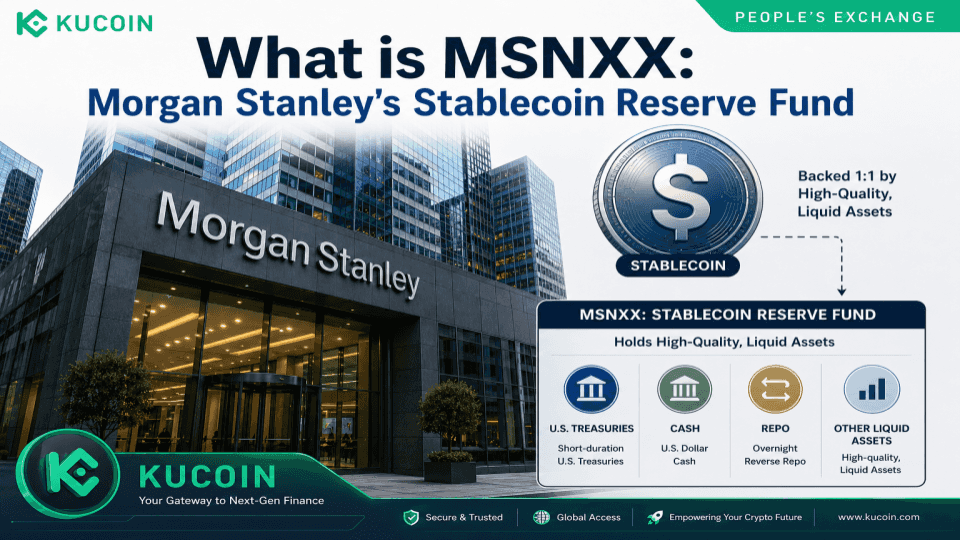
MSNXX is designed to invest only in cash and very short-term U.S. government-backed instruments. Its holdings include cash balances, U.S. Treasury securities with maturities of 93 days or less, and overnight repurchase agreements backed by U.S. Treasuries.
The fund aims to maintain a stable net asset value of $1.00 per share. Its structure prioritizes capital preservation and immediate liquidity, ensuring that funds can be accessed on demand.
This conservative allocation is intentional. By focusing only on highly liquid and low-risk assets, MSNXX minimizes exposure to market volatility and credit risk.
The portfolio is also aligned with the reserve requirements defined under the GENIUS Act. Each asset category held by the fund falls within the list of eligible reserve assets permitted for stablecoin backing.
Because of this alignment, stablecoin issuers can use MSNXX as a ready-made reserve solution. Instead of managing reserves independently, they can rely on the fund to maintain compliance with regulatory standards.
How MSNXX Addresses the Reserve Compliance Problem
One of the less visible challenges the GENIUS Act creates is operational. Stablecoin issuers must hold reserves in eligible assets, keep them segregated, maintain daily liquidity, and disclose their composition monthly. For large issuers, managing a Treasury ladder with short-duration maturities across billions of dollars in assets is a significant infrastructure commitment.
MSNXX simplifies that problem. An issuer can invest reserve capital in shares of the fund and satisfy its reserve obligation through fund participation rather than direct asset management. The fund handles maturity management, reinvestment, and liquidity, while the issuer receives the compliance benefit of holding an eligible reserve asset recognized under the Act's framework.
Fred McMullen, Co-Head of Global Liquidity at Morgan Stanley Investment Management, stated at launch: "The significant increase in stablecoin issuers as well as the growing number of assets held in stablecoins represents an evolving portion of the marketplace that is ripe for future growth."
MSNXX Within the Broader Morgan Stanley Digital Strategy
The launch of MSNXX builds on a broader push into digital assets by Morgan Stanley Investment Management. In April 2026, the firm introduced the Morgan Stanley Bitcoin Trust, an exchange-traded product listed on NYSE Arca that tracks the performance of Bitcoin.
It marked the first cryptocurrency ETP from a U.S. bank-affiliated asset manager and reflects a wider strategy to expand access to digital asset exposure through regulated investment structures.
Alongside this, the firm has experimented with blockchain-based financial infrastructure, including DAP Class shares tied to an institutional liquidity fund that uses tokenized record-keeping. These initiatives show a consistent direction: combining traditional asset management frameworks with emerging digital asset rails.
MSNXX takes a different position within that strategy. Instead of offering exposure to crypto price movements, it focuses on the underlying financial infrastructure that supports stablecoins. The fund is built around reserve management, aligning directly with regulatory requirements rather than market speculation.
This distinction is important. While products like MSBT give investors access to Bitcoin’s price performance, MSNXX is designed for issuers and institutions that need compliant, liquid reserve solutions. It operates closer to the plumbing of the stablecoin system rather than its market-facing layer.
If MSNXX sees widespread adoption among stablecoin issuers, Morgan Stanley could become embedded in the reserve management layer of the ecosystem. That position would place the firm within a segment of the market that already supports trillions of dollars in transaction volume, but is now shifting toward more structured and regulated financial infrastructure.
Together, these products reflect a deliberate strategy by Morgan Stanley to participate across multiple layers of the digital asset ecosystem, from investor exposure to core financial infrastructure.
Why the Reserve Rules Matter Beyond Compliance
Understanding the GENIUS Act's reserve requirements is not just relevant for issuers. It has practical implications for traders, investors, and users of stablecoin-denominated platforms.
For Stablecoin Users
The reserve rules raise the floor on stablecoin safety for everyday users. A permitted stablecoin must now be backed by recognized liquid assets and must honor redemptions at par. That protection did not exist in federal law before July 2025. Users on platforms that list GENIUS Act-compliant stablecoins can assess issuer quality by reviewing their monthly reserve disclosures.
For Institutional Market Participants
Institutional investors who use stablecoins for settlement, liquidity management, or yield strategies now have a clearer framework for evaluating counterparty risk. Issuers operating under the GENIUS Act carry a federal permit and meet a defined reserve standard. That signal matters for risk assessment in a way that informal issuer disclosures never could.
For the Reserve Asset Market Itself
The GENIUS Act does not just regulate stablecoins directly. It also creates structural demand for specific asset classes. Because the law restricts eligible reserves to short-duration Treasuries, cash, and government-collateralized repos, compliant issuers collectively represent a growing buyer pool for exactly those instruments. As the stablecoin market grows, so does the demand signal for short-term U.S. government debt held within compliant reserve structures.
Products like MSNXX are designed to capture that flow. They sit between stablecoin issuers and the Treasury market, providing a pooled vehicle that aggregates reserve capital into compliant asset classes at scale.
Key Takeaways: Stablecoin Reserves, the GENIUS Act, and MSNXX
The GENIUS Act established the first federal reserve standard for U.S. payment stablecoins, requiring 100% backing in high-quality liquid assets, mandating monthly disclosure, and enforcing redemption at par. It created a licensing regime that distinguishes permitted issuers from unregulated ones and made reserve quality a legal requirement rather than a voluntary practice.
MSNXX is a direct product response to that framework. Morgan Stanley Investment Management built a government money market fund with a maturity cap and investment limited to Treasuries, cash, and Treasury-backed repos. That structure was constructed to align with GENIUS Act reserve requirements, giving stablecoin issuers a compliant, institutionally managed vehicle in which to park their reserve capital.
The larger signal here is that regulated stablecoin infrastructure is taking shape fast. Major financial institutions are not simply observing the regulated stablecoin market from the outside. They are building the reserve management, custody, and liquidity products that stablecoin issuers need to operate inside the new legal framework. MSNXX is one of the first products in that category, but it is unlikely to be the last.
For anyone participating in the stablecoin market, whether as a trader, an issuer, or an institutional user, understanding what backs the tokens and what the law now requires is foundational knowledge. The GENIUS Act made reserve transparency a legal obligation. Products like MSNXX made it an accessible operational option.
FAQs
What is MSNXX and how does it work?
MSNXX is a government money market fund created by Morgan Stanley Investment Management to help stablecoin issuers manage their reserves. It invests in cash and short-term U.S. Treasury-backed assets, allowing issuers to meet regulatory reserve requirements without managing assets directly.
What are the reserve requirements under the GENIUS Act?
The GENIUS Act requires stablecoin issuers to hold reserves equal to 100% of tokens in circulation. These reserves must consist of approved, low-risk assets such as cash, short-term U.S. Treasuries, and government-backed instruments, with strict rules on liquidity, segregation, and transparency.
How does MSNXX help stablecoin issuers stay compliant?
MSNXX provides a ready-made reserve solution that aligns with GENIUS Act requirements. By holding reserves in the fund, issuers can meet asset eligibility, liquidity, and reporting standards without building their own treasury management infrastructure.
Can stablecoin reserves include crypto or other risky assets?
No. Under the GENIUS Act, reserve assets are limited to a defined list of low-risk, highly liquid instruments. Cryptocurrencies, equities, and long-term bonds are not allowed and cannot be used to back stablecoins.
Why are stablecoin reserves important for users and investors?
Stablecoin reserves determine whether tokens can be redeemed at their fixed value. Strong reserve standards reduce the risk of depegging and improve trust, especially under regulated frameworks introduced by the GENIUS Act.