

Could AI-Driven Bug-Finding Tools Like Mythos Audit Web3 and Browser-Based Crypto Wallets?
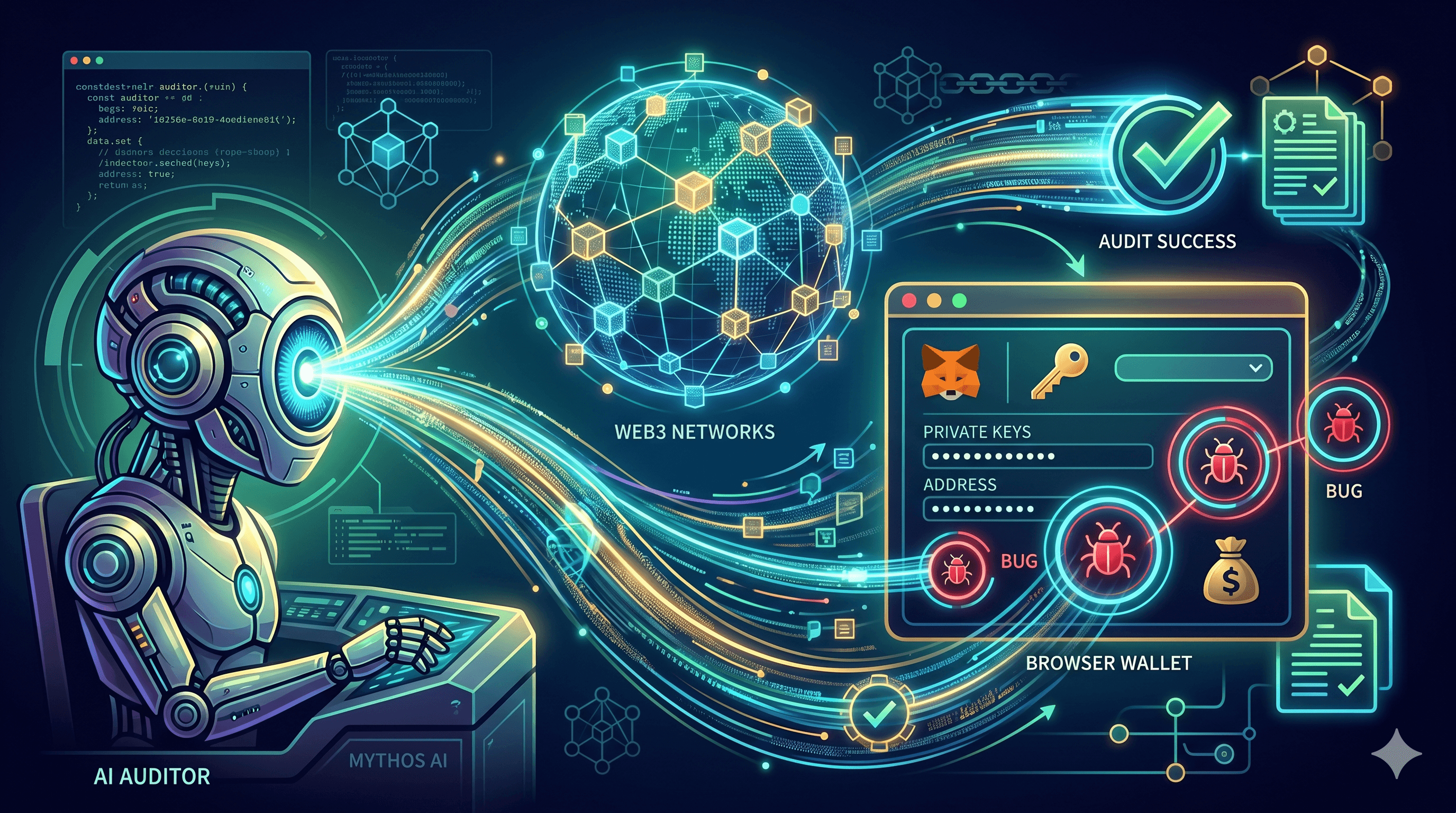
The crypto security landscape entered a new and alarming chapter this week. CertiK, one of the most respected names in blockchain security, issued a stark warning: the industry has already lost over $600 million to hacks in 2026, driven primarily by two North Korea-linked exploits — the $293 million Kelp DAO breach and the $280 million Drift Protocol attack — both occurring in April alone. Meanwhile, agentic AI tools capable of autonomously scanning smart contracts for exploitable bugs and drafting exploit code are accelerating at "machine speed," according to CertiK senior investigator Natalie Newson.
But here is the question every Web3 developer, wallet provider, and crypto holder should be asking: what if the same AI power being weaponized by attackers could be turned decisively toward defense?
Enter Anthropic's Claude Mythos — an AI security model reportedly capable of finding vulnerabilities in major operating systems, now being deployed defensively with a limited release to select tech firms. Add to this the established Mythril ecosystem (the symbolic execution engine that powered the MythX security suite before its shutdown on March 31, 2026), and a growing generation of AI-native audit tools like Octane Security, ContractScan, and ChainGPT's Smart Contract Auditor — and the picture of a new AI-powered security paradigm begins to take shape.
The critical question this article addresses is both timely and technically complex: can AI-driven bug-finding tools like Mythos be effectively deployed to audit not just smart contracts, but the full stack of Web3 and browser-based crypto wallets — including MetaMask extensions, browser-integrated wallet SDKs, and the JavaScript supply chain they depend on? The answer is nuanced, essential, and relevant to every person who has ever connected a wallet to a dApp.
Key Takeaways
-
$600M+ already lost to crypto hacks in 2026, with AI-driven attacks — including deepfakes, autonomous exploit agents, and supply chain compromises — identified as the primary escalating threat by CertiK.
-
Anthropic's Claude Mythos is an AI model claimed to find vulnerabilities in major operating systems, now being deployed defensively with select tech firms — representing a genuine new frontier in AI-powered security auditing.
-
Mythril (the open-source symbolic execution engine) uses concolic analysis, taint analysis, and SMT solving to detect EVM bytecode vulnerabilities — and its architecture can be applied to wallet-integrated smart contracts, not just standalone DeFi protocols.
-
Browser-based crypto wallets like MetaMask face a fundamentally different threat surface than smart contracts: JavaScript supply chain attacks, malicious extension updates, XSS in NFT metadata, and chrome.storage encryption flaws require AI tools specifically designed for browser-layer analysis.
-
Trust Wallet's $7M breach in December 2025 — caused by a malicious Chrome extension update that passed Google's review — exemplifies exactly the vulnerability class that existing AI contract auditors do not cover, but next-generation tools are being built to address.
-
The MythX shutdown on March 31, 2026 left a gap in the CI/CD security pipeline that the market is actively filling with multi-engine, AI-augmented alternatives.
The State of Crypto Wallet Security in 2026 — A Crisis at the Browser Layer
To understand why AI audit tools are urgently needed for Web3 wallets, you need to understand where the attacks are actually happening in 2026.
The common narrative around crypto security focuses on smart contract exploits — the reentrancy bugs, oracle manipulation schemes, and logic flaws that have drained DeFi protocols of billions. Those attacks are real and ongoing. But the data from 2025 and early 2026 tells a more disturbing story about where individual user funds are most immediately at risk: the browser layer.
Chainalysis data shows that personal wallet compromises reached $713 million in losses in 2025 — an extraordinary figure representing 20% of total crypto theft that year. The Trust Wallet Chrome extension breach of December 2025 is the paradigm case. A malicious update to version 2.68, enabled by a leaked Chrome Web Store API key, exfiltrated wallet data and drained approximately $7 million from users before the company could push a fix. The compromised version passed Google's own review process, auto-updated in the background as browser extensions are designed to do, and targeted users who had followed every standard self-custody practice — never shared seed phrases, checked URLs, used reputable wallets. The attack was not against the blockchain. It was against the browser.
MetaMask — with over 100 million users and a decade-long track record — has itself never been directly hacked. But its monthly security reports paint a picture of escalating user-level threats: signature phishing attacks surged 207% in January 2026, draining $6.27 million from 4,700 wallets. Attackers are exploiting Ethereum's EIP-7702 feature to create malicious delegation scripts — Wintermute's analysis found that over 80% of EIP-7702 delegations were linked to a single malicious script designed to drain wallets with compromised keys. And JavaScript supply chain attacks — where malicious NPM packages silently swap crypto addresses before they reach the user — have seen payloads downloaded more than 1 billion times, according to Ledger's CTO.
This is the security environment in which AI-driven bug-finding tools must operate. And it is a fundamentally more complex environment than smart contract auditing alone.
What Is Mythril (and Mythos) — and How Do These AI Security Tools Actually Work?
To evaluate whether AI audit tools can protect Web3 wallets, you first need to understand what they are technically capable of — and what they are not.
Mythril is an open-source security analysis tool for EVM bytecode, developed by ConsenSys Diligence. Its core mechanism is concolic analysis — a portmanteau of "concrete" and "symbolic" execution — combined with SMT solving and taint analysis. In practice, Mythril emulates contract execution across all possible branches, attempts to reach "dangerous" states by exploring different parameter combinations, and flags vulnerabilities including integer underflows, owner-overwrite-to-Ether-withdrawal, unprotected selfdestruct operations, and reentrancy patterns. It was a foundational component of the MythX security suite, which shut down on March 31, 2026, leaving a gap that has accelerated the market's transition to AI-augmented alternatives.
Anthropic's Claude Mythos is a categorically different tool. As referenced by CertiK's senior investigator Natalie Newson this week, Mythos is described as an AI model "claimed to have the ability to find vulnerabilities in major operating systems," now being deployed defensively with a limited set of tech firms. Unlike Mythril's deterministic symbolic execution, Mythos represents the emerging class of large language model-powered security tools that can reason about code intent, identify business logic violations, and flag patterns that correlate with real-world exploit categories from a trained database of attack incidents — capabilities that rule-based tools fundamentally cannot match.
The distinction matters enormously for wallet security. Mythril and its symbolic execution peers excel at finding precise, codifiable vulnerability classes in EVM bytecode: the reentrancy bug that allows an external contract to re-enter a function before a balance update, the integer overflow that corrupts accounting logic, the unprotected function that any caller can invoke. These are deterministic bugs with well-defined signatures, and symbolic execution finds them reliably.
Mythos and its LLM-powered counterparts excel at something different: understanding the semantic intent of code, identifying patterns that resemble known attack scenarios without matching any single hardcoded rule, and reasoning across the multiple layers of a system — smart contract logic, frontend JavaScript, wallet integration APIs — to identify risk surfaces that emerge from their interaction rather than from any individual component in isolation. An AI model that can understand that a particular wallet's transaction signing flow could be manipulated by a malicious dApp's frontend, even when both the contract and the wallet extension code are individually correct, is doing something qualitatively different from Mythril's bytecode scanning.
Together, these two paradigms — deterministic symbolic execution and AI-powered semantic analysis — represent the dual engine of the next-generation crypto security stack.
Can These Tools Actually Audit MetaMask and Browser-Based Web3 Wallets?
This is where the technical reality gets nuanced. The direct answer is: partially, and with important limitations that the industry is actively working to address.
What AI audit tools can do today for wallet security:
Browser-based wallet extensions like MetaMask are fundamentally JavaScript applications. Their attack surface, as documented by security firm Zealynx, includes several distinct layers: extension manifest permissions and content security policy configurations; chrome.runtime.sendMessage communication channels that could be exploited if improperly locked; XSS vulnerabilities in NFT metadata rendering and dApp integrations; key storage encryption in chrome.storage.local (including PBKDF2 and scrypt implementations); and unauthorized transaction signing and IDOR vulnerabilities that allow sensitive functions to be called without proper user confirmation.
AI-powered static analysis tools can scan the JavaScript and TypeScript source code of browser extensions for several of these vulnerability classes. Exposed API keys, mnemonics, and secrets in source code, config files, and test accounts — the category of vulnerability that enabled the Trust Wallet breach — are directly detectable by AI-augmented static analysis (SAST) tools integrated into CI/CD pipelines. Tools like ContractScan, which already runs five security engines in parallel (Slither, Mythril, Semgrep, Aderyn, and AI), and platforms like Octane Security — which used its AI tool to discover a high-severity bug in Ethereum's Nethermind client that could have affected 40% of all validators — demonstrate that AI-native security tools are already finding real vulnerabilities at the infrastructure level.
The key insight from the Octane Nethermind case is significant: Octane's AI tool found a bug that could have allowed an attacker to sabotage validators by submitting a malformed transaction, causing sustained missed slots across all Nethermind-based block proposers. The Ethereum Foundation awarded Octane a $50,000 bug bounty. This was not a contract-level bug — it was a client infrastructure bug, demonstrating that AI security tools are already operating above the bytecode layer.
What these tools cannot yet do reliably:
The Trust Wallet breach was not caused by a code vulnerability in the traditional sense. It was caused by a compromised API key that allowed a malicious actor to submit a poisoned extension update through legitimate channels. No static analysis tool, however sophisticated, can detect a credential compromise in a CI/CD pipeline by scanning source code alone — because the malicious code was introduced after the development phase. Similarly, the JavaScript supply chain attacks that have plagued the Web3 ecosystem — malicious NPM packages that swap crypto addresses — require behavioral analysis and dependency provenance verification, not just code scanning.
Business logic vulnerabilities in wallet-dApp interactions — where a wallet's frontend can be manipulated to show users one transaction while signing another (the Bybit "Safe wallet interface manipulation" attack vector) — require understanding the full interaction flow between a dApp's frontend, the wallet's signing interface, and the smart contract being called. This is precisely where AI semantic analysis tools like Mythos are most promising and currently most nascent. Early results suggest that large language models trained on comprehensive exploit databases can identify these interaction-layer risks, but the tooling to operationalize this analysis in a continuous CI/CD pipeline for browser extensions is still maturing.
The New AI Security Stack for Web3 — Multi-Engine Defense in Depth
The MythX shutdown on March 31, 2026 crystallized a lesson that the security community had been learning for years: the single-vendor, single-engine security model is a single point of failure. ContractScan's post-MythX analysis put it plainly — "relying on a single security tool, behind a single company's API, is a single point of failure."
The emerging replacement architecture is a multi-engine, AI-augmented defense-in-depth model with five distinct layers, each addressing a different segment of the Web3 wallet attack surface.
Layer 1: The Code X-Ray (Static Analysis)
Tools: Slither, Aderyn, Semgrep Think of this as a grammar checker for code. It looks at the "skeleton" of your smart contract to find obvious typos, missing locks, or broken logic.
-
Strength: It’s lightning-fast and never misses a known "spelling mistake" in the code.
-
Weakness: It doesn't understand why you wrote the code; it only knows if the syntax is dangerous.
Layer 2: The Security Brain (AI Semantic Analysis)
Tools: Claude Mythos, Specialized LLMs If Layer 1 is a grammar checker, this is a master editor. Using AI trained on nearly 700 real-world DeFi hacks, it reads the intent of your code. It asks: "Does this contract's behavior look like the Drift exploit from last month?"
-
Strength: Catches complex logic errors and "weird" interactions between different contracts that humans often miss.
Layer 3: The Stress Test (Behavioral Fuzzing)
Tools: Diligence Fuzzing This is the "infinite monkeys" approach. It hammers your contract with millions of random, bizarre inputs to see if it breaks under pressure. For wallets, it monitors the background "chatter" to ensure no data is leaking out.
-
Strength: Finds "impossible" edge cases that neither humans nor basic AI could predict.
Layer 4: The Border Patrol (Supply Chain Defense)
Focus: NPM Packages & Dependencies Most hacks don't happen in your code—they happen in the "ingredients" you imported. In 2026, AI agents scan every update to your software's building blocks to ensure no malicious "backdoors" were sneaked in during a routine update.
-
Strength: Blocks the "Trust Wallet style" attacks where a trusted library turns rogue overnight.
Layer 5: The Night Watchman (Post-Deployment Monitoring)
Focus: Real-time Behavior & Governance Security doesn't end when you hit "deploy." This layer stays awake 24/7, watching how the contract behaves in the wild. It monitors who holds the keys and alerts the team if admin permissions look like they are being prepped for a hostile takeover.
-
Strength: Prevents disasters like the $285M Drift Protocol exploit by flagging suspicious "manager" behavior before the money actually leaves the vault.
Stay Ahead of the Security Curve — The Crypto Market Opportunity Behind AI Auditing
Here is a question that any crypto investor aware of the security crisis of 2026 should be sitting with: who are the financial winners when AI-powered security becomes as essential to Web3 as auditing itself?
The answer connects directly to several of the most interesting token categories available on the market today. The AI security revolution in crypto requires three infrastructure layers: the AI compute that powers LLM-based analysis tools (DePIN GPU networks like Render, Aethir, and Akash); the AI intelligence protocols that coordinate decentralized models and compute marketplaces (Bittensor's TAO, Fetch.ai's FET, and the Virtuals Protocol); and the blockchain infrastructure that must handle the throughput generated by thousands of AI agents performing continuous security analysis and real-time transaction monitoring.
The crypto industry lost over $600 million in the first four months of 2026 alone. The security tooling market that addresses this — AI audit tools, bug bounty infrastructure, on-chain insurance protocols, and real-time monitoring networks — is responding to a demand signal that is only going to intensify as AI-powered attacks grow faster than manual defense capabilities.
KuCoin has established itself as one of the best-positioned exchanges for investors who want early, liquid access to the token categories that benefit most directly from the convergence of AI and crypto security. Tokens representing AI infrastructure (TAO, FET, ATH, RENDER), cybersecurity-native Web3 platforms, and the high-performance blockchains that AI security agents will route their on-chain settlements through are all listed on KuCoin with the order-book depth to support meaningful positions. For traders tracking the security narrative specifically, KuCoin's early listing track record in AI and DePIN categories — combined with its automated trading tools for managing volatility during news-driven price moves — makes it a natural home for the AI security thesis. When a $293 million breach like Kelp DAO hits the wire, the market reaction in AI security tokens can move in minutes. Platform choice matters at that velocity.
The security crisis of 2026 is not good news for the crypto industry at large — but it is a clear signal for investors who understand which tools and infrastructure protocols are being built to solve it.
What Web3 Developers and Wallet Users Must Do Right Now
The pace of AI-powered attacks in 2026 is outrunning the adoption of AI-powered defenses. Both wallet developers and individual users need actionable responses, not just awareness.
🛠 For Developers: The "Triple-Lock" System
If you are building a wallet or a dApp, a single audit isn't enough. You need an automated security pipeline that works while you sleep.
1. The Automated Filter (CI/CD)
Think of this as a security gate at your factory. Every time you change code, three things must happen:
-
The Robot Scan: Use tools like Slither and Mythril to catch basic coding errors.
-
The AI Brain: Use ContractScan to check if your code logic "feels" like a scam or a hack seen in the past.
-
The Ingredient Check: Before using any outside code (NPM packages), have an AI scanner verify it hasn't been tampered with.
2. The "Wallet-Specific" Shield (Zealynx Framework)
Developing browser extensions is like building a house with many windows. You need to:
-
Lock the Windows: Check your browser permissions and ensure NFT metadata can't "inject" malicious code (XSS).
-
Hide the Keys: Use AI to scan your source code for "hardcoded secrets"—passwords or keys accidentally left in the text that hackers can find in seconds.
🦊 For Individual Users: The "Digital Hygiene" Checklist
Individual users are being targeted by signature phishing (up over 200% this year). Here is how to stay safe:
1. See the Future (Transaction Simulation)
Never sign a transaction blindly. * Use tools that show you a "movie" of what will happen before you click confirm. If the simulation says "You lose 50 ETH" and you’re just trying to mint a free NFT, stop.
2. Read the Fine Print (Human-Readable Signing)
-
If your wallet shows you a wall of random numbers and letters (Hex data), don't sign it.
-
Insist on using wallets that translate that gibberish into plain English: "You are giving Site X permission to spend 100 USDC."
3. Clean Your House (Revoke.cash)
-
Every time you interact with a dApp, you likely gave it a "key" to your tokens.
-
Go to Revoke.cash regularly and take those keys back from apps you aren't using anymore.
4. Use the "Vault and Wallet" Strategy
-
The Wallet: Keep a small amount of "spending money" in your browser extension for daily dApp use.
-
The Vault: Keep your life savings in a separate, "cold" hardware wallet that never touches a dApp.
The coming generation of AI-powered wallet security — tools that can analyze a dApp's code in real-time before you connect, flag suspicious transaction structures before signing, and monitor your approval history for anomalous delegation patterns — is being built. Anthropic's Mythos deployment to select tech firms is an early indicator of the direction. The integration of AI semantic analysis into wallet guard systems like MetaMask's own Wallet Guard product is a natural evolution that the industry is already on a path toward.
The "audited once" model is definitively over. Continuous AI-powered security monitoring is the new baseline — and the tools, teams, and tokens enabling it are the most important part of the 2026 crypto security story.
Conclusion
The convergence of AI-powered attacks and AI-powered defenses has made 2026 the most consequential year in Web3 security history. On one side: agentic AI tools autonomously scanning contracts at machine speed, generating deepfakes to bypass KYC, and poisoning JavaScript supply chains. On the other: Claude Mythos finding operating system vulnerabilities, Octane Security's AI discovering a Nethermind bug that could have destabilized 40% of Ethereum validators, and ContractScan building the post-MythX multi-engine security stack that the market urgently needs.
Can AI-driven bug-finding tools like Mythos audit Web3 and browser-based crypto wallets? The answer in 2026 is: yes, partially, and increasingly more comprehensively with each passing month. Symbolic execution tools like Mythril cover the EVM bytecode layer reliably. AI semantic analysis tools like Mythos are expanding coverage to operating-system-level vulnerabilities and cross-layer interaction risks. The browser extension attack surface — where Trust Wallet lost $7 million to a malicious update and where MetaMask's 100 million users face daily phishing attacks — requires a full stack of AI-augmented defenses that goes beyond any single tool.
The $600 million already lost in 2026 is not a failure of the blockchain. It is a failure of the security stack surrounding it. Fixing that stack is the most important technical challenge in Web3 right now — and AI, deployed properly on the defensive side, is the most powerful tool available for meeting it.
FAQs
What is Claude Mythos and how does it differ from Mythril?
Claude Mythos is Anthropic's AI security model, reported by CertiK in April 2026 as being capable of finding vulnerabilities in major operating systems and deployed defensively to select tech firms. Unlike Mythril's deterministic symbolic execution, Mythos uses large language model reasoning to understand code intent, identify business logic violations, and correlate patterns with real-world exploit databases — capabilities that rule-based tools cannot match. It represents the next generation of AI-powered security analysis beyond bytecode scanning.
Can AI audit tools protect MetaMask and browser wallet extensions?
Partially. AI-powered static analysis and SAST tools can detect exposed API keys, hardcoded secrets, XSS vulnerabilities in NFT metadata rendering, and insecure permission configurations in browser extension source code. However, supply chain attacks — where malicious code is introduced through compromised CI/CD credentials or poisoned NPM packages — require credential management and dependency provenance verification that code scanners alone cannot provide. The next generation of AI wallet security tools is being built to address these gaps.
Why did MythX shut down, and what has replaced it?
MythX, the commercial smart contract security service that combined Mythril's symbolic execution with proprietary analysis layers, shut down on March 31, 2026. Its closure exposed the fragility of the single-vendor security model. Replacements include ContractScan (running five parallel engines plus AI), Octane Security (AI-native firm that found the Nethermind Ethereum client bug), ChainGPT's Smart Contract Auditor, and Diligence Fuzzing (the evolved form of MythX's Harvey fuzzing component). The market is consolidating around multi-engine, AI-augmented pipelines.
What are the biggest crypto security threats for wallet users in 2026?
CertiK identifies four primary threats: AI-powered phishing and deepfake social engineering (phishing losses up 200% year-over-year), supply chain attacks on wallet browser extensions (Trust Wallet lost $7M to a malicious Chrome extension update in December 2025), cross-chain infrastructure vulnerabilities (Kelp DAO lost $293M via a LayerZero failure in April 2026), and signature-based wallet draining attacks (EIP-7702 delegation exploits). Over $600 million has been lost to crypto hacks in 2026 as of late April.
How do I protect my MetaMask or Web3 wallet from AI-powered attacks in 2026?
Use transaction simulators that show what a transaction will actually execute before you confirm it. Enable human-readable transaction signing where available. Regularly revoke unused token approvals via Revoke.cash. Maintain separate wallets for different risk profiles — a dedicated "burner" wallet for new dApp interactions, a separate wallet for long-term holdings paired with a hardware wallet. Never store significant balances in browser extension wallets alone. Follow MetaMask's monthly security reports for emerging threat awareness.
What crypto tokens benefit from the growth of AI-powered blockchain security?
The AI security revolution in crypto drives demand for AI compute infrastructure (DePIN tokens like RENDER, AKT, ATH), AI intelligence protocols (TAO, FET), and on-chain insurance and monitoring platforms. High-performance blockchains that AI security agents use for on-chain settlements also benefit from the volume increase. These token categories are accessible on exchanges like KuCoin, which has deep liquidity in AI, DePIN, and infrastructure token categories.
Disclaimer: This article is for informational purposes only and does not constitute financial or investment advice. Cryptocurrency investments carry significant risk. Always conduct your own research before making any investment decisions.