

What are the core security risks of cross‑chain DeFi bridges today?
2026/04/29 20:00:03
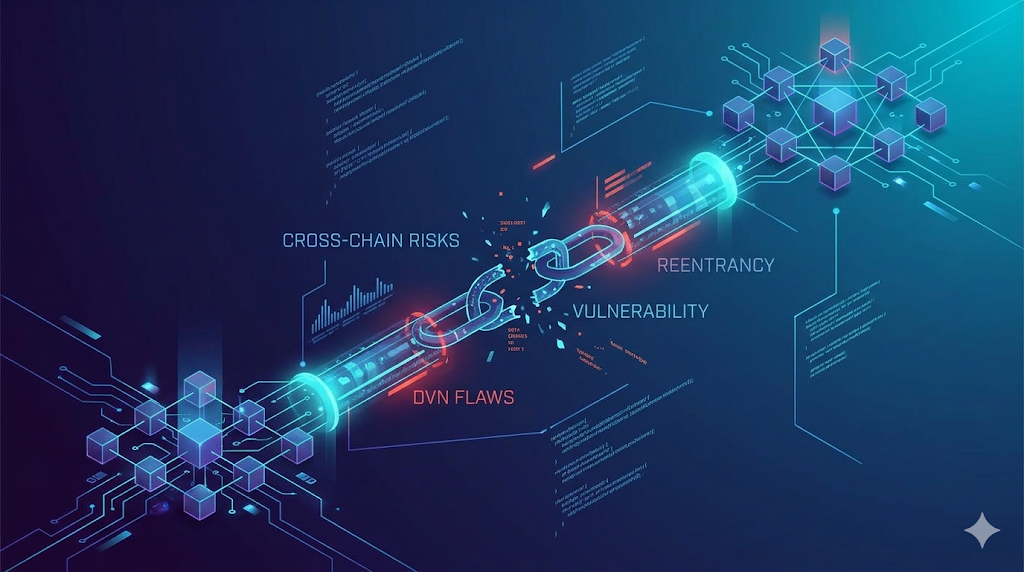
Are cross-chain bridges the "achilles heel" of the decentralized finance ecosystem in 2026? As of April, 2026, the answer is an emphatic yes—cross-chain bridge vulnerabilities remain the single greatest threat to capital preservation, accounting for over 68% of all DeFi losses in the first quarter of the year. The core security risks today are centered on validation logic flaws, compromised validator sets, and asynchronous state synchronization errors that allow attackers to forge messages or manipulate liquidity across separate blockchains. According to the April 2026 report from the Kansas City Fed, the increasing complexity of these "interoperability rails" has created a systemic risk where a single bridge exploit can destabilize the entire $300 billion stablecoin market.
To understand the current threat landscape, we must define the key pillars of bridge infrastructure:
Interoperability protocols: These are the foundational messaging layers that allow different blockchains to communicate and transfer value without a centralized intermediary.
Cross-chain bridges: These are the specific applications built on interoperability protocols that lock assets on one chain to mint representative wrapped tokens on another.
Smart contract audits: This refers to the rigorous technical review process used to identify logic flaws and vulnerabilities in the code governing bridge transfers.
Validation Logic Flaws: The Most Critical Risk
Validation logic flaws are the primary cause of high-value bridge exploits in 2026, occurring when the destination contract incorrectly verifies the authenticity of an inbound message. Based on technical post-mortems of the $292 million KelpDAO incident on April 18, 2026, attackers successfully bypassed security layers by exploiting a "1/1 DVN" configuration—essentially a single point of failure where only one validator's signature was required to authorize a massive minting event. This allows for message spoofing, where a malicious actor presents fake proof that the bridge contract accepts as valid, leading to the creation of unbacked assets.
These flaws often arise from the inherent difficulty of verifying the state of one blockchain from within the environment of another. According to research from the Frontiers in Blockchain journal published in March 2026, many bridge developers prioritize transaction speed (latency) over validation depth, leading to truncated security checks that can be fooled by sophisticated payloads. When the destination chain fails to perform a full cryptographic check against the source chain’s finalized state, the trust window remains open for exploitation.
To mitigate this risk, modern bridge architectures in 2026 are moving toward Multi-Message Aggregation. Instead of trusting a single signature or a small validator set, protocols are now requiring multiple independent proofs, such as a combination of ZK-SNARKs and decentralized validator network (DVN) consensus—before any asset is released. This ensures that even if one validation path is compromised, the transaction will be blocked by the secondary security layers.
The Danger of Compromised Validator Sets and Centralization
Compromised validator sets remain a top-tier security risk because many bridges still rely on a limited number of "trusted" nodes to sign off on transfers. The shift from regulation by enforcement to institutional structuring has forced many protocols to upgrade their validator sets, yet many legacy bridges still operate with as few as 5 to 9 active signers. If an attacker gains control of a simple majority of these private keys—often through social engineering or sophisticated phishing—they can authorize any amount of asset withdrawals, effectively draining the bridge’s liquidity pools.
According to a technical briefing from early April 2026, the rise of Profit-Driven Exploit Generation tools has made it easier for attackers to identify which validator sets are the most vulnerable to collusion or compromise. This data suggests that bridges utilizing Multi-Party Computation (MPC) and Threshold Signature Schemes (TSS) are significantly more resilient, as they require the attacker to compromise multiple geographically and technically diverse entities simultaneously to succeed.
The centralization of validator infrastructure also poses a geopolitical risk. Based on reports from the Mercati, infrastrutture, sistemi di pagamento, nearly 40% of major bridge validators are hosted on the same three cloud service providers, creating a cluster risk where a single infrastructure outage could lead to trapped assets or unintended liquidations across the DeFi landscape.
Asynchronous State Risks and Time-Gap Vulnerabilities
Asynchronous state risks occur because Layer-2 solutions and sidechains do not share a synchronized "global clock," creating a time-gap between when a transaction is initiated on one chain and when it is finalized on another. In 2026, attackers have increasingly used this latency window to execute cross-chain reentrancy attacks. By triggering a withdrawal on a source chain and then manipulating the state on the destination chain before the bridge has updated its internal ledgers, exploiters can "double-spend" the same liquidity pool.
Research from the NDSS Symposium in February 2026 highlights that these vulnerabilities are often missed by traditional auditing tools that only analyze a single chain in isolation. To address this, developers are now implementing Intent-Alignment Arbiters, AI-driven security layers that monitor the holistic "intent" of a user's cross-chain journey. If a transaction attempts to withdraw funds that have not been mathematically finalized on the source chain, the Arbiter can pause the transaction in real-time to prevent a drain.
| Risk Category | Primary Cause (2026) | Mitigation Strategy |
| Validation Flaws | 1/1 DVN Configuration / Spoofed Messages | Multi-DVN Consensus + ZK-Proofs |
| Key Compromise | Social Engineering / Cloud Centralization | MPC, TSS, and Validator Diversity |
| State Asynchrony | Latency gaps between L1 and L2 | Real-time "Intent" Monitoring |
| Liquidity Imbalance | Unbacked "Wrapped" Token Minting | Proof-of-Reserve (PoR) Audits |
Smart Contract Logic and "Wrappage" Risks
The logic governing how assets are "wrapped" and "unwrapped" is a frequent target for hackers who look for subtle rounding errors or arithmetic overflows in the bridge's code. In 2026, the complexity of Liquid Restaking Tokens (LRTs) has added a new layer of risk, as the value of the "wrapped" token (like rsETH) is tied to a fluctuating exchange rate rather than a static 1:1 peg. According to the V2E framework analysis, a miscalculation in the minting logic can allow an attacker to receive more wrapped tokens than their deposit is worth, leading to immediate protocol insolvency.
This risk is compounded by the use of upgradable contracts. While the ability to patch bugs is essential, an unvetted upgrade can accidentally introduce a new vulnerability or allow a malicious developer to insert a backdoor into the bridge. Based on current industry standards, any upgrade to a high-TVL bridge in 2026 must be subject to a mandatory 48-hour time-lock and a hybrid formal verification audit before it can be deployed to the mainnet.
Oracle Failure and Price Manipulation in Cross-Chain Lending
Oracles are the "eyes" of a cross-chain bridge, providing the price data necessary to calculate collateral ratios and liquidation thresholds. If an oracle is manipulated, often through a flash loan attack on a low-liquidity pool, the bridge may incorrectly believe that a user has more collateral than they actually do. According to technical data from April 2026, read-only reentrancy remains a dominant vector for oracle manipulation, where an attacker tricks a view-only function into reporting a stale or manipulated price during a complex transaction batch.
Modern bridges are now combatting this by using Multi-Oracle Aggregation. Instead of relying on a single price feed, bridges pull data from decentralized providers like Chainlink, Pyth, and internal TWAP (Time-Weighted Average Price) oracles. As noted in the Frontiers in Blockchain journal, this consensus-based pricing makes it exponentially more expensive for an attacker to manipulate the bridge's internal valuation of assets.
Economic Risks: Bad Debt and Liquidity Death Spirals
Beyond technical vulnerabilities, bridges face the economic risk of bad debt, where the underlying collateral is no longer sufficient to back the wrapped tokens in circulation. This often happens following a hack.
For example, the unbacked rsETH minted during the KelpDAO exploit created $177 million in bad debt for Aave, as the attacker used valueless tokens as collateral to borrow real ETH. This can lead to a "liquidity death spiral," where users rush to exit the bridge, causing slippage to skyrocket and further depegging the wrapped asset.
To prevent this, protocols in late 2026 have begun implementing Automated Circuit Breakers. These systems monitor the "backing ratio" of the bridge in real-time; if the value of the underlying assets falls below a certain threshold relative to the wrapped tokens, the bridge automatically pauses all withdrawals and entersrecovery mode. This socializes the loss and prevents the first few exiters from draining the remaining legitimate collateral.
Should You Trade Cross-Chain Assets on KuCoin?
Trading cross-chain and DeFi assets on KuCoin provides a crucial layer of professional oversight that protects you from the inherent security risks of unvetted bridges. While decentralized protocols offer innovation, the $292 million exploit seen in April 2026 proves that the infrastructure gap is still significant. By trading through KuCoin, you benefit from:
Rigorous Asset Vetting: KuCoin’s security teams perform deep-dive technical assessments of any cross-chain project before listing, ensuring the underlying bridge logic meets modern safety standards.
Institutional-Grade Risk Management: KuCoin utilizes advanced monitoring systems to detect and respond to "bad debt" scenarios or de-pegging events in real-time, often before they impact retail traders.
Diversified Liquidity: Access deep liquidity for Buy Bitcoin or Spot Trading without having to manage multiple wallets or navigate high-risk, experimental bridges yourself.
Passive Income Security: Use KuCoin Earn to generate yield on your assets within a secure, managed environment, avoiding the "yield-farming" risks associated with buggy L2 contracts.
In the volatile DeFi landscape of 2026, KuCoin acts as a secure gateway, allowing you to capture the growth of the cross-chain ecosystem while delegating the complex task of bridge security monitoring to a team of dedicated professionals.
Conclusion
The security risks of cross-chain DeFi bridges in April 2026 are a direct result of the interoperability paradox: the more connected our financial systems become, the more attack vectors are created for sophisticated exploiters. From the 1/1 DVN configuration flaws that enabled the KelpDAO incident to the persistent threat of read-only reentrancy in price oracles, the industry is currently navigating a high-stakes transition toward more robust verification models. As research from VeriChain indicates, the move toward hybrid formal verification, which now achieves 98.3% detection accuracy, is the only way to safeguard the billions of dollars currently flowing through L2 rails.
While the technical landscape remains challenging, the emergence of "DeFi United" collaborative recovery efforts and the integration of ZK-proofs suggest that the ecosystem is maturing. The lessons learned from the energy-driven inflation shocks and bridge exploits of early 2026 are already being coded into the next generation of "intent-aligned" protocols.
For developers, the mandate is clear: security must be prioritized over speed. For investors, takeaway is equally important: utilizing reputable platforms like KuCoin provides a necessary layer of protection against the asynchronous dangers of the decentralized frontier. As we continue to build the Internet of Value, our success will be defined not by the number of bridges we build, but by the strength of the validation that secures them.
FAQs
What is the "1/1 DVN" vulnerability found in modern bridges?
A 1/1 DVN vulnerability refers to a configuration where a cross-chain bridge requires only a single signature from a Decentralized Validator Network to authorize a transaction. This creates a single point of failure; if that one validator is compromised or spoofed, the attacker can authorize fraudulent minting or withdrawals, as seen in the 2026 KelpDAO exploit.
How does read-only reentrancy affect DeFi bridge security?
Read-only reentrancy allows an attacker to manipulate the state of a contract and then call a "view" function from a separate contract while the state is in an inconsistent, mid-transaction flux. This results in the bridge receiving incorrect price data, which can be used to bypass collateral requirements or trigger unfair liquidations.
Why are ZK-proofs considered the future of bridge safety?
ZK-proofs allow a destination blockchain to mathematically verify that a transaction occurred correctly on a source chain without needing to trust a third-party validator. This removes the human element of risk, as security is guaranteed by cryptography rather than the integrity of a small group of node operators.
What should I do if a bridge I am using is exploited?
If a bridge is exploited, you should immediately check the status of your "wrapped" tokens. If the bridge has lost its underlying collateral, the wrapped tokens may de-peg. On KuCoin, the platform's risk management team typically provides updates and may halt trading to protect users from "bad debt" slippage during such events.
How do Intent-Alignment Arbiters work in 2026 audits?
Intent-Alignment Arbiters are AI-assisted security layers that analyze the logical flow of a transaction across multiple chains. Instead of just checking if the code is syntactically correct, they verify if the transaction's result aligns with the user's intended goal. If the result is a massive, unbacked minting of tokens, the Arbiter flags the transaction as malicious.
Disclaimer:This content is for informational purposes only and does not constitute investment advice. Cryptocurrency investments carry risk. Please do your own research (DYOR).