

How to Short Bitcoin Without Getting Liquidated: Risk Management Rules That Work
TL;DR — Key Takeaways
-
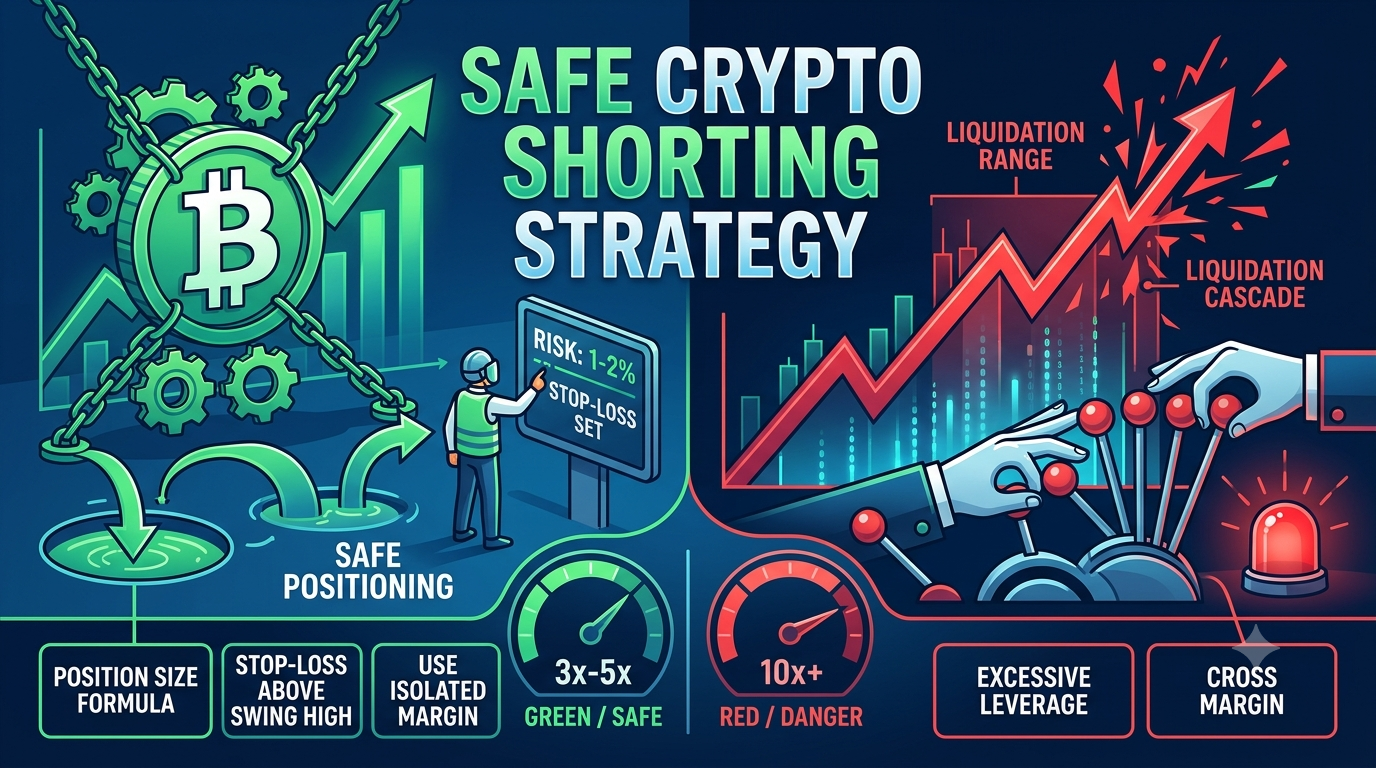
Liquidation happens when your losses eat through your margin. At 10x leverage, a ~9% move against you wipes you out. At 3x, you survive a ~30% move.
-
Use this formula: Position Size = (Account Balance × Risk %) ÷ (Entry Price − Stop-Loss Price). Risk only 1–2% of your account per trade.
-
Never exceed 5x leverage when learning to short. Start at 3x. The difference between 3x and 10x is the difference between surviving and being liquidated.
-
Place your stop-loss above the recent swing high, not at a random percentage. Let the market structure dictate your risk.
-
Isolated margin on KuCoin Futures caps your loss to the margin you allocate. Cross margin puts your entire account at risk—avoid it until you're experienced.
Why Liquidation Is the Key Barrier to Short Bitcoin Without Getting Liquidated
If you want to learn how to short Bitcoin without getting liquidated, the first truth to accept is this: most traders who get liquidated don't fail because of analysis—they fail because of math.
Liquidation is an automatic forced closure of your position when your losses exceed your margin. In crypto futures, there's no margin call, no phone ringing, no chance to wire more funds. The exchange's liquidation engine simply closes your position at market price, and your margin vanishes.
Here's the brutal math. Let's say BTC is trading at $62,800 (the current KuCoin Futures mark price as of July 2026). You open a short with $1,000 margin:
|
Leverage
|
Position Size
|
Liquidation Distance
|
What Kills You
|
|
3x
|
$3,000
|
BTC rises ~30% to ~$81,600
|
Major bull rally
|
|
5x
|
$5,000
|
BTC rises ~18% to ~$74,100
|
Strong relief rally
|
|
10x
|
$10,000
|
BTC rises ~9% to ~$68,400
|
Normal daily volatility
|
|
20x
|
$20,000
|
BTC rises ~4.5% to ~$65,600
|
A single volatile hour
|
|
50x
|
$50,000
|
BTC rises ~1.8% to ~$63,900
|
Normal spread + wick
|
The hard truth: At 10x leverage, Bitcoin's average daily volatility of 3–5% puts you within liquidation range *on a normal day*. At 20x, a single funding-rate countdown can wipe you out. This is why the #1 rule for anyone learning to short Bitcoin without getting liquidated is simple: use 3x–5x leverage, period.
The current market environment underscores this risk. BTC is trading at $62,787 on KuCoin Futures, with 24-hour turnover of $463 million USDT and open interest at 29,810 BTC (~$1.87 billion). High open interest means crowded positioning—and crowded positions can trigger rapid liquidation cascades when the market moves against the majority.
The Position Sizing Formula That Protects Your Account
Professional traders don't guess position sizes. They use a formula. Here's the exact calculation to short Bitcoin without getting liquidated:
The Formula
Position Size (in BTC) = (Account Balance × Risk Percentage) ÷ (Entry Price − Stop-Loss Price) Then: Required Margin = Position Size × Entry Price ÷ Leverage
Live Example: Shorting BTC at $62,800
Your account: $2,000 USDT
Your risk tolerance: 1.5% per trade ($30 max loss)
BTC entry price: $62,800
Stop-loss: $65,000 (above the recent swing high—explained in the next section)
Leverage: 5x
Step 1: Calculate position size
Position Size = ($2,000 × 0.015) ÷ ($65,000 − $62,800) = $30 ÷ $2,200 = 0.0136 BTC
Step 2: Check if you have enough margin
Required Margin = 0.0136 × $62,800 ÷ 5 = $171 USDT
Result: You're risking only $30 (1.5% of your account) to control a $854 position. Even if your stop-loss hits, you lose $30 and live to trade another day. If BTC drops to your target of $58,000, you pocket roughly $65 profit—a 2.1:1 reward-to-risk ratio.
Quick-Reference Position Sizing Table
|
Account Size
|
Risk per Trade (1.5%)
|
Leverage
|
Max Position
|
Typical Margin Used
|
|
$500
|
$7.50
|
3x–5x
|
~$75–$125
|
~$15–$25
|
|
$1,000
|
$15.00
|
3x–5x
|
~$150–$250
|
~$30–$50
|
|
$2,000
|
$30.00
|
3x–5x
|
~$300–$500
|
~$60–$100
|
|
$5,000
|
$75.00
|
3x–5x
|
~$750–$1,250
|
~$150–$250
|
|
$10,000
|
$150.00
|
3x–5x
|
~$1,500–$2,500
|
~$300–$500
|
Key insight: Notice how little margin you actually use. At 5x leverage with a $2,000 account, you're only tying up $100 of margin per trade. The rest of your capital sits safely in your wallet, untouched. This is how you survive.
Leverage Limits: Why 3x–5x Is the Maximum for Safe Shorting
Your liquidation buffer—the price move needed to wipe you out—shrinks exponentially as leverage increases:
|
Leverage
|
Approx. Liquidation Buffer
|
Real-World Scenario
|
|
3x
|
~30% against you
|
You survive most rallies
|
|
5x
|
~18% against you
|
You survive normal relief rallies
|
|
10x
|
~9% against you
|
Wiped out by daily volatility
|
|
20x
|
~4.5% against you
|
Wiped out by a single wick
|
|
50x
|
~1.8% against you
|
Wiped out by the bid-ask spread
|
|
100x
|
~0.9% against you
|
Wiped out by exchange price discrepancy
|
Why KuCoin Defaults to 5x
Notice that when you open the KuCoin Futures BTCUSDT Perpetual trading page, the default leverage is set to 5.00x. This isn't random—it's a calculated recommendation based on risk management best practices.
KuCoin supports up to 125x leverage on BTC perpetuals, but the platform starts you at 5x for a reason. Treat anything above 5x as a professional-only setting. Beginners who crank leverage to 20x or 50x aren't trading—they're gambling with mathematical certainty of eventual ruin.
Stop-Loss Placement: The Method That Actually Works
Most beginners place stop-losses at arbitrary percentages: "I'll stop out if it goes 5% against me." This is wrong. Your stop-loss should be placed based on market structure—specifically, above the recent swing high that invalidates your short thesis.
The Swing-High Method
When you short Bitcoin, you're betting that the price will make a lower low. If the price instead breaks above the recent swing high, your thesis is wrong. That's where your stop-loss belongs.
Step-by-step placement:
-
Identify the recent swing high on the 4-hour or daily chart. This is the highest point Bitcoin reached before the current downtrend began. Let's say it's $65,000.
-
Add a buffer of 1–2% to account for volatility and wicks. Your stop-loss becomes $66,000–$66,300.
-
Calculate your position size using the formula above, with the stop-loss distance now being $66,300 − $62,800 = $3,500.
-
Enter the short at $62,800, knowing exactly how much you're risking.
Why This Beats Percentage-Based Stops
|
Method
|
Stop at $62,800 Entry
|
Problem
|
|
"5% stop"
|
$65,940
|
Placed below the swing high of $65,000. Likely to get hit by a normal pullback before the real move down.
|
|
"Above swing high"
|
$66,300
|
Only triggers if the downtrend structure is genuinely broken. Survives normal noise.
|
The swing-high method accepts a slightly larger dollar risk in exchange for a dramatically higher win rate. You get stopped out less often by random volatility, and when you do get stopped out, it means you were genuinely wrong—not just unlucky.
Setting Stops on KuCoin Futures
On the KuCoin Futures trading interface:
-
Open your BTCUSDT Perpetual position.
-
After entering your short, locate your open position in the Positions tab at the bottom of the screen.
-
Click "TP/SL" (Take Profit / Stop Loss) on your position row.
-
Enter your Stop-Loss Price (e.g., $66,300).
-
Enter your Take-Profit Price (e.g., $58,000).
-
Click Confirm.
Your stop is now server-side. Even if your internet drops, KuCoin's system will execute it. This is non-negotiable—never trade without a stop-loss set on the platform.
Isolated vs. Cross Margin: Choose the One That Saves Your Account
KuCoin Futures offers two margin modes, and your choice determines whether a single bad trade costs you a small allocation or your entire account.
Isolated Margin (Recommended for Short Sellers)
In Isolated Margin mode, each position has its own dedicated margin. If your short gets liquidated, only the margin allocated to that position is lost. The rest of your futures wallet remains untouched.
Example: You allocate $200 margin to a BTC short at 5x leverage. Even if the position is liquidated, your remaining $1,800 in the futures wallet is safe. Isolated margin acts as a circuit breaker for your account.
When to use it: Always, if you're a beginner or intermediate trader. If you're testing a short strategy, trading volatile markets, or running anything above 3x leverage, Isolated Margin is your safety net.
Cross Margin (Advanced Only)
In Cross Margin mode, your entire futures account balance backs all open positions. Profits from one trade can cover losses in another, but a single catastrophic move can drain your whole account.
Example: You have $2,000 in your futures account and open a BTC short using cross margin. If BTC rallies hard enough, the system pulls from your entire $2,000 balance to avoid liquidation—until there's nothing left. All positions may be liquidated simultaneously.
When to use it: Only if you're running hedged strategies (e.g., long spot BTC + short BTC futures) where gains in one leg offset losses in the other. Even then, monitor your Risk Ratio constantly—KuCoin displays it in real time, and when it hits 95%, the system starts canceling your orders. At 100%, liquidation triggers.
Comparison Table
|
Feature
|
Isolated Margin
|
Cross Margin
|
|
Collateral
|
Fixed per position
|
Entire account balance
|
|
Liquidation Impact
|
Only that position's margin lost
|
Can wipe entire account
|
|
Risk Control
|
Hard cap on each trade
|
Flexible but dangerous
|
|
Best For
|
Beginners, short sellers, high-leverage trades
|
Hedgers, professionals, multi-position portfolios
|
|
Risk Ratio Display
|
Per-position margin ratio
|
Account-wide risk rate (liquidation at ≥100%)
|
Verdict: If your goal is to short Bitcoin without getting liquidated in a way that preserves your capital, use Isolated Margin until you have 6+ months of profitable futures trading under your belt.
Conclusion
Learning how to short Bitcoin without getting liquidated isn't about finding a secret indicator or perfect entry timing. It's about mastering the boring math of risk management: small position sizes, low leverage, and stop-losses placed at logical levels.
Remember the core formula: Position Size = (Account Balance × 1–2%) ÷ (Entry − Stop-Loss). At 3x–5x leverage with isolated margin, even a series of losing trades won't end your trading career. The traders who survive bear markets aren't the ones with the best predictions—they're the ones who never let a single trade destroy their account.
BTC is trading at $62,787 on KuCoin Futures as of July 2026, with open interest at nearly $1.9 billion—a reminder that billions in leveraged positions are one volatile move away from liquidation. Don't be one of them. Use the position-sizing formula. Cap your leverage at 5x. Place your stop above the swing high. And practice on KuCoin's demo account until these rules become automatic.
FAQs
Can I short Bitcoin without any risk of liquidation?
No—any leveraged futures trade carries liquidation risk. The only way to short without liquidation risk is to short spot (borrow and sell actual BTC), which requires finding a lender and doesn't offer leverage. In futures, the goal isn't zero risk—it's controlled, capped risk through position sizing and stop-losses.
What happens when I get liquidated on KuCoin Futures?
In Isolated Margin, your position closes at market price and you lose the margin allocated to that trade. Your remaining account balance is untouched. In Cross Margin, liquidation can cascade across all positions, potentially draining your entire futures wallet. This is why beginners should always use Isolated Margin.
Should I use market or limit orders for stop-losses?
Use stop-market orders for your stop-loss. They guarantee execution but may have slippage in volatile conditions. For take-profits, use limit orders to lock in your exact target price. Never use a stop-limit as your primary stop-loss—if the market gaps past your limit price, you won't get filled and losses can extend toward liquidation.