

European Central Bank to Watch Rising Energy Prices — 21bp Hike Expected in September
2026/07/26 15:05:00
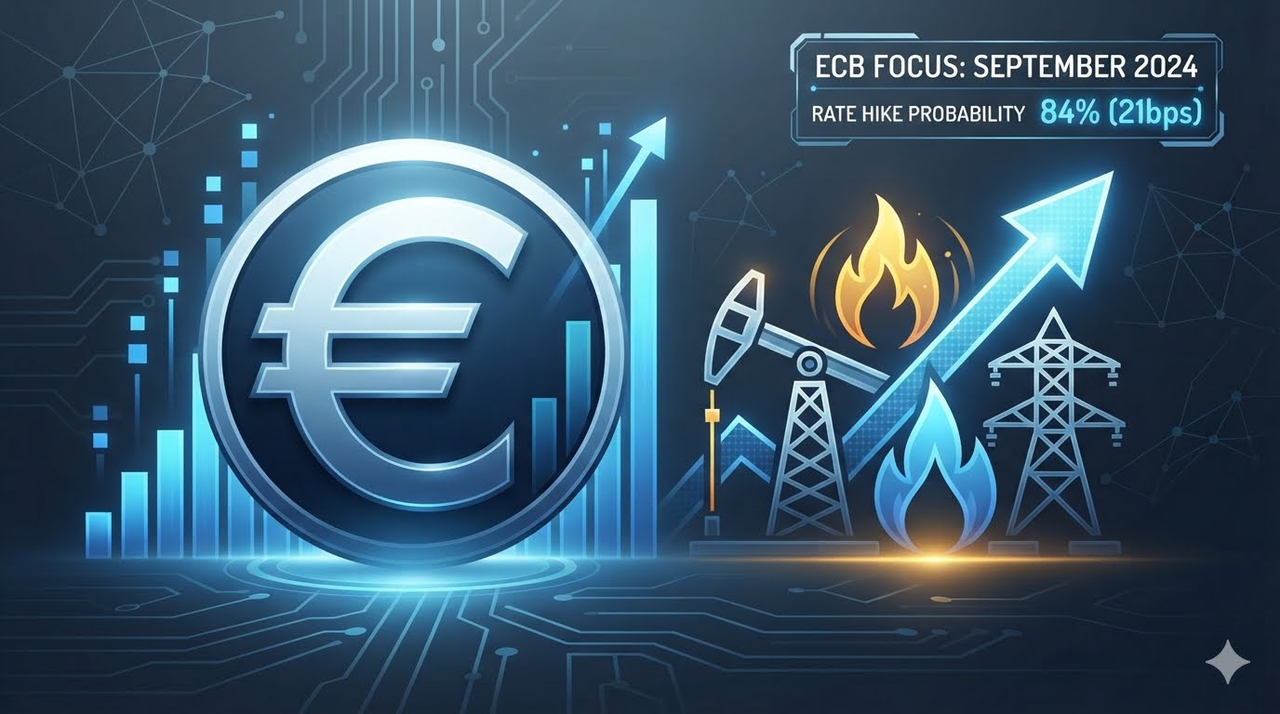
The global financial landscape is experiencing a strong convergence of geopolitical friction, structural commodity shocks, and monetary policy adjustments. At the center of this shift is the Eurozone economy. Following its decision to hold its key benchmark deposit rate at 2.25% during the July monetary policy meeting, the European Central Bank (ECB) has found itself forced into a defensive posture. A sudden and severe resurgence in crude oil and natural gas prices has upturned previous assumptions that inflation was safely on a path toward cooling down.
As a result, overnight indexed swap (OIS) markets have moved aggressively, fully pricing in a 21-basis-point (bp) interest rate hike for the upcoming September meeting. This market movement signals an 84% implied probability of a standard 25-basis-point tightening move, ending any hopes for an extended policy pause.
For digital asset investors, these macroeconomic developments are far from irrelevant noise. Cryptocurrencies do not trade in a vacuum. Instead, they operate downstream from global fiat liquidity flows, which are fundamentally governed by major central banks like the ECB and the Federal Reserve. When the cost of capital in the world’s second-largest economic bloc rises, the ripple effects alter global money supply, cross-border capital flows, and investor appetite for risk-on assets.
The Catalyst: Geopolitics, Energy Shocks, and the ECB’s July Pause
The primary catalyst behind the ECB’s hawkish pivot is a structural supply-side shock in the energy markets, ignited by escalating geopolitical tensions. The rekindling of direct friction involving major Middle Eastern powers has introduced acute logistical risks to critical maritime trade corridors, including the Red Sea and the Strait of Hormuz. Continuous drone and missile strikes targeting commercial shipping vessels have forced maritime freight conglomerates to reroute tankers away from the Suez Canal, opting instead for the lengthy route around the Cape of Good Hope.
This disruption has systematically increased shipping insurance premiums and fuel consumption costs, driving global benchmark Brent crude back toward the $98 to $100 per barrel range. Concurrently, European natural gas prices have spiked to a three-year high, exacerbated by record-breaking summer heatwaves across southern Europe that have strained regional electrical grids and limited hydro-electric and nuclear power generation capacities.
This sudden energy shock caught the Governing Council at a delicate policy crossroads. During its July meeting, the ECB chose to maintain its key deposit facility rate at 2.25%. This pause followed a 25-basis-point rate increase implemented in June, which marked the central bank's first rate hike in three years. The June hike was executed under the assumption that Eurozone headline consumer price inflation, which cooled to 2.8%, was consolidating toward the bank's long-term 2.0% target.
By freezing rates in July, ECB President Christine Lagarde intended to gather a wider array of second-quarter economic data, particularly regarding corporate wage settlements and service-sector inflation. However, the subsequent energy price spikes altered those calculations, prompting monetary authorities to publicly acknowledge that upstream cost pressures pose a threat of second-round inflation effects.
To understand the institutional baseline from which the ECB is operating ahead of the autumn sessions, the current structure of European interest rates is detailed below:
Current ECB Benchmark Interest Rates
| Rate Type | Current Level (%) | Last Action (June) | September Market Implied Expectation |
| Deposit Facility Rate | 2.25% | +25 bps | 2.46% - 2.50% (84% Implied Probability) |
| Main Refinancing Rate | 2.40% | +25 bps | 2.61% - 2.65% |
| Marginal Lending Facility | 2.65% | +25 bps | 2.86% - 2.90% |
Decoding the September Pricing: What Does a "21bp Hike" Actually Mean?
In traditional fixed-income and derivative markets, interest rate expectations are not measured through binary guesses, but via continuous market-implied pricing derived from Overnight Indexed Swaps (OIS). When institutional trading desks state that a "21bp hike is expected," they are describing a mathematical aggregation of millions of euros worth of derivative contracts. Because central banks historically adjust interest rates in discrete increments of 25 basis points (0.25%), an implied pricing of 21 basis points means that over four-fifths of the market is actively betting on a standard quarter-point hike, while a minor fraction expects an unchanged policy stance.
This pricing reveals that institutional fixed-income traders have concluded that the probability of the ECB staying on hold in September is exceptionally low.
The underlying driver of this market pricing is the classic macroeconomic dilemma: stagflation. The ECB finds itself navigating a restrictive policy path while dealing with weak domestic economic growth. Recent industrial data from the Eurozone painted a challenging picture, showing negative surprises in German factory orders and a minor contraction in broader Eurozone manufacturing purchasing managers' indexes (PMIs). Under normal economic conditions, a weakening industrial base would prompt a central bank to cut interest rates to stimulate credit creation and business investment.
However, because the current economic slowdown is driven by supply-side energy costs rather than excess demand, cutting interest rates would devalue the Euro, make dollar-denominated oil imports more expensive, and worsen domestic inflation.
Faced with this scenario, the ECB’s primary mandate of price stability overrides short-term growth concerns. In her post-meeting press conferences, President Lagarde stated that the pass-through of energy shocks to core inflation exhibits a lag, and the full impact has yet to manifest across the services sector.
Internal ECB research divisions have begun modeling severe economic scenarios. If energy supply lines in the Middle East remain disrupted throughout the winter, the central bank’s projections indicate that headline Eurozone inflation could rebound back toward a 3.5% to 4.4% range. Consequently, major commercial banks, including Deutsche Bank and BNP Paribas, have revised their multi-quarter forecasts, warning clients that the ECB’s restrictive cycle may extend well into next year.
How ECB Decisions Impact Global Crypto Liquidity
The transmission channel through which Eurozone monetary policy impacts the cryptocurrency market is anchored in the behavior of global fiat liquidity. Capital is highly fungible and constantly seeks the highest risk-adjusted yield. When the ECB raises its deposit rate, it alters the mathematical models used by international institutional desks, market makers, and quant trading firms. The relationship between monetary tightening and digital asset valuations functions through three primary economic mechanisms:
The Contraction of Global M2 Money Supply: Cryptocurrencies, led by Bitcoin, have shown a strong historic correlation with the expansion and contraction of the global M2 money supply. When major central banks simultaneously run restrictive monetary policies—either through higher policy interest rates or quantitative tightening (QT)—they reduce the availability of credit within the commercial banking system. As credit conditions tighten, the overall velocity of money slows down. This reduction in excess fiat liquidity naturally limits the volume of capital available for deployment into speculative or early-stage technology asset classes, which includes the entire digital asset ecosystem.
Fixed-Income Capital Flight: The rise in the ECB deposit rate directly pushes up sovereign bond yields across Europe, with the benchmark German 10-year Bund yield climbing past 3.19%. When risk-free sovereign debt instruments offer guaranteed nominal yields above 3%, the opportunity cost of holding non-yielding or highly volatile assets increases substantially. Institutional asset managers operating under strict risk mandates often reallocate a percentage of their portfolios out of variable-risk capital allocations and back into sovereign bonds. Within the crypto market, this shift reduces the capital pool that supports liquidity on spot order books and derivatives exchanges.
Stablecoin Yield Arbitrage: A more direct operational threat to crypto-native liquidity lies within the mechanics of stablecoin yields. The stablecoin market, dominated by USDT and USDC, represents the primary fiat-to-crypto liquidity bridge. When traditional financial cash yields are near zero, investors are highly incentivized to lock stablecoins into decentralized finance (DeFi) lending protocols or yield aggregator platforms. However, as traditional yields climb toward 3.5% to 5.0% on short-term fiat instruments, the risk-adjusted yield premium of DeFi diminishes. Large funds often choose to redeem stablecoins for physical fiat currency to capture clean yields in traditional markets, draining foundational liquidity from the crypto ecosystem.
Bitcoin at a Crossroads: Risk-On Asset or Stagflation Hedge?
As the market prepares for the ECB’s September rate decision, Bitcoin finds itself navigating dual identities: its short-term behavior as a traditional "risk-on" asset versus its long-term structural role as a decentralized hedge against inflation. This tension creates a distinct divergence between near-term price action and multi-year fundamental asset positioning.
In the immediate weeks surrounding a central bank rate hike, automated algorithmic trading systems and institutional risk-management models treat Bitcoin primarily as an equity-adjacent risk asset. Modern institutional desks manage Bitcoin allocations alongside high-growth tech stocks and index derivatives. When a major central bank like the ECB delivers an energy-driven rate hike, it raises the discount rate applied to corporate future cash flows, putting pressure on traditional equity markets. Algorithmic systems often execute programmatic sell orders across all risk-correlated assets simultaneously. This dynamic means that an aggressive ECB rate hike in September can trigger short-term capital liquidations and spikes in volatility for Bitcoin and major altcoins, regardless of crypto-specific fundamentals.
Over a longer time horizon, however, the fundamental narrative for Bitcoin undergoes a structural transformation. The root cause of the ECB’s tightening cycle is not an overheating, highly productive economy, but rather the erosion of fiat currency purchasing power driven by rising energy inputs. When citizens within the Eurozone witness domestic electricity, heating, and fuel costs increasing while their savings yield sub-inflation returns in commercial banks, the core value proposition of absolute digital scarcity becomes more apparent. Unlike fiat currencies, which can see supply expansion or interest rate adjustments by central bank committees, Bitcoin features a fixed programmatic supply cap of 21 million units. This structural independence makes energy-driven macro crises a long-term catalyst for Bitcoin’s role as an anti-inflationary alternative asset.
For users executing trades on KuCoin, managing capital through a major central bank interest rate shift requires a balanced approach that combines short-term risk management with systematic portfolio positioning. Rather than reacting emotionally to sudden intraday price movements, spot and derivatives traders can utilize specific platform tools and market frameworks to navigate the expected volatility:
Systematic Accumulation via Dollar-Cost Averaging (DCA): Given the likelihood of short-term liquidity contraction during the summer-to-autumn transition, spot market participants can utilize the KuCoin Trading Bot to deploy automated DCA strategies. By fracturing capital into consistent purchase intervals during macro-driven price consolidations, long-term investors can lower their average entry price for high-conviction assets like Bitcoin (BTC) and Ethereum (ETH) without attempting to time precise market bottoms.
Hedging Exposure through KuCoin Futures: Professional traders holding large spot portfolios can manage downside risk by selectively entering short hedge positions within the KuCoin Futures interface. Utilizing low leverage and monitoring key funding rates allows market participants to offset potential temporary spot pullbacks, while capitalizing on heightened directional volatility around the September ECB press conference dates.
Optimizing Stablecoin Reserves on KuCoin Earn: During microeconomic windows where risk-on liquidity is contracting, maintaining capital flexibility is critical. Traders can transition a portion of their tactical trading balances into fully backed stablecoins like USDT or USDC, locking them into flexible or fixed-term yield products via KuCoin Earn. This approach keeps capital liquid and ready for redeployment when market conditions clear, while still generating steady daily returns that compete effectively with traditional money market rates.
Conclusion
The European Central Bank’s upcoming policy path serves as an important reminder of the interconnected nature of modern global finance. Driven by structural geopolitical friction and rising upstream energy costs, the expected 21-basis-point interest rate hike in September represents an institutional effort to manage persistent supply-side inflation. While the resulting global fiat liquidity squeeze may create near-term friction across both traditional and digital asset markets, it also highlights the foundational design principles of decentralized digital assets.
By staying informed on these macroeconomic trends and utilizing comprehensive suite of spot, futures, and yield products, traders can approach periods of central bank policy adjustments with clarity and a structured plan.
Join KuCoin 9th Anniversary Trading Campaign
KuCoin is celebrating its 9th anniversary with a special platform campaign filled with exclusive rewards, trading activities, and limited-time offers. Don’t miss the chance to participate and enjoy the benefits as the exchange marks nine years of growth and innovation. Visit the official campaign page now:
FAQs
Why does the European Central Bank (ECB) policy matter to crypto traders?
The ECB regulates the world’s second-largest fiat currency bloc. Its monetary tightening drains global M2 liquidity, which directly reduces the pool of speculative capital available to flow into high-risk digital assets like Bitcoin and altcoins.
What does a "21bp hike" mean in simple trading terms?
Central banks usually move interest rates in 25-basis-point steps. A market pricing of 21bps means institutional fixed-income traders are pricing in an 84% probability of a standard quarter-point rate increase for the September meeting.
How do rising oil and natural gas prices trigger a rate hike?
Soaring energy costs increase upstream manufacturing and transport expenses. These supply-side shocks create sticky, second-round headline consumer inflation, forcing the ECB to raise benchmark interest rates to maintain its core mandate of price stability.
Will an aggressive ECB rate decision crash Bitcoin's price?
In the short term, algorithmic trading desks often bundle Bitcoin with traditional tech equities. A hawkish ECB surprise can trigger programmatic sell-offs and liquidations, causing temporary risk-off price drawdowns across the crypto market.
Can Bitcoin act as a reliable hedge against European inflation?
Yes, over a long-term horizon. While energy shocks devalue fiat currency purchasing power through infinite printing, Bitcoin's strict, immutable programmatic cap of 21 million units highlights its fundamental strength as decentralized digital gold.
Disclaimer
The information provided on this page may originate from third-party sources and does not necessarily represent the views or opinions of KuCoin. This content is intended solely for general informational purposes and should not be considered financial, investment, or professional advice. KuCoin does not guarantee the accuracy, completeness, or reliability of the information, and is not responsible for any errors, omissions, or outcomes resulting from its use. Investing in digital assets carries inherent risks. Please carefully evaluate your risk tolerance and financial situation before making any investment decisions. For further details, please consult KuCoin’s Terms of Use and Risk Disclosure.