

DoorDash Pays with Stablecoins: Why Web3 Payments Are Going Mainstream
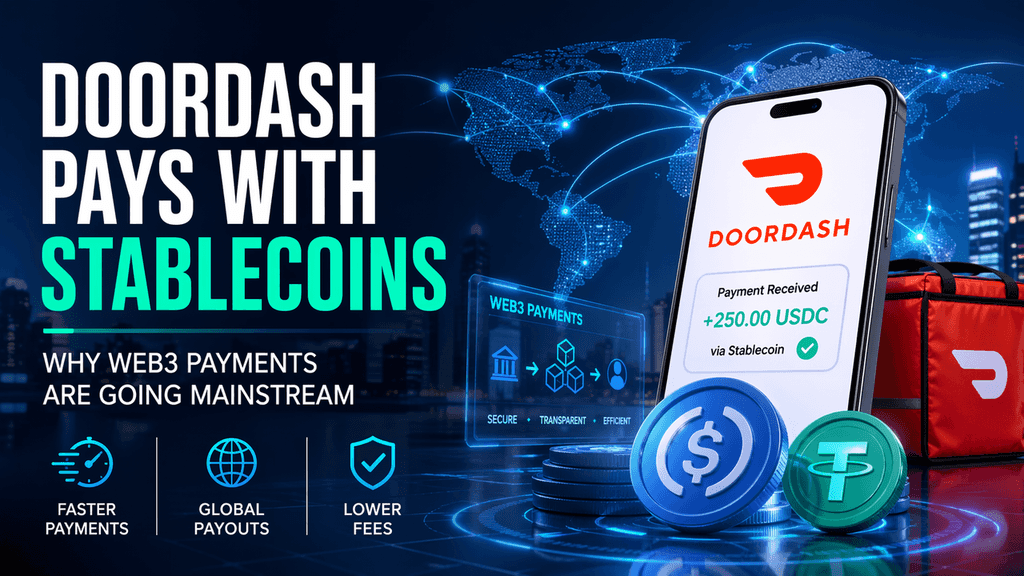
What happens when a mainstream delivery platform starts using stablecoin infrastructure for real payment flows? The answer is bigger than one company announcement. It points to a broader shift in how blockchain is being used across commerce.
Recent reporting says DoorDash is working with Tempo, a payments-focused blockchain incubated by Stripe and Paradigm, to build stablecoin-powered payment infrastructure for Dashers, merchants, and users in more than 40 countries. That matters because it moves stablecoins out of speculation and into operational payments. By the end of this article, you will understand what this development means, why stablecoins are gaining momentum in global payments, what benefits businesses see in the model, and what challenges still need to be addressed.
Hook
Stablecoins were once treated mainly as crypto trading tools. Now they are increasingly being used to solve one of the oldest business problems on the internet: moving money across borders faster and at lower cost. DoorDash’s reported adoption of stablecoin rails is one of the clearest signs yet that Web3 payments are entering the mainstream.
Overview
This article covers what stablecoin payments are, why DoorDash’s move matters, how stablecoin rails can impact the crypto and payments landscape, the main advantages for large platforms, and the risks businesses still need to manage before adoption scales further.
Thesis
The purpose of this article is to explain why DoorDash’s stablecoin integration is not just another crypto headline, but evidence that blockchain-based payments are becoming practical infrastructure for global commerce, especially in payouts and cross-border settlement.
Introduction to Stablecoin Payments
Stablecoin payments use blockchain-based digital tokens that are typically pegged to fiat currencies such as the US dollar. Their appeal in commerce is simple: they can move value globally on internet-native rails while maintaining a relatively stable reference price compared with more volatile crypto assets. Stripe’s documentation says stablecoin payments allow customers to pay with crypto wallets while completed payments settle into a Stripe balance in USD. Stripe currently supports stablecoin payments using USDC, USDP, and USDG on selected networks.
Tempo describes itself as a blockchain built specifically for real-world payments via stablecoins, not for speculative trading. Its core pitch is that existing blockchain systems were not designed for payments at scale, while Tempo is purpose-built for high-volume payment use cases such as global payouts, remittances, and merchant settlement.
That distinction matters. The key concept here is not crypto as an investment narrative. It is stablecoins as payment infrastructure. According to recent reporting, DoorDash is working with Tempo to bring stablecoin-powered payment infrastructure to its marketplace, with cross-border speed, lower costs, and transaction flexibility among the main reasons cited for the integration.
DoorDash Pays with Stablecoins
DoorDash’s reported move into stablecoin payments shows how crypto is being used for real business operations, especially global payouts and settlement.
-
DoorDash is reportedly using stablecoin infrastructure for payments.
-
The rollout is said to cover more than 40 countries.
-
The focus is on faster and smoother cross-border transactions.
-
This shows real-world utility beyond crypto trading.
-
Stablecoins can help reduce payment delays and friction.
-
The move supports growing enterprise use of blockchain payments.
-
It also signals that Web3 payments are becoming more mainstream.
Impact of Stablecoin Infrastructure on Cryptocurrency
-
DoorDash links crypto to a practical business use case: Its reported move shows how cryptocurrency can support real payment operations, especially payouts, rather than staying limited to trading activity.
-
The focus shifts from speculation to utility: The bigger significance is not retail hype but transaction efficiency. Stablecoin infrastructure is being used to solve payment friction in real marketplace systems.
-
Stablecoins fit into existing business workflows: DoorDash is reportedly using Tempo for payment flows involving Dashers, merchants, and users across more than 40 countries, showing how blockchain can work inside established platform operations.
-
One of the strongest aspects of this model is that stablecoin rails can work in the background, without forcing users to completely change how they normally interact with payments.
-
The crypto narrative is evolving: This kind of adoption moves the conversation away from whether crypto can replace banking and toward whether it can improve specific financial functions like cross-border settlement and global payouts.
-
High-friction payment areas are the first target: Companies are focusing on problems such as payroll, remittances, and international disbursements, where traditional systems are often slower and more expensive.
-
Stablecoin infrastructure strengthens enterprise adoption: Stripe’s materials around stablecoin payments highlight faster global payments and infrastructure efficiency, supporting the idea that this technology is becoming more useful for mainstream business applications.
-
Tempo serves as a strong case study: The broader Tempo ecosystem shows how stablecoins are being positioned for enterprise payment flows, not just crypto-native use cases.
-
This signals a move beyond pilot projects: DoorDash’s involvement suggests the market is shifting from experimentation toward real infrastructure with measurable business value.
-
Traditional payment rails face growing competition in specific areas: Where legacy systems remain costly or slow, stablecoin infrastructure is increasingly being considered as a more flexible alternative.
Advantages of Stablecoin Payments in the Current Market
Faster cross-border settlement
Traditional international payment systems often involve intermediary banks, local processing windows, and delays. Stablecoin-based rails can reduce that friction by allowing funds to move on-chain with faster settlement mechanics. Tempo positions this as one of its central advantages, and Stripe’s stablecoin materials emphasize global payment efficiency as a core use case.
Lower payment friction for global platforms
For a platform with international reach, payout complexity can become expensive. Recent reporting says DoorDash’s rollout is focused on global marketplace payment infrastructure, which makes sense because international disbursement is usually where inefficiencies are most visible. Stablecoin rails can reduce fragmentation across regional payout systems.
Better infrastructure for internet-native commerce
Stablecoins operate on programmable rails. That opens the door to payment automation, wallet-based disbursements, and more flexible settlement flows. Stripe’s documentation shows that businesses can accept stablecoins while settling completed payments in USD, which lowers the barrier to adoption for companies that want blockchain efficiency without fully changing their treasury model.
Enterprise-grade payment tooling
One reason this trend is gaining credibility is the involvement of large payment infrastructure providers. Tempo is positioned as a payments-first blockchain incubated by Stripe and Paradigm, while Stripe has expanded its stablecoin product stack across payment flows and related services. That makes enterprise adoption more realistic than in earlier crypto cycles.
Real-world commercial relevance
The biggest benefit is that this is not theoretical anymore. DoorDash is a mainstream platform, not a crypto-native startup. When a company like that explores stablecoin-powered payment infrastructure, it signals that blockchain payments are being judged on operational performance, not hype alone.
Challenges and Considerations
Despite the momentum, stablecoin adoption still comes with real constraints.
Regulatory and compliance requirements
Stablecoin payments do not remove the need for legal compliance. Stripe’s stablecoin payment terms and documentation make clear that these products operate within structured payment and settlement frameworks. Businesses still need jurisdiction-specific review, onboarding controls, and transaction monitoring.
User experience and conversion concerns
Not every worker, merchant, or user wants to receive value in stablecoins. For widespread adoption, businesses need off-ramp options, wallet support, clear interfaces, and simple conversion paths back into local currency where needed. That is an inference supported by the sources’ emphasis on payouts and settlement rather than a full consumer shift.
Network, integration, and treasury complexity
Stablecoin systems still require integration work, treasury planning, and operational controls. Companies must decide how funds are received, held, settled, and reconciled. Even with strong infrastructure, rolling out stablecoin payments at scale is a payments-operations project, not just a simple feature launch.
Market perception risk
Stablecoins may be more stable than volatile crypto assets, but they still carry reputational baggage because many consumers associate them with the wider crypto sector. Mainstream adoption will depend on making the payment experience reliable, compliant, and easy to understand.
A practical precaution for businesses is to introduce stablecoin rails where they deliver the clearest value first, such as international payouts or settlement, then expand only after compliance, UX, and treasury processes are proven. That conclusion aligns with the current emphasis in reporting and product documentation on cross-border payment use cases.
Why Web3 Payments Are Becoming Mainstream
Web3 payments are going mainstream because they are solving real payment problems, not just attracting crypto attention. Stablecoins and blockchain payment rails are increasingly being used for cross-border transfers, merchant checkout, and business payouts where speed, cost, and global reach matter most.
-
Faster global payments: Stablecoin rails can move money more quickly than many traditional cross-border systems, especially for international settlement and remittances.
-
Lower transaction friction: Businesses are adopting stablecoins because they can reduce payment delays, simplify settlement, and lower some cross-border costs.
-
Big platforms are adopting them: Shopify introduced USDC payments through Shopify Payments, and PayPal expanded PYUSD to 70 markets, showing that Web3 payments are moving beyond crypto-native apps.
-
Infrastructure is getting better: Stripe now supports stablecoin payments that settle in USD, making blockchain payments easier for mainstream businesses to use.
-
Stablecoins are more practical than volatile crypto for payments: Their price stability makes them more suitable for commerce, payroll, and settlement than assets that swing sharply in value.
-
Businesses do not need to replace their full payment stack: Companies can add stablecoin rails for specific use cases like payouts or checkout without rebuilding everything from scratch.
That is why Web3 payments are becoming mainstream: they are increasingly being used as practical financial infrastructure for real commerce.
CTA
Want to learn how Web3 is changing finance and online transactions? Visit KuCoin’s Web3 learning hub for more insights.
Conclusion
DoorDash’s reported stablecoin integration is important because it shows how Web3 payments are evolving into real business infrastructure. The story is not just about one delivery company experimenting with blockchain. It is about stablecoins finding traction in one of the most practical corners of finance: global payouts and settlement.
Stablecoin payments offer faster cross-border transfers, lower friction, and more flexible internet-native money movement. At the same time, they still require compliance controls, operational planning, and better user experience to scale cleanly. Even so, the direction is clear. The more major platforms use stablecoins behind the scenes for real payment flows, the more mainstream Web3 payments become.
FAQs
What does it mean that DoorDash pays with stablecoins?
It means DoorDash is reportedly using stablecoin-based payment infrastructure to support marketplace payment flows such as payouts and settlement, rather than relying only on traditional banking rails.
What blockchain is DoorDash using for stablecoin payments?
Recent reporting links DoorDash with Tempo, a payments-focused blockchain incubated by Stripe and Paradigm.
Why are stablecoins useful for payments?
Stablecoins can support faster global money movement, lower cross-border friction, and more programmable payment flows while keeping value tied to fiat-backed units such as the US dollar.
Are stablecoin payments replacing traditional banking?
Not entirely. The stronger near-term use case is improving specific payment flows such as international payouts and settlement, not replacing every existing payment method. This is an inference from how Stripe and Tempo describe current use cases.
Which stablecoins does Stripe support for payments?
Stripe documentation says it supports stablecoin payments using USDC, USDP, and USDG on supported networks, with settlement into a Stripe balance in USD.
Why is this considered a sign that Web3 payments are going mainstream?
Because a major consumer platform is reportedly using blockchain infrastructure for real payment operations. That is a stronger sign of adoption than purely speculative or crypto-native activity.
What are the main challenges with stablecoin payment adoption?
The biggest challenges include compliance, legal review, treasury operations, user onboarding, wallet or off-ramp support, and integration complexity.
Disclaimer
The information provided on this page may originate from third-party sources and does not necessarily represent the views or opinions of KuCoin. This content is intended solely for general informational purposes and should not be considered financial, investment, or professional advice. KuCoin does not guarantee the accuracy, completeness, or reliability of the information, and is not responsible for any errors, omissions, or outcomes resulting from its use. Investing in digital assets carries inherent risks. Please carefully evaluate your risk tolerance and financial situation before making any investment decisions. For further details, please consult KuCoin’s Terms of Use and Risk Disclosure.