

Aave Set to Restrict High-Risk Assets Across V3, V4 & Horizon
2026/06/02 15:55:00
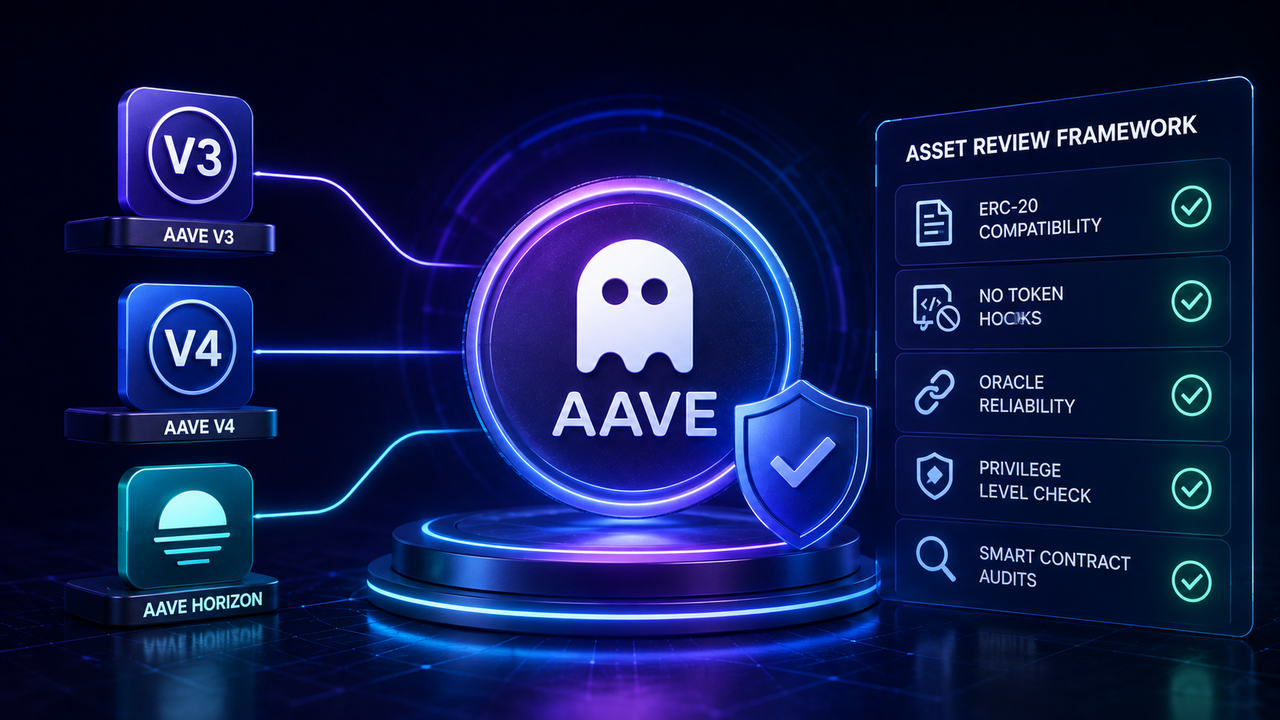
The decentralized finance landscape is undergoing a massive paradigm shift as top-tier lending protocols prioritize long-term economic sustainability over short-term liquidity influxes. As a leading global crypto exchange platform like KuCoin, we closely monitor these institutional-grade security shifts to help our users navigate changing market dynamics. Aave’s latest risk mitigation framework marks a definitive turning point in decentralized asset management and protocol insolvency prevention.
This comprehensive Aave V3 V4 asset review examines how the protocol intends to identify, categorize, and restrict high-risk tokens across its current and upcoming lending pools.
Key Takeaways
-
Paradigm Shift: Aave is actively moving its primary risk-assessment focus from external market volatility and liquidity metrics toward intrinsic, hidden smart contract technical risks.
-
Standardized Criteria: The newly proposed asset vetting process enforces zero-tolerance policies for non-standard ERC-20 tokens, unverified price oracles, and excessive admin privileges.
-
Protocol-Wide Impact: Strict asset limitations will concurrently apply to existing Aave V3 pools, upcoming Aave V4 deployments, and the highly anticipated, institutional-focused Aave Horizon architecture.
-
Defensive Guardrails: Non-compliant assets face immediate defensive actions, including aggressive reductions in Loan-to-Value (LTV) ratios, lowered supply caps, or outright onboarding rejections.
Shift From Market Risks to Technical Risks
For years, decentralized lending platforms evaluated risk through a purely financial lens, analyzing historical volatility, average daily trading volume, and market capitalization. While these metrics effectively mitigate cascading liquidations during standard market downturns, they fall short when facing complex smart contract exploits. Aave’s updated framework introduces an aggressive pivot toward identifying underlying code vulnerabilities before an asset can ever be deposited as collateral.
What Are Hidden Technical Risks?
Hidden technical risks refer to structural anomalies embedded directly within a token's smart contract code that alter its behavior under specific conditions. Unlike market risks, which are visible via public order books and exchange depth charts, technical risks remain dormant until triggered by an exploit or governance manipulation. Examples include non-standard transfer functions, hidden upgradeability patterns without timelocks, and undocumented external dependencies. These hidden vulnerabilities can allow malicious actors to artificially manipulate balances or drain liquidity pools regardless of how "liquid" the asset appears on public markets.
Why Code Weakness Threatens Solvency
When a borrower deposits an asset on an exchange or a lending platform like Aave, the protocol assumes that the asset's supply and transfer mechanisms are deterministic and unchangeable. A single critical code weakness can completely destroy this assumption, leading to catastrophic protocol insolvency. If a collateral token contains a vulnerability that allows for arbitrary minting or balance manipulation, an attacker can generate infinite collateral out of thin air. They can then use this counterfeit collateral to borrow legitimate, highly liquid assets like USDC or ETH, leaving the protocol with worthless, exploited tokens and unbacked bad debt.
Limits of Traditional On-Chain Data
Traditional on-chain data analytics are inherently lagging indicators, focusing heavily on past performance, wallet concentration, and historic DEX liquidity. While these metrics are useful for mapping out market manipulation risks, they are blind to zero-day smart contract exploits and sudden malicious governance upgrades. A token might sport a pristine on-chain profile with millions of dollars in locked liquidity and thousands of unique holders, yet still possess a catastrophic vulnerability in its codebase. Aave's new paradigm acknowledges that relying solely on historical transactional data creates a false sense of security, necessitating a comprehensive code-level audit.
Core Criteria of Aave V3 V4 Asset Review
To systematically eliminate technical vulnerabilities, Aave is deploying a strict, standardized evaluation framework designed to filter out asset anomalies. This structured approach serves as the foundational bedrock for the Aave V3 V4 asset review, ensuring that every supported token conforms to rigid security benchmarks.
| Vetting Criteria | Target Focus | Acceptable Standard |
| ERC-20 Conformance | Token code structure | Strict EIP-20 adherence without side-effects |
| Hook Regulations | State changes during transfer | Complete ban on arbitrary external executions |
| Oracle Dependability | Price feed security | Redundant decentralized feeds with fallback paths |
| Privilege Escalation | Admin control and multi-sigs | Level 0 to Level 2 classification only |
| Supply Inflation | Minting permissions | Hard-coded caps or multi-sig timelocked controls |
| Audit Continuity | Smart contract lifecycle | Regular, independent, third-party code reviews |
Strict ERC-20 Compatibility Rules
The ERC-20 standard was designed to ensure seamless interoperability across the Ethereum ecosystem, but many modern tokens deviate from its core specifications to implement custom features. Aave’s updated review process enforces an uncompromising stance against tokens that utilize non-standard implementations, such as deflationary transfer fees, rebasing mechanisms, or dual-token balances. Tokens that subtract a fee upon transfer distort the protocol's internal ledger tracking, causing discrepancies between recorded balances and actual tokens held in the smart contract. Consequently, any asset that fails to precisely mirror the standard EIP-20 transfer behavior will be barred from integration.
Banning Token Hooks for Safety
Token hooks, popularized by standards like ERC-777 and certain custom ERC-20 extensions, allow a token contract to notify external addresses whenever transfers occur. While this feature enables advanced programming patterns, it introduces a massive attack vector known as a reentrancy vulnerability. During a reentrancy attack, a malicious contract intercepts the transfer hook and executes a secondary, unauthorized transaction before the lending protocol can update its internal state balances. To maintain absolute protocol safety, Aave is issuing an outright ban on any collateral asset that utilizes arbitrary transfer hooks or callbacks.
Mandatory Price Oracle Reliability
A decentralized lending platform is only as secure as the price feeds that dictate its liquidation thresholds. Aave requires that every asset possess an ultra-reliable, highly decentralized price oracle architecture, primarily leveraging Chainlink while demanding robust secondary fallback systems.
Oracle configurations must demonstrate extreme resilience against flash-loan price manipulation, low liquidity slippage distortions, and data delivery latency. If an asset relies on a single-source decentralized exchange (DEX) pool for its price discovery, it will be instantly disqualified due to the ease with which those pools can be temporarily manipulated.
Grading Privileged Roles (Level 0-5)
To address centralization risks, Aave categorizes the governance and administrative controls of candidate tokens using a strict Level 0 to Level 5 grading scale. Level 0 represents complete immutability or distribution to an automated, timelocked DAO, whereas Level 5 indicates a single, un-timelocked externally owned account (EOA) with absolute control.
-
Level 0: Fully immutable code or decentralized DAO control with lengthy timelocks.
-
Level 1: Multi-signature control with a minimum 72-hour public timelock for all functions.
-
Level 2: Multi-signature control with short timelocks, restricted to non-critical parameter tweaks.
-
Level 3: Centralized team multi-sig capable of pausing or upgrading contracts without a timelock.
-
Level 4: Single EOA or developer wallet with upgradeability or contract-pausing rights.
-
Level 5: Single EOA with unrestricted access to user balances, minting, or code rewriting.
Under the new guidelines, assets exhibiting a risk profile of Level 3 or higher will face severe restrictions or complete exclusion from the protocol's collateral tiers.
Auditing Unlimited Minting Functions
Tokens that feature underlying minting mechanics pose an existential threat to lending protocols if the minting keys are compromised or misused. Aave's risk team conducts deep-dive code reviews to map out every single address, smart contract, and multi-sig capable of calling a minting function. If a project maintains an unlimited minting capability without transparent, hardcoded supply caps or strict cryptographic multisig guardrails, it cannot be trusted as collateral. The protocol will flag these assets immediately, ensuring that an unexpected supply inflation event cannot dilute the asset's value to zero overnight.
Continuous Smart Contract Security Audits
A single security audit conducted at a token's launch is no longer sufficient in an ecosystem characterized by rapid upgrades and evolving attack vectors. Aave now mandates that asset issuers provide proof of ongoing, continuous smart contract security audits conducted by reputable, independent third-party firms. Whenever an asset project undergoes a code upgrade, a migration, or a structural change to its ecosystem, a new audit trail must be submitted. Failure to maintain an up-to-date, transparent record of independent code reviews will trigger an automated reassessment of the asset's risk tier within the Aave ecosystem.
Sectors Facing Restrictions: V3, V4 & Horizon
The enforcement of these heightened security standards will ripple across multiple core sectors within the decentralized finance landscape. The strict guidelines outlined in the Aave V3 V4 asset review will heavily impact three primary pillars of the Aave ecosystem: established V3 pools, upcoming V4 markets, and the specialized institutional lending architecture known as Aave Horizon.
Cross-Chain Bridge Supply Vetting
Cross-chain bridged assets, wrapped tokens, and synthetic variants represent some of the most targeted and exploited vectors in modern decentralized finance history. When an asset is bridged from its native blockchain to another network, its security is entirely dependent on the underlying bridge smart contract infrastructure. Aave is implementing an exhaustive vetting process for all wrapped and bridged assets across its V3 pools, looking closely at the bridge's historical uptime, multi-sig structure, and validator decentralization. Assets backed by brittle, centralized, or frequently modified bridge architectures will have their supply limits aggressively curtailed to isolate potential cross-chain contagion.
Tighter Screws on Risky LRTs
Liquid Restaking Tokens (LRTs) have driven billions of dollars in capital inflows, but their hyper-composability introduces complex layers of systemic risk. An LRT represents a claim on staked ETH that is further re-delegated to secure various Actively Validated Services (AVSs), creating a lengthy chain of technical dependencies. Aave V4 is tightening the screws on this sector by dissecting the underlying slashing risks, node operator centralization, and withdrawal liquidity delays associated with each LRT. LRTs that back unproven AVSs with unaudited slashing contracts will face immediate borrow caps and heavily reduced collateral utility to protect the core protocol from a mass-slashing event.
Aave Horizon: Strict RWA Audits
Aave Horizon represents the protocol’s strategic expansion into the Real World Asset (RWA) sector, creating dedicated, highly regulated pools designed for institutional capital. Because RWAs bridge the gap between decentralized smart contracts and traditional physical infrastructure, they require a fundamentally different auditing approach.
Every RWA asset onboarding onto Aave Horizon must undergo exhaustive tokenization contract reviews, ensuring that blacklisting capabilities and freeze functions cannot be abused by external actors.
Verifying Off-Chain Legal Frameworks
Beyond standard code audits, the RWA sector requires absolute verification of the underlying off-chain legal entities, bankruptcy-remote vehicles, and collateral custody frameworks. If an RWA token represents a tokenized US Treasury bill or real estate asset, the legal recourse available to the DAO in the event of default must be crystal clear. Aave’s risk management framework demands that issuers provide ironclad legal opinions detailing how property titles, cash flows, or debt obligations are defended in traditional courts. Any asset whose off-chain legal framework is ambiguous, poorly structured, or registered in an uncooperative jurisdiction will be locked out of the Horizon ecosystem entirely.
Consequences for Non-Compliant Assets
Tokens currently listed or seeking listing that fail to meet these rigorous parameters will face immediate, programmatic disciplinary adjustments. The goal is not to punish specific projects, but to dynamically insulate the broader liquidity pools from potential code failures, systemic exploits, or governance-level attacks.
Lowering Supply and Borrow Caps
The first line of defense against a structurally suspect asset is the immediate reduction of its supply and borrow caps across all active lending pools. By lowering the supply cap, Aave restricts the total amount of that specific token that can be deposited into the protocol, effectively limiting total exposure. Simultaneously, slashing the borrow cap prevents users from accumulating massive short positions or utilizing the token to extract cleaner liquidity from the platform. In severe scenarios where a technical vulnerability is actively suspected, supply and borrow caps will be reduced directly to zero, freezing all further protocol exposure.
Restricting Loan-to-Value Parameters
Loan-to-Value (LTV) parameters dictate exactly how much capital a user can borrow against their deposited collateral assets. For example, an 80% LTV means a user depositing $100 worth of an asset can borrow up to $80 of another cryptocurrency.
LTV = \left( \frac{\text{Maximum Borrowable Value}}{\text{Deposited Collateral Value}} \right) \times 100\%
For non-compliant or high-risk assets identified in the review, Aave will programmatically lower the LTV ratio, sometimes dropping it all the way to 0%. Reducing the LTV to 0% strips the token of its collateral utility entirely, forcing users to treat it purely as an isolated, non-borrowable asset and preventing it from backing systemic protocol debt.
Delayed Launches and Asset Rejections
For assets that are working through the governance pipeline or awaiting deployment in the upcoming V4 and Horizon ecosystems, non-compliance results in immediate launch delays or permanent rejection. The protocol's risk core will issue detailed technical feedback reports outlining the exact code adjustments, oracle improvements, or legal clarifications required for compliance. The asset will remain frozen in the onboarding queue until independent security firms verify that all technical red flags have been thoroughly resolved. This proactive gatekeeping ensures that high-risk technical debt is stopped at the protocol's doorstep, long before it can endanger user capital.
Conclusion
As decentralized finance matures into a globally recognized financial primitive, protocol security must evolve from reactive crisis management to proactive risk isolation. Aave’s decisive shift toward analyzing deep technical and structural code risks across V3, V4, and Horizon sets a benchmark for the entire industry. By implementing this comprehensive Aave V3 V4 asset review and enforcing uncompromising standards on ERC-20 code compatibility, oracle resilience, and legal transparency, the protocol effectively immunizes itself against systemic insolvency. As a leading crypto exchange platform like KuCoin, we highly endorse these rigorous security frameworks, which ultimately foster a safer, more predictable trading and lending environment for all digital asset participants.
FAQ
What is the primary purpose of the latest Aave V3 V4 asset review?
The primary purpose of the Aave V3 V4 asset review is to systematically transition the protocol's risk evaluation focus from standard market volatility metrics toward deep, underlying smart contract technical vulnerabilities to prevent protocol exploitation and bad debt insolvency.
Why is Aave targeting Liquid Restaking Tokens (LRTs) for restrictions?
Aave is implementing stricter controls on LRTs due to their complex layers of systemic risk, including potential smart contract reentrancy vulnerabilities, unproven underlying validator slashing parameters, and liquidity delays that threaten liquidations during market drawdowns.
How does Aave Horizon handle Real World Asset (RWA) risk management?
Aave Horizon enforces strict, institutional-grade RWA audits that evaluate both the tokenization smart contract code and the underlying off-chain legal frameworks, ensuring bankruptcy-remote asset security and clear legal recourse for the protocol.
What happens to a token if its Loan-to-Value (LTV) is reduced to 0%?
When a token's LTV is reduced to 0%, it completely loses its utility as collateral within the platform, meaning users can no longer borrow any other digital assets against their deposited balances of that specific token.
Can an asset be re-listed after being rejected by the new Aave risk framework?
Yes, an asset can be reconsidered for listing once the development team completely resolves the highlighted technical risks, passes subsequent smart contract security audits, and successfully re-submits the asset for formal review.