

Are We in a Crypto Bubble? Identifying 2026 Market Warning Signs
2026/03/17 15:24:02
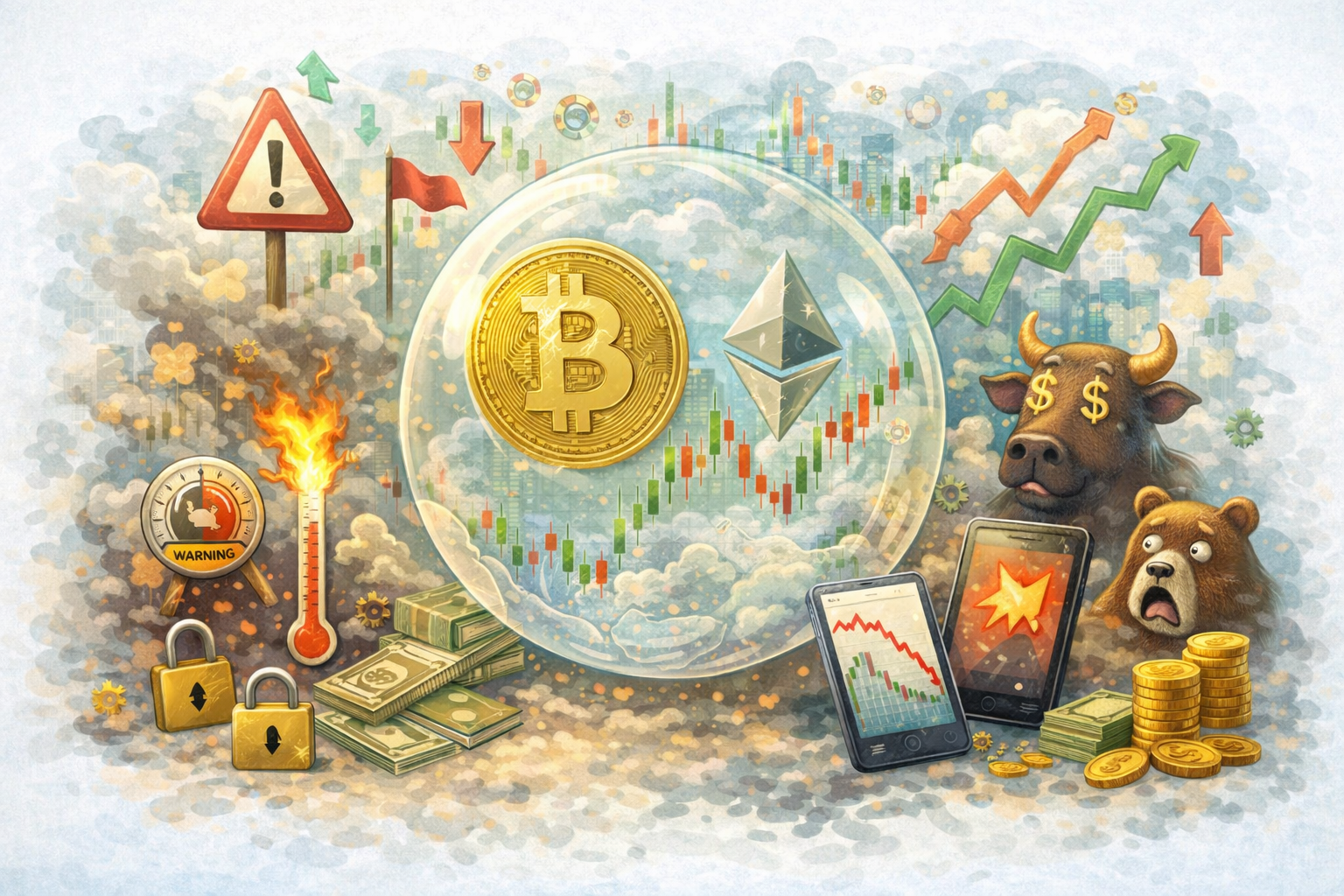
The digital asset market has historically operated in high-amplitude cycles, characterized by periods of rapid price appreciation followed by significant deleveraging events. As of March 2026, the global cryptocurrency market cap fluctuates near $2.39 trillion, emerging from a period of extreme volatility that saw Bitcoin reach all-time highs above $120,000 in late 2025 before retracing. Distinguishing between a healthy corrective phase and a terminal speculative bubble is a critical skill for market participants looking to navigate these shifts without catastrophic loss.
While institutional adoption via spot ETFs and the implementation of frameworks like the European Union's MiCA regulation have introduced structural stability, the fundamental psychology of financial markets remains unchanged. Speculative manias, or crypto bubbles, occur when market prices deviate significantly from intrinsic utility, driven by collective exuberance rather than technical or economic milestones. This guide provides an objective framework for identifying the technical, on-chain, and social warning signs that define a market bubble in the current 2026 landscape.
Key Takeaways
-
A crypto bubble is defined by asset prices far exceeding their fundamental value, often driven by the "greater fool theory" rather than technological utility.
-
Market bubbles typically progress through five distinct stages: displacement, boom, euphoria, profit-taking, and panic.
-
Quantifiable warning signs include extreme derivatives funding rates, a decoupling of price from network activity, and a rapid increase in retail-driven leverage.
-
Historical precedents, such as the 2017 ICO mania and the 2021 NFT peak, serve as blueprints for how speculative excesses eventually correct.
-
In 2026, Bitcoin exhibits characteristics of both a speculative asset and a macro hedge, requiring a nuanced analysis of institutional flows versus retail sentiment.
-
Effective risk management involves rebalancing portfolios, utilizing stop-loss orders, and maintaining a portion of capital in stablecoin reserves during high-volatility periods.
What's a crypto bubble?
A crypto bubble describes a market condition where the valuation of digital assets reaches levels that are unsustainable based on their underlying economic reality. In these scenarios, the demand for tokens is fueled by the expectation of higher future prices rather than the demand for the service or utility the protocol provides. This phenomenon is not unique to the blockchain industry; it mirrors historical events like the Dutch Tulip Mania or the Dot-com bubble of the late 1990s.
When participants begin trading or accessing the token's markets purely on the basis of social media momentum or "fear of missing out" (FOMO), the market loses its connection to fundamental data. In a bubble, the intrinsic value—derived from transaction fees, network security, or governance rights—is ignored in favor of price action. Because these valuations are built on sentiment rather than cash flow or utility, they are fragile and prone to rapid collapse once the inflow of new capital slows down.
How does a crypto bubble form?
The formation of a bubble is a multi-stage process that often starts with a legitimate technological breakthrough.
Displacement and the Initial Boom
A bubble begins with a "displacement," such as the emergence of a new blockchain primitive or a shift in regulatory policy that opens the door for institutional capital. In the current 2026 context, the integration of AI-powered crypto agents and real-world asset (RWA) tokenization has acted as this catalyst. As early adopters see significant returns, the broader public begins to take notice, leading to the "boom" phase where prices rise steadily and the narrative of a "new era" begins to dominate financial discourse.
Euphoria and Speculative Peak
During the euphoria phase, valuation metrics are discarded. Participants often use circular logic to justify prices, believing that "this time is different" due to institutional involvement or specific protocol upgrades. This stage is characterized by a surge in "meme" culture and the launch of thousands of derivative projects with little to no unique value. The supply of new tokens begins to accelerate to meet the insatiable demand of retail buyers, eventually creating a surplus that the market cannot absorb once the initial hype fades.
How can you spot the warning signs of a crypto bubble?
Recognizing a bubble in real-time requires a shift from qualitative sentiment to quantitative market data and trading pairs.
-
Extreme Funding Rates: In the perpetual futures market, very high positive funding rates indicate that the vast majority of traders are "longing" the market with leverage. This creates a precarious situation where a small price drop can trigger a cascade of liquidations.
-
On-chain Divergence: If a token's price is reaching new highs while the number of active wallet addresses or daily transaction volume is declining, the price growth is likely inorganic and driven by speculation rather than usage.
-
Retail Sentiment Peaks: Historically, when cryptocurrency becomes a dominant topic in non-financial mainstream media or among "celebrity" influencers without prior industry involvement, it often signals the final stages of retail exhaustion.
-
Stablecoin Supply Ratios: A high Stablecoin Supply Ratio (SSR) indicates that the "buying power" of the market is low compared to the total market cap of Bitcoin, suggesting that there is limited sidelined capital available to support further price increases.
What are some examples of crypto bubbles that burst?
The history of the digital asset industry provides a clear timeline of speculative excesses and their subsequent corrections.
-
2013 Mt. Gox Peak: An early bubble driven by the concentration of liquidity on a single exchange. When Mt. Gox faced structural failures. The lack of market depth led to an 80% correction.
-
2017 ICO Craze: Thousands of projects raised funds via Initial Coin Offerings with nothing more than a whitepaper. The bubble burst in 2018 when it became clear that most projects could not deliver functional products, leading to the "Great Crypto Crash" where many assets lost 90% of their value.
-
2021-2022 DeFi and NFT Summer: Excessive leverage within the decentralized finance ecosystem, combined with the collapse of specific algorithmic stablecoins, led to a systemic deleveraging event. This period demonstrated that even "yield-bearing" assets are subject to bubble dynamics if the yield is generated through inflationary tokenomics rather than real revenue.
Traders often look into further reading or research resources to analyze the specific on-chain signatures that preceded these historical collapses to better prepare for future volatility.
Is Bitcoin in a crypto bubble?
As of March 2026, the question of whether Bitcoin is in a bubble is a subject of intense debate among macroeconomists. Unlike the purely speculative tokens of prior cycles, Bitcoin has matured into a global macro asset with significant institutional backing via spot ETFs. However, technical analysis suggests that Bitcoin still follows cyclical patterns.
Currently, Bitcoin trades near $73,000, showing resilience despite geopolitical tensions and a high-interest-rate environment. Some analysts point to the "MVRV Z-Score"—which measures the ratio of market cap to realized cap—as evidence that Bitcoin is in a healthy consolidation phase rather than a speculative peak. However, others warn that the increasing correlation between Bitcoin and high-growth tech stocks means that a broader market correction in traditional finance could pop a perceived "crypto bubble." The 2026 market is uniquely characterized by "Bitcoin Season," where BTC dominance remains above 58%, suggesting that the speculative "altcoin" bubble has not yet fully formed in this cycle.
How can you protect your investments during a crypto bubble?
Protecting capital during periods of high speculative intensity requires a disciplined approach to risk management and the removal of emotional bias.
-
Staged Profit-Taking: Rather than attempting to time the exact market peak, successful participants often sell small percentages of their holdings at predetermined price intervals. This ensures that some gains are "locked in" even if the market reverses suddenly.
-
Utilizing Stop-Loss Orders: Automated sell orders can protect a portfolio from the rapid "wick-down" events common during a bubble burst. Setting a stop-loss 10-15% below key support levels can prevent a minor correction from becoming a major loss of capital.
-
Stablecoin Rotation: Maintaining a portion of a portfolio in USD-pegged stablecoins allows for "dry powder" to be used when the bubble eventually bursts and assets return to fundamental valuations.
-
Monitoring Platform Data: Keeping an eye on platform updates and announcements regarding exchange liquidity and regulatory changes can provide early warnings of systemic stress that might precede a market-wide sell-off.
Summary
The existence of crypto bubbles is an inherent part of the price discovery process for a new and highly disruptive asset class. While these periods of "irrational exuberance" can lead to significant wealth creation, they are followed by necessary periods of contraction where inorganic projects are flushed out of the system. In 2026, the market is structurally more sound than in 2017 or 2021, yet the core indicators of speculative mania—high leverage, decoupling from utility, and extreme social sentiment—remain the primary signals for an impending correction. Navigating these cycles requires a focus on verifiable data and a commitment to capital preservation over short-term greed.
Start your crypto journey in minutes by creating a secure KuCoin account with no initial deposit required. Sign Up Now!
FAQs
What is the most reliable indicator of crypto bubbles?
While no single metric is foolproof, the MVRV Z-Score and derivatives funding rates are widely considered the most reliable technical indicators. A high MVRV Z-Score suggests the market is significantly overvalued relative to the price at which most coins last moved, while high funding rates signal an over-leveraged and fragile market structure.
Can a crypto bubble occur without Bitcoin participating?
Yes, it is possible for specific sectors—such as AI tokens, Memecoins, or a specific Layer-1 ecosystem, to experience a localized bubble. In 2026, we often see "narrative bubbles" where certain categories of tokens surge based on hype while the broader market, including Bitcoin, remains relatively stable or in a corrective phase.
How long does it usually take for a bubble to burst?
The "euphoria" phase, which is the final stage of a bubble, typically lasts between two to six months. However, the subsequent "burst" and deleveraging process can happen much faster, often wiping out months of gains in a matter of days as automated liquidations and panic-selling accelerate the price decline.
Is institutional involvement preventing crypto bubbles in 2026?
Institutional capital provides more significant liquidity and depth, which can reduce the frequency of small "flash crashes." However, institutions are also subject to market cycles and macro-economic pressures. While they may stabilize the floor price of major assets like Bitcoin, they do not prevent speculative manias from occurring in the broader, less-regulated altcoin market.
What should I do if I suspect the market is in a bubble?
The most prudent action is to evaluate your risk exposure and ensure your portfolio is diversified. This may include moving a portion of your holdings into stablecoins, tightening your stop-loss orders, and avoiding the use of high leverage. Focus on assets with clear utility and high organic network activity, as these tend to recover faster after bubble bursts.
Disclaimer: The information on this page may have been obtained from third parties and does not necessarily reflect the views or opinions of KuCoin. This content is provided for general informational purposes only, without any representation or warranty of any kind, nor shall it be construed as financial or investment advice. KuCoin shall not be liable for any errors or omissions, or for any outcomes resulting from the use of this information. Investments in digital assets can be risky. Please carefully evaluate the risks of a product and your risk tolerance based on your own financial circumstances. For more information, please refer to our Terms of Use and Risk Disclosure.