
What Are Prediction Markets and How Do They Work?
Last updated: 09/30/2026 10:48:00
A prediction market is a market based on the possible outcome of an event. Instead of focusing only on the future price of a crypto asset, participants can express a market view on what may happen next.
On KuCoin, eligible users can browse supported prediction markets related to popular events, crypto, and sports. The markets available to a user depend on the product page, region, payment asset, and applicable market rules. KuCoin provides access to supported Polymarket markets through its Web3 wallet integration within the KuCoin App. The specific prediction markets are provided by Polymarket.
Events, Markets, and Outcomes
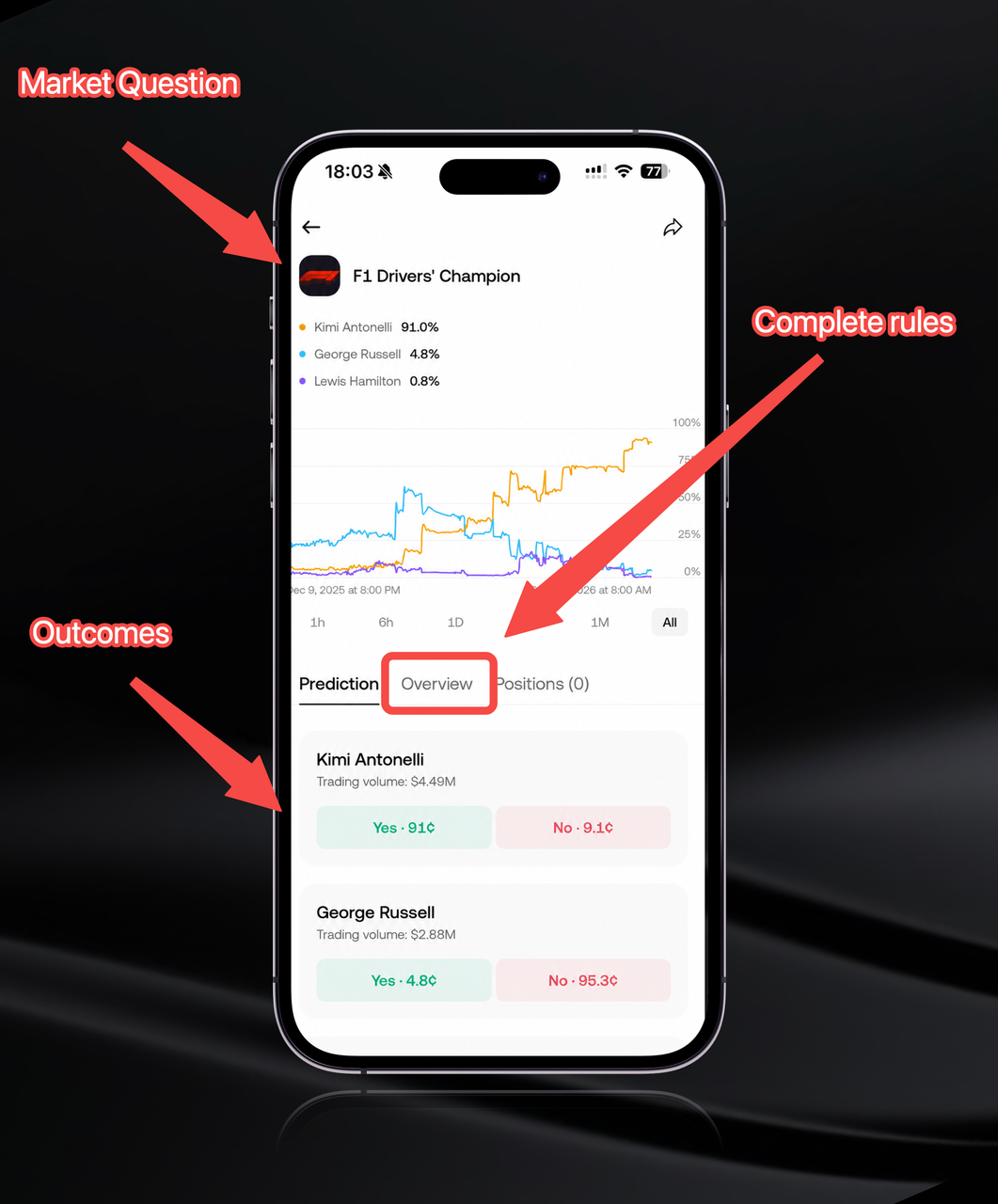
Every prediction market starts with a clearly defined question and rules for determining the result. Many individual markets have two complementary outcomes, usually Yes and No. Some use equivalent names, such as Up and Down.
An event may also contain several related markets. For example, an election event may include a separate Yes/No market for each candidate.
Before trading, review:
-
The complete market question
-
The available outcomes
-
The event period and trading cutoff
-
The resolution criteria and named result source
-
Any special conditions covering postponements, cancellations, invalid results, or disputes
Do not rely on the short market title alone. The complete rules shown for the individual market determine what each outcome means and how the result will be decided.
How Outcome Shares and Prices Work
When you select Yes, No, Up, or Down, you are trading an outcome share. You are not buying the underlying event, team, candidate, or crypto asset.
Outcome-share prices normally range from $0 to $1. A price can be interpreted as the market’s current implied probability.
For example, a Yes price of approximately $0.60 represents an implied probability of approximately 60%.
This is a market signal, not a guarantee. Prices are formed through market activity and may change as participants trade, new information becomes available, or liquidity changes.
At the underlying Polymarket market level, one complete Yes/No set is backed by $1. When compatible opposing orders are matched, their complementary prices add up to $1. For example, a Yes order at $0.60 may be matched with a No order at $0.40.
However, this does not mean that two prices independently displayed on the market page—or the prices at which two separate orders actually execute—will always add up to exactly $1.
Bid-ask spreads, price movement, available liquidity, and partial fills may affect the displayed prices and final execution results.
What Happens at Settlement?
Resolution determines which outcome satisfies the market’s published rules.
The displayed market price, the most popular outcome, an unofficial report, or the end of the underlying event does not by itself determine the final result. The result follows the resolution criteria and result source specified for the individual market.
After a binary market is resolved normally:
-
Each share in the winning outcome is worth $1.
-
Each share in the losing outcome is worth $0.
For example:
-
If Yes is the final result, each Yes share is worth $1 and each No share is worth $0.
-
If No is the final result, each No share is worth $1 and each Yes share is worth $0.
The $1 or $0 amount is the underlying market’s final settlement value per share. It is different from the price originally paid for the share.
Canceled, invalid, or disputed markets may follow different handling under the rules shown for the individual market.
KuCoin users do not need to redeem the underlying Polymarket outcome shares separately. After settlement is completed, the resulting USDT settlement proceeds are credited to the Funding Account, even if the original order was paid from the Financial Account or Trading Account.
The amount credited in USDT is subject to any applicable conversion and fees, as disclosed in the product.
The end of an event does not necessarily mean settlement is immediate. The result may still need to be confirmed, reviewed, or processed under the applicable market rules.
Why Do Market Prices Change?
Market prices reflect current trading activity and participant expectations. They may change and should not be treated as certain predictions or official conclusions.
How Prediction Markets Differ From Polls and Crypto Trading
A poll records the answers submitted by a group of respondents. A prediction market produces prices through the buying and selling of outcome shares. Its implied probabilities can change as market activity and available information change.
Prediction trading is also different from buying Bitcoin or another crypto asset. When you buy an outcome share, you do not own the underlying asset.
Your position’s value depends on the outcome-share market and, if held through resolution, on the final market result.
Using Predictions on KuCoin
Eligible users can:
-
Open the prediction-market entry in the KuCoin App.
-
Browse supported popular-event, crypto, and sports markets.
-
Review a market's outcomes, displayed information, and rules.
-
Use their KuCoin Funding Account to participate in a supported market.
-
View orders, positions, trading history, and settlement results.
The supported markets, regions, payment assets, and trading rules are those displayed on the product page at the time of use.
Risk Notice
Prediction-market prices can change, and the final result may differ from the market's earlier view. Participation involves risk. Review the individual market rules, understand the available outcomes, and consider the risks before proceeding.
DISCLAIMER: This information is provided for general informational and educational purposes only and does not constitute financial or investment advice, an offer, solicitation, or guarantee. Trading involves risk, and past performance is not indicative of future results. Users should conduct their own research, carefully consider the relevant risks, and make decisions based on their own circumstances. We accept no responsibility for any loss arising from reliance on or use of this information. For more information, please refer to the Polymarket Integration User Agreement and Risk Disclosure.