


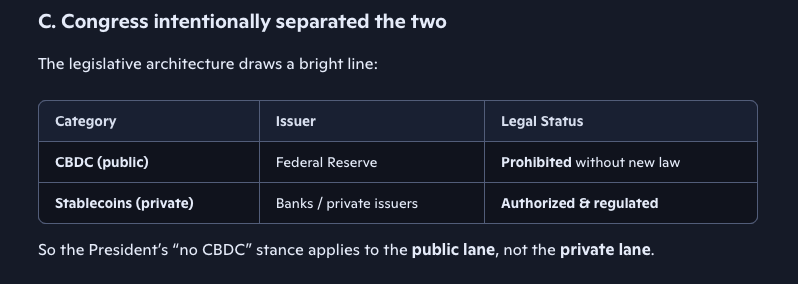
1913………..??? The Banks Vs Government. Requires explicit congressional authorization for any CBDC The Fed cannot proceed unilaterally. Congress must pass a separate law to authorize any CBDC. Effect: The “public digital money” lane is effectively closed unless Congress reopens it. How the Anti‑CBDC and GENIUS Acts divide public vs. private digital money... Stablecoins are treated as “digital cash equivalents,” not CBDCs... The Resulting Policy Landscape Public digital dollar (CBDC): ❌ Not allowed without new law ❌ Fed cannot issue ❌ Fed cannot test retail CBDCs ❌ Fed cannot use CBDCs for monetary policy Private digital dollars (stablecoins): ✔ ✅Allowed ✔ ✅Regulated ✔ ✅Bank‑custodied ✔ ✅Treated as digital cash equivalents ✔ ✅Positioned for domestic and cross‑border settlement Lane 1 — Public Digital Money (CBDC) Congress passed legislation that: * Prohibits the Federal Reserve from issuing a retail CBDC * Requires explicit congressional authorization for any CBDC * Blocks the Fed from using a CBDC for monetary policy * This matches the position that “no CBDC” should exist unless Congress explicitly approves one. * * So the “public” lane is effectively closed. Lane 2 — Private Digital Money (Stablecoins) This is where the GENIUS Act comes in. The GENIUS Act: * Creates a regulated framework for private stablecoins * Requires full reserves, audits, and bank‑level supervision * Treats stablecoins as private digital cash equivalents, not government money * Explicitly does not authorize the Fed to issue a CBDC This lane is private, not public. So even though the President opposes a CBDC, the GENIUS Act is not a CBDC. It’s a framework for private‑sector digital dollars, which is a different category. XRP becomes the neutral bridge asset between private digital‑dollar systems. ⭐ Bottom line: Retail can hold XRP. Nothing changed. Nothing is restricted. “Private settlement stack” simply means: XRP is part of the private‑sector settlement infrastructure, not a government‑issued CBDC, and not part of the Fed’s monetary system. It’s about architecture, not ownership rights. Lock In...

Share


Source:Show original
Disclaimer: The information on this page may have been obtained from third parties and does not necessarily reflect the views or opinions of KuCoin. This content is provided for general informational purposes only, without any representation or warranty of any kind, nor shall it be construed as financial or investment advice. KuCoin shall not be liable for any errors or omissions, or for any outcomes resulting from the use of this information.
Investments in digital assets can be risky. Please carefully evaluate the risks of a product and your risk tolerance based on your own financial circumstances. For more information, please refer to our Terms of Use and Risk Disclosure.