


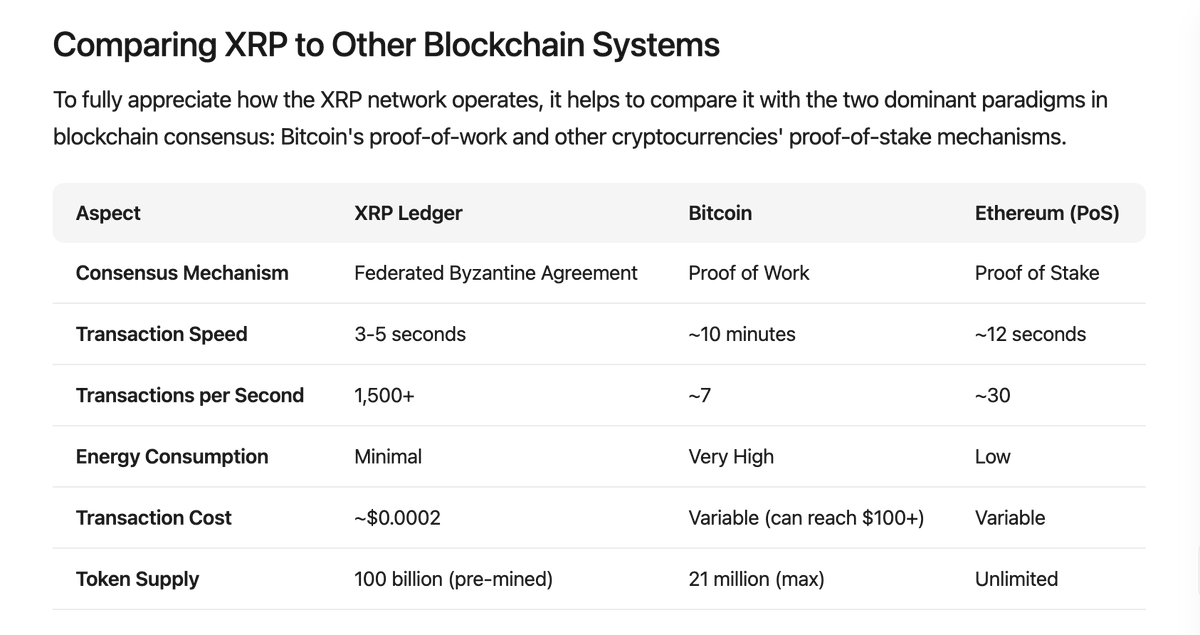
Comparing #XRP to Other Blockchain Systems To fully appreciate how the XRP network operates, it helps to compare it with the two dominant paradigms in blockchain consensus: Bitcoin's proof-of-work and other cryptocurrencies' proof-of-stake mechanisms. The fundamental difference lies in how these systems achieve trust and security. Bitcoin's proof-of-work requires massive computational effort to secure the network, creating an enormous environmental footprint but achieving a high degree of decentralization through pure mathematical competition. Ethereum's proof-of-stake requires validators to lock up cryptocurrency as collateral, penalizing bad behavior through forfeiture. The XRP Ledger takes a different approach entirely: rather than relying on economic incentives and mathematical puzzles, it achieves consensus through a federated system of trusted validators. This makes the network faster and more energy-efficient, but critics argue it introduces a different kind of centralization risk, as the validators are known entities rather than anonymous participants. WHO WINS?

Share


Source:Show original
Disclaimer: The information on this page may have been obtained from third parties and does not necessarily reflect the views or opinions of KuCoin. This content is provided for general informational purposes only, without any representation or warranty of any kind, nor shall it be construed as financial or investment advice. KuCoin shall not be liable for any errors or omissions, or for any outcomes resulting from the use of this information.
Investments in digital assets can be risky. Please carefully evaluate the risks of a product and your risk tolerance based on your own financial circumstances. For more information, please refer to our Terms of Use and Risk Disclosure.