


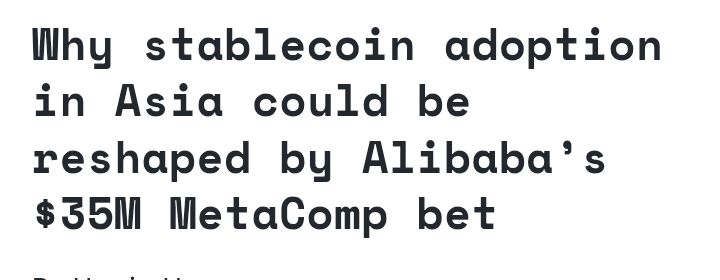
China has strict rules on stablecoins, so companies like Alibaba are investing abroad instead. That’s why it invested in MetaComp, a company that built stablecoin payment systems for businesses and international transfers. In 2025, MetaComp processed over $10 billion in stablecoin payments. With $35 million in new funding plus the cash from its own business, it now has more than $100 million to grow its network and handle even bigger payment. What MetaComp Actually Built; Most fintech companies stick to either traditional banking or crypto. MetaComp did something different. It built a system that lets regular money and stablecoins work together in under three seconds. ✓ Their platform also supports tokenizing real‑world assets into digital assets for wealthy individuals who want to invest or manage large amounts of money. The company is now expanding into Latin America, Africa, and the Middle East, where sending money across borders is usually slow and expensive. MetaComp runs a licensed payment system in Singapore. @0xfairblock adds a privacy layer that keeps big payments and tokenized asset transfers private. This helps companies and investors protect sensitive details while still following the rules and letting regulators check everything. This balance of transparency and privacy makes the system safer and more reliable for companies and investors moving money across borders in Asia and beyond.

Share


Source:Show original
Disclaimer: The information on this page may have been obtained from third parties and does not necessarily reflect the views or opinions of KuCoin. This content is provided for general informational purposes only, without any representation or warranty of any kind, nor shall it be construed as financial or investment advice. KuCoin shall not be liable for any errors or omissions, or for any outcomes resulting from the use of this information.
Investments in digital assets can be risky. Please carefully evaluate the risks of a product and your risk tolerance based on your own financial circumstances. For more information, please refer to our Terms of Use and Risk Disclosure.