


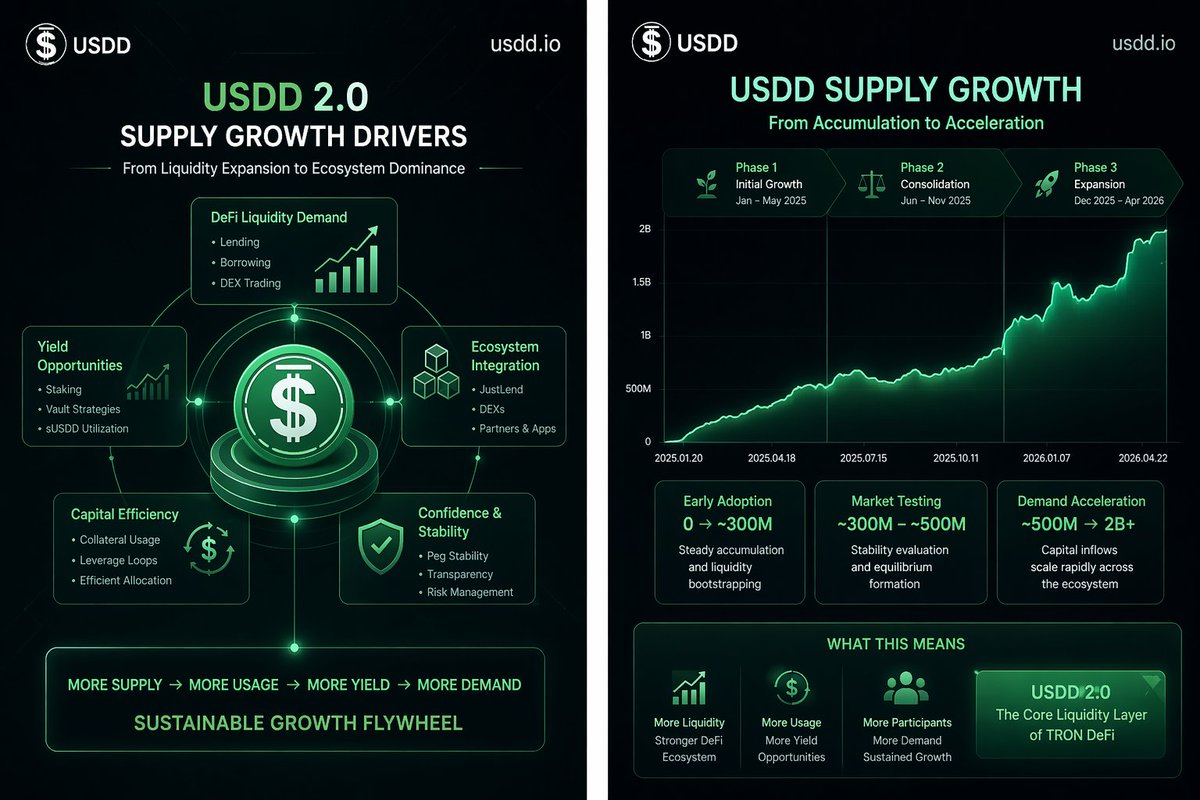
USDD Supply Expansion — Reading the On-Chain Growth Curve From gradual accumulation → to aggressive expansion. The USDD supply chart is signaling a structural shift in demand across the TRON DeFi stack. 1️⃣ Overview — What the Chart Shows The total supply trajectory of USDD reveals three distinct phases: ➜ Early-stage accumulation (Q1–Q2 2025) ➜ Stabilization and consolidation (mid 2025) ➜ Breakout expansion (late 2025 → 2026) The most critical observation: Supply is no longer growing linearly — it is accelerating. 2️⃣ Phase Breakdown — Understanding the Growth Regime ➊ Phase 1: Initial Growth (Jan → May 2025) ➜ Supply rises from near zero to ~300M ➜ Growth is steady but controlled Interpretation: → Early adoption → Liquidity bootstrapping → Limited capital rotation ➋ Phase 2: Consolidation (Mid 2025 → Late 2025) ➜ Range-bound movement (~300M–500M) ➜ Lower volatility in supply changes Interpretation: → Market testing equilibrium → Stability mechanisms under observation → Users evaluating risk-adjusted returns ➌ Phase 3: Expansion (Late 2025 → Apr 2026) ➜ Sharp increase toward ~1.5B–2B+ ➜ Multiple vertical supply jumps Interpretation: → Demand shock entering the system → Capital inflows accelerating → DeFi integrations reaching scale 3️⃣ Key Signal — Stepwise Supply Jumps Notice the discrete upward jumps, not smooth curves. This implies: ➜ Large capital deployments (whales / institutions) ➜ Vault migrations or campaign-driven inflows ➜ Liquidity incentives triggering batch minting This is not retail-driven growth — this is coordinated capital allocation. 4️⃣ sUSDD vs Total Supply — Capital Efficiency Layer The presence of sUSDD supply tracking suggests: ➜ A portion of USDD is not idle ➜ It is being actively deployed into yield strategies Implication: → USDD is evolving into a productive asset, not just a stable store This aligns with: ➜ Lending markets ➜ Yield vaults ➜ Structured DeFi strategies 5️⃣ Why Supply Growth Matters (Beyond the Number) Stablecoin supply expansion is a leading indicator, not a lagging one. It reflects: A. Liquidity Demand More USDD minted = more demand for: ➜ Borrowing ➜ Trading pairs ➜ Collateral usage B. DeFi Activity Expansion Supply growth correlates with: ➜ TVL increase ➜ Lending utilization ➜ DEX depth C. Market Confidence Users only mint stablecoins when: ➜ They trust peg stability ➜ They expect yield opportunities ➜ They need capital efficiency 6️⃣ Strategic Interpretation — What This Signals for TRON USDD supply expansion indicates: ➜ TRON DeFi is entering a scaling phase ➜ Capital is moving from passive holding → active deployment ➜ Infrastructure (JustLend, DEXs, vaults) is absorbing liquidity effectively This creates a flywheel: More supply → More usage → More yield → More demand 7️⃣ Forward Outlook — Sustainability vs Acceleration Key question: Can this growth sustain without destabilizing the system? Watch these metrics: ➜ Collateral ratios ➜ Peg deviation stability ➜ Lending utilization rates ➜ Yield sustainability If maintained: → USDD can transition from growth phase → dominance phase 8️⃣ Final Take — From Growth to System Importance This chart is not just about supply. It reflects: The increasing role of USDD as a core liquidity layer in TRON’s financial system. The shift is clear: ➜ From experimental stablecoin ➜ To systemically relevant DeFi primitive @justinsuntron #TRONEcoStar @usddio

Share


Source:Show original
Disclaimer: The information on this page may have been obtained from third parties and does not necessarily reflect the views or opinions of KuCoin. This content is provided for general informational purposes only, without any representation or warranty of any kind, nor shall it be construed as financial or investment advice. KuCoin shall not be liable for any errors or omissions, or for any outcomes resulting from the use of this information.
Investments in digital assets can be risky. Please carefully evaluate the risks of a product and your risk tolerance based on your own financial circumstances. For more information, please refer to our Terms of Use and Risk Disclosure.