


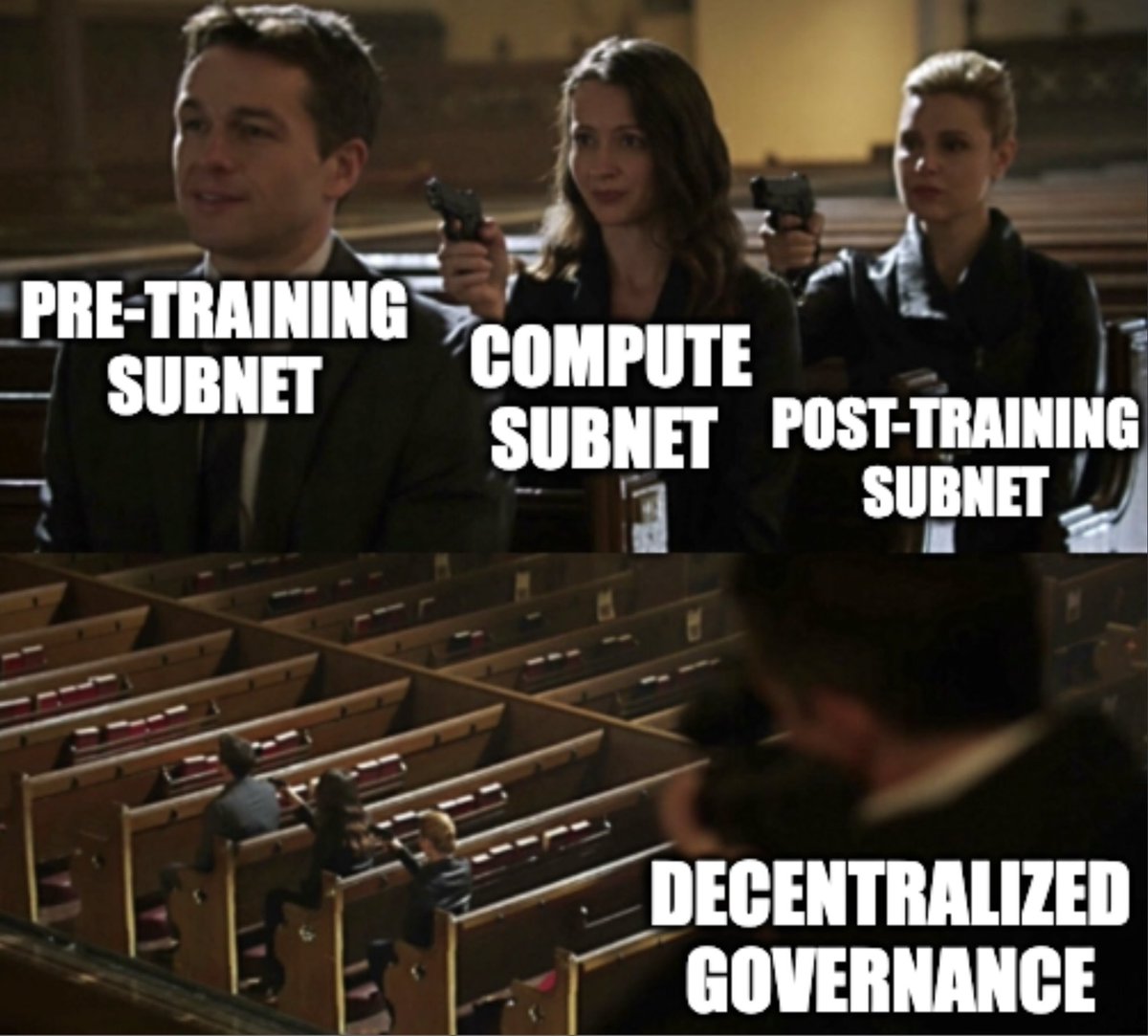
Covenant called Bittensor "decentralization theater." They themselves were running three puppet subnets paying each other with subsidized TAO and calling it revenue. Both sides running theaters. Just different genres. Covenant owned pre-training (Templar), GPU compute (Basilica), and post-training (Grail). Templar pays Basilica for GPU time. Grail uses Templar's models. Each payment gets counted as "revenue" for the receiving subnet. None of it came from a real external customer. One company paying itself with protocol-issued tokens and booking each internal transfer as ecosystem adoption. Meanwhile all three mine TAO emissions. At peak Covenant was capturing ~990 TAO/day across the three. The more interconnected the subnets look, the higher the emission share. So the optimal strategy is to build vertical pipelines that transact with themselves - every inter-subnet transaction doubles as "ecosystem growth" and boosts emissions. This isn't a bug. It's how dTAO is designed. Taoflow rewards alpha-token activity, not external customer revenue. Vertical pipelines of self-dealing subnets are literally the optimal play under the current mechanism. Whoever builds N subnets that bill each other wins. No external customer revenue has ever been published for any of the three. Not by Covenant. Not by investors. Not by independent research. You can find emission shares, market caps, training benchmarks. You cannot find one "we sold X GPU hours to Y outside customer for Z dollars" statement. In over a year. Network-wide, Bittensor pays $148M/year in subsidies against $3-15M in real external revenue. A 10-50x gap. Covenant was just the most visible example. Simple test: if any subnet publicly shows real external customer revenue - signed contracts, enterprise invoices, dollar figures - this thesis falls apart. A year in, nobody has shown a single number. TAO = Tokenomics Above Outcomes. Turns out the outcomes were tokenomics too.

Share


Source:Show original
Disclaimer: The information on this page may have been obtained from third parties and does not necessarily reflect the views or opinions of KuCoin. This content is provided for general informational purposes only, without any representation or warranty of any kind, nor shall it be construed as financial or investment advice. KuCoin shall not be liable for any errors or omissions, or for any outcomes resulting from the use of this information.
Investments in digital assets can be risky. Please carefully evaluate the risks of a product and your risk tolerance based on your own financial circumstances. For more information, please refer to our Terms of Use and Risk Disclosure.