


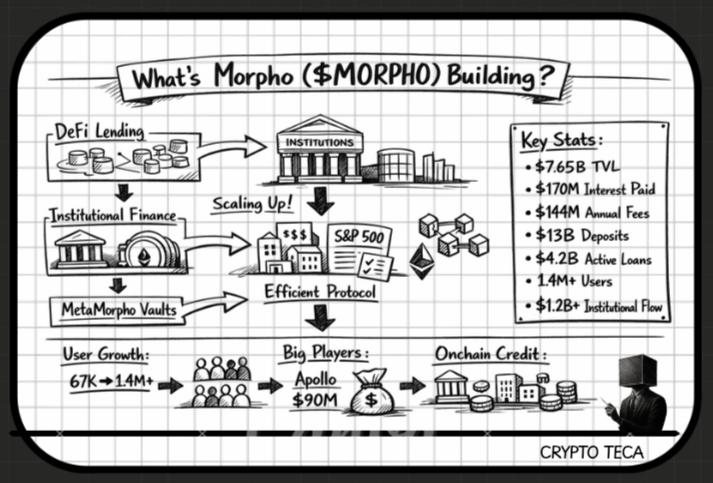
Hard not to pay attention to what @Morpho is building with $MORPHO right now… I remember when DeFi lending was mostly fragmented liquidity pools, inconsistent rates, and very retail-driven capital… and now we’re watching a protocol evolve into something that looks like institutional credit infrastructure at scale. And the numbers are starting to make that very hard to ignore. Morpho is sitting at roughly $7.65B in TVL, making it one of the largest lending protocols in DeFi. Over the last 12 months alone, borrowers have paid ~$170M in interest, which is a 210%+ increase YoY, while the protocol is generating around $144M annualized fees flowing through the system. At the same time, deposits have scaled into the $13B range at peak, and active loans are sitting around $4.2B+, which tells you this isn’t just idle liquidity, it’s actually being used at scale. User growth is another quiet signal people underestimate: from roughly 67K users to 1.4M+ in 2025. That’s not DeFi tourists anymore, that’s a widening base of allocators and integrations. And the institutional side is where things start to feel meaningfully different. Vault strategies like MetaMorpho are now being managed by firms like @gauntlet_xyz, @SteakhouseFi, and @BlockAnalitica, which basically means risk is no longer ad-hoc, it’s being professionally underwritten. You also have real capital rails opening up through @coinbase Prime, with over $1.2B+ in $USDC lending originations already flowing through the system, which is a major bridge between traditional capital access and onchain credit. Then you zoom out and see something even more important: real-world assets becoming productive inside DeFi. Tokenized exposures like @centrifuge S&P 500 products are now being used as collateral inside Morpho. And with $1.9B+ already tokenized on Centrifuge, that template is clearly meant to scale across multiple RWA issuers. So instead of RWAs sitting idle, they’re now entering credit markets directly. On the protocol design side, Morpho remains extremely lean, immutable contracts, permissionless markets, and sub-600 line core architecture deployed across @ethereum, @base, and 20+ chains. That matters because it reduces institutional friction while keeping composability intact. And then you get the most important signal of all: capital conviction at the top end. Apollo Global Management reportedly locking up to $90M of $MORPHO (~9% supply over 48 months) is not a retail signal—it’s a long-duration infrastructure bet. When you combine all of this: ▸ ~$7.65B TVL ▸ ~$170M annual borrower interest ▸ ~$144M annualized protocol revenue ▸ ~$13B peak deposits ~$4.2B+ active loans ▸ 1.4M+ users ▸ $1.2B+ institutional credit flow …it starts to look less like “DeFi lending growth” and more like the early formation of a credit settlement layer for onchain capital markets. The most interesting part is still ahead though. Morpho Agents [Beta] now introduces a world where AI systems can directly interact with lending markets, simulate positions, deploy capital, and integrate borrowing/earning flows without SDK friction. That pushes Morpho from just “capital infrastructure” into something closer to machine-accessible financial rails. And if that layer keeps compounding, the narrative stops being DeFi lending entirely. It becomes credit infrastructure for both humans and agents. And that’s a much bigger market than most people are currently pricing in.

Share


Source:Show original
Disclaimer: The information on this page may have been obtained from third parties and does not necessarily reflect the views or opinions of KuCoin. This content is provided for general informational purposes only, without any representation or warranty of any kind, nor shall it be construed as financial or investment advice. KuCoin shall not be liable for any errors or omissions, or for any outcomes resulting from the use of this information.
Investments in digital assets can be risky. Please carefully evaluate the risks of a product and your risk tolerance based on your own financial circumstances. For more information, please refer to our Terms of Use and Risk Disclosure.