


Monad Oracle Landscape: Who’s Actually Winning? As @monad ecosystem starts to take shape, one layer is becoming increasingly critical: Oracles Let's dive in ↓ 1. RedStone is leading in native projects @redstone_defi, especially RedStone Bolt is currently the most preferred oracle among first-wave native protocols. Major native lending & liquid staking projects like Curvance, TownSquare, Kintsu, and FastLane all chose RedStone Bolt as their primary oracle from day one of mainnet. RedStone fits Monad’s architecture almost perfectly: - Ultra-low latency - Strong support for yield-bearing assets (LSTs, LRTs) - Designed for high-throughput, parallel execution environments ⤷ If you’re building for speed, you need an oracle that can keep up. 2. Chainlink remains the "safe & trusted" option Neverland (one of the highest-revenue native lending protocols) uses Chainlink as its core oracle for most of its TVL. @chainlink is still valued for its long track record and battle-tested reliability, making it a go-to choice for risk minimization. 3. Pyth fits trading / high-frequency use cases Trading-focused native projects like Kuru Exchange typically prefer Pyth or RedStone Bolt due to real-time, low-latency data. @PythNetwork is strong in speed and its pull-based model, but is less commonly used as a primary oracle in lending compared to RedStone. 4. The Real Trend: Speed > Tradition Native projects are prioritizing speed + LST support over traditional "trust-first" models → giving RedStone a clear edge on high-throughput chains like Monad. 5. Multi-Oracle Is becoming the standard One important detail: Most serious protocols are not choosing just one oracle. They’re using dual or multi-oracle setups like Curvance combines RedStone + Pyth + Chainlink + Chronicle The goal is simple: - Reduce single-point-of-failure risk - Improve price robustness - Add redundancy for extreme market conditions Monad’s oracle stack is diverse (Chainlink, Pyth, RedStone, Chronicle, Switchboard, Stork, Supra) But RedStone is currently dominating the first native wave. On ultra-fast chains like Monad, low-latency oracles (RedStone Bolt, Pyth, Stork) become critical since liquidation, leverage, and high-frequency trading require near real-time data. RedStone is capitalizing well on the narrative of being the "oracle for next-gen high-speed chains" (Monad, MegaETH) Chainlink remains the default "safe choice" for large TVL, but is increasingly challenged by faster, more modular oracle designs.

Share


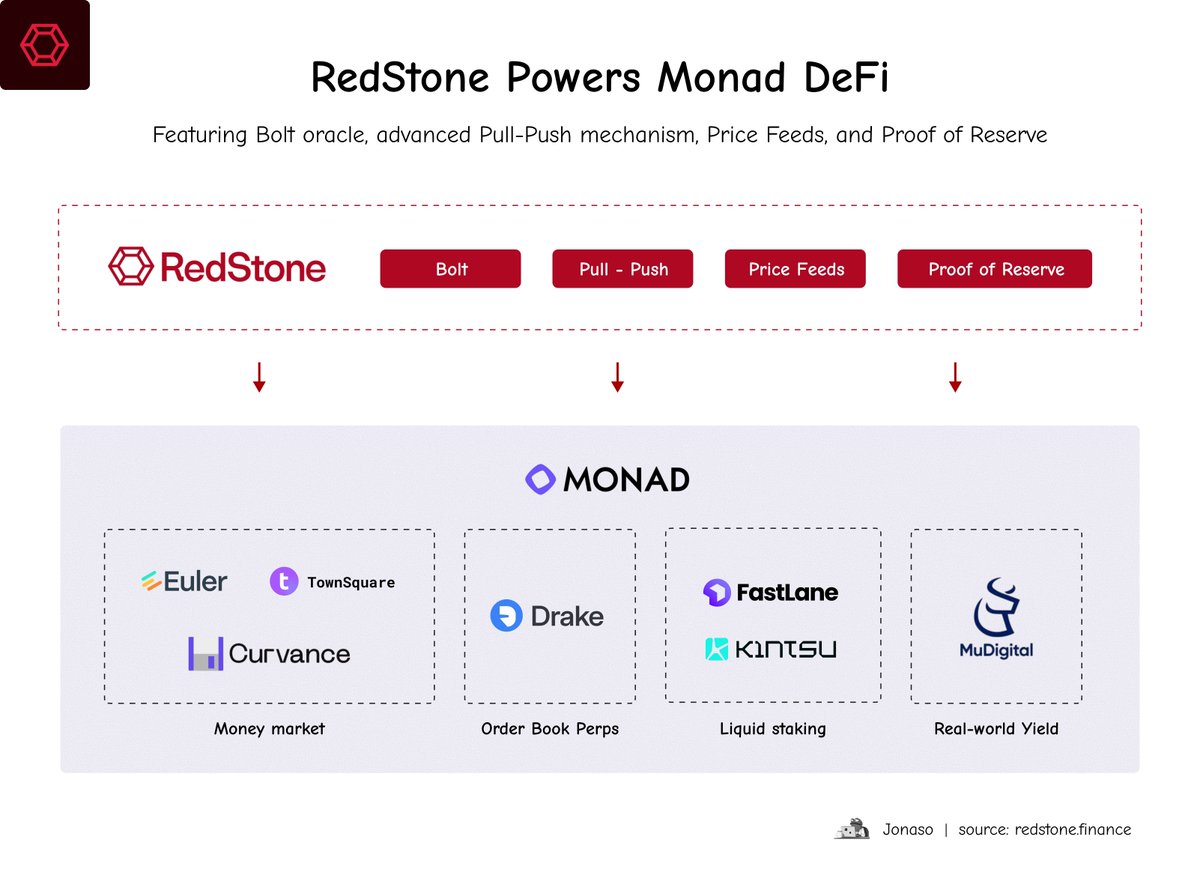
Source:Show original
Disclaimer: The information on this page may have been obtained from third parties and does not necessarily reflect the views or opinions of KuCoin. This content is provided for general informational purposes only, without any representation or warranty of any kind, nor shall it be construed as financial or investment advice. KuCoin shall not be liable for any errors or omissions, or for any outcomes resulting from the use of this information.
Investments in digital assets can be risky. Please carefully evaluate the risks of a product and your risk tolerance based on your own financial circumstances. For more information, please refer to our Terms of Use and Risk Disclosure.