


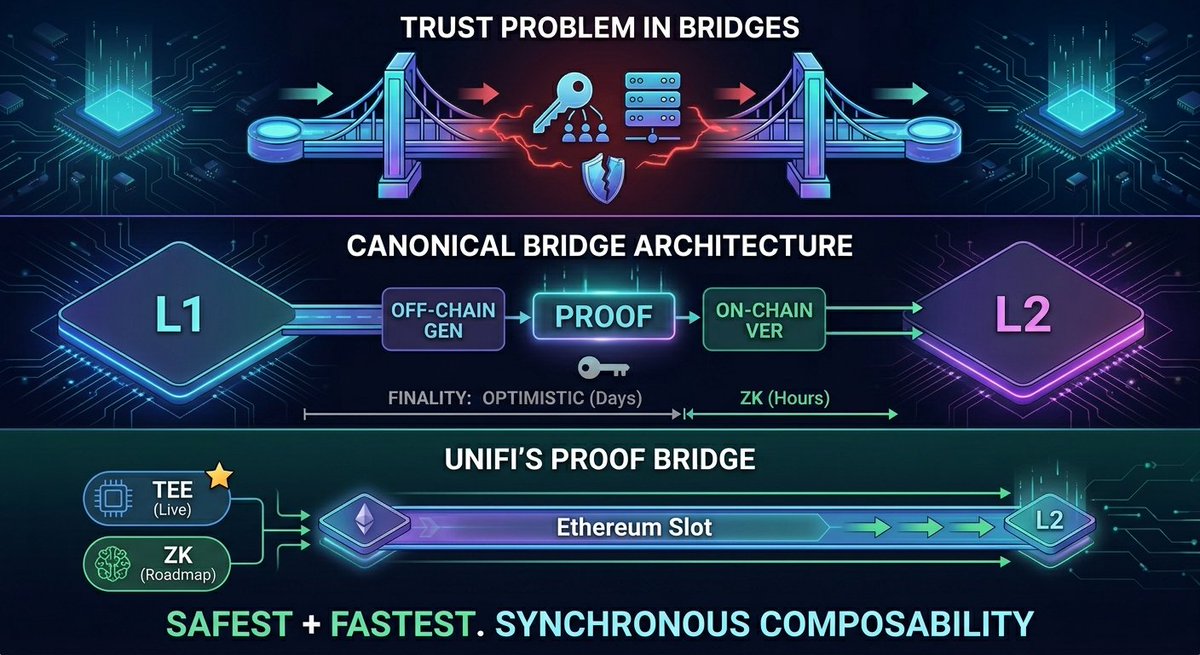
Bridges have a trust problem. A bridge is a way to pass messages between chains — moving assets, state, and instructions from one execution environment to another. Simple concept. But every bridge needs to answer one question: is this cross-chain message legitimate? Most bridges answer it by trusting someone like a DVN, a multisig, a relayer. That someone is an off-chain verifier. And off-chain verifiers can be compromised, poisoned, or coerced. We have seen the consequences. The canonical bridge answers that question differently with cryptographic proof. Instead of trusting a verifier to say "this message is valid," the canonical bridge requires proof that it is valid. Generated off-chain. Verified on-chain by the L2 protocol itself. No trusted entity in the critical path. The protocol is the final arbiter. This has always been the most trust-minimized bridge architecture. But the problem was speed. Optimistic Rollups need 7 days to finalize. ZK Rollups take hours. So third-party bridges flourished — faster, but built on trust assumptions that could be exploited. Real-time proving changes this permanently. @puffer_unifi 's canonical bridge — what we call proof-generated bridging — combines the security of the canonical bridge with the speed of real-time proving. TEE proving is live today. ZK proving is on the roadmap. And proof-generated bridging is what makes synchronous composability real. When L1 and L2 can exchange cryptographically verified messages within the same Ethereum slot within the same block, same state, protocol-enforced validity, where L1 and L2 stop feeling like separate chains and start feeling like one execution environment. Cryptographic validity. Instant finality. No trusted third party. Synchronous composability across L1 and L2. The safest bridge is now also the fastest. That’s how UniFi handles cross-chain messaging. 🐡

Share


Source:Show original
Disclaimer: The information on this page may have been obtained from third parties and does not necessarily reflect the views or opinions of KuCoin. This content is provided for general informational purposes only, without any representation or warranty of any kind, nor shall it be construed as financial or investment advice. KuCoin shall not be liable for any errors or omissions, or for any outcomes resulting from the use of this information.
Investments in digital assets can be risky. Please carefully evaluate the risks of a product and your risk tolerance based on your own financial circumstances. For more information, please refer to our Terms of Use and Risk Disclosure.