


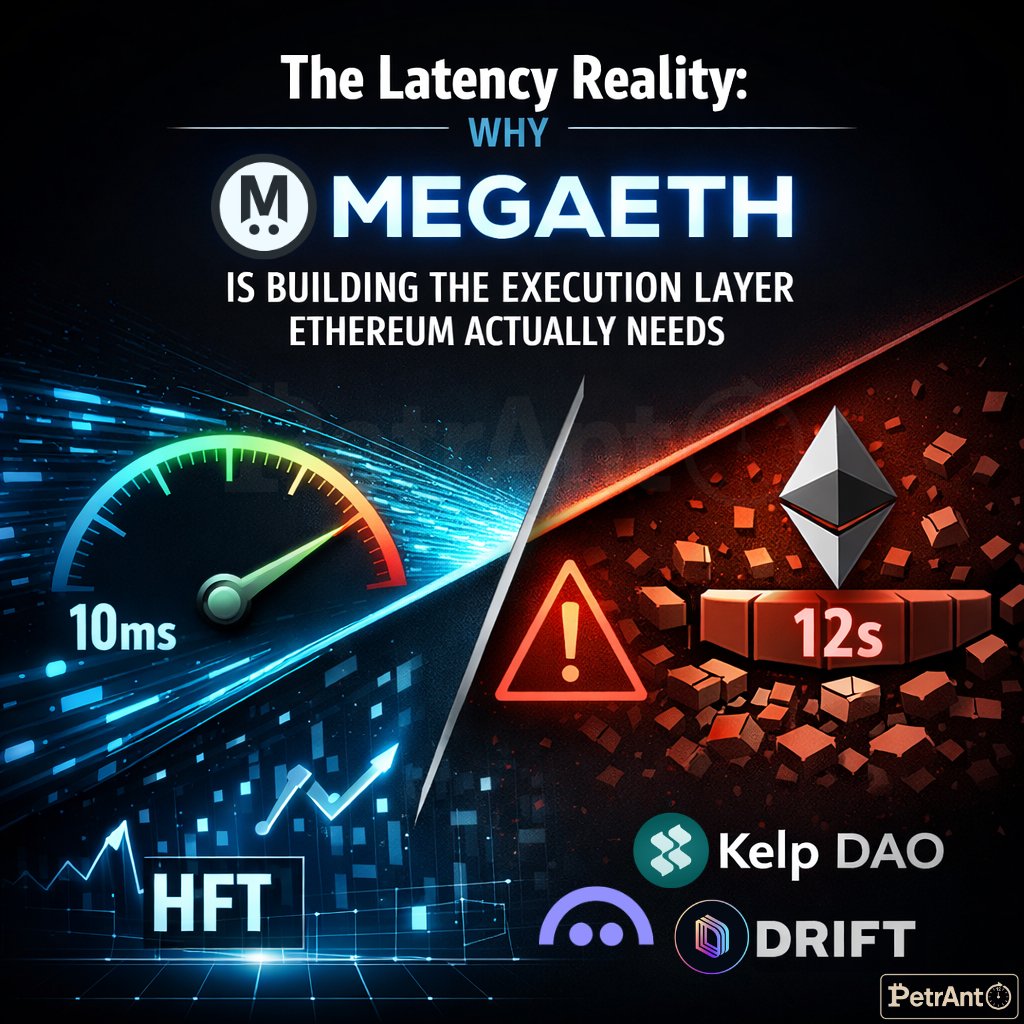
The Latency Reality: Why MegaETH Is Building the Execution Layer Ethereum Actually Needs Vitalik Buterin has long highlighted a structural truth: Ethereum L1 prioritizes security and decentralization over raw execution speed. Base-layer blockchains operating on 12-second block times cannot mathematically support the sub-10ms finality required for high-frequency trading, rapid arbitrage, and reactive perpetuals. That vacuum is now being filled. MegaETH launched its mainnet in February 2026 as the first real-time Ethereum L2. However, in a year that has already seen nearly $800 million in DeFi exploits - including the $293 million Kelp DAO exploit cascading into Aave and the $285 million Drift Protocol hack - speed without credible guardrails is a massive liability. ⬇️ ◽️ The Architecture of Millisecond Execution MegaETH does not cheat physics; it specializes ruthlessly to achieve its speed. ▫️ Hardware & State: A single high-spec sequencer paired with SALT (a RAM-based state trie) completely eliminates the disk I/O bottlenecks that cripple standard EVM clients. ▫️ Streaming Finality: Mini-blocks stream state diffs to replica nodes every ~10ms, while full EVM blocks periodically settle to Ethereum. ▫️ Throughput Reality: Stress tests successfully cleared 100k+ TPS. The live network is currently processing 2.26 million transactions per day with roughly 84% compute headroom remaining. The result is effective sub-10ms latency for order placement, cancellation, and feedback loops. This is currently the only on-chain environment where sophisticated HFT bots can operate without constant congestion or execution jitter. ◽️ MegaETH vs. Hyperliquid: The Execution Divide Hyperliquid is the undisputed perps leader today, boasting $1.5 billion in TVL, nearly $4.9 billion in daily volume, and battle-tested execution. MegaETH is extremely early, registering just $17.5 million in daily perps volume. However, MegaETH holds distinct structural advantages for generalized algorithmic trading: 👉 Latency Edge: Sub-10ms streaming physically outpaces Hyperliquid’s sub-second blocks. For bots requiring true real-time loops, this hardware gap is decisive. 👉 Composability Moat: Full EVM compatibility plus direct Ethereum settlement makes complex atomic strategies trivial. Executing an Aave liquidation, a spot arbitrage, and a perps hedge in a single transaction is seamless. Hyperliquid excels at siloed order books; MegaETH enables cross-protocol, real-time DeFi. ◽️ Security: The Real Trade-Off in 2026 L2Beat currently rates MegaETH as high-risk for specific, structural reasons... The network relies on a single permissioned sequencer that can theoretically censor or reorder transactions. Full decentralization is deliberately delayed because it would reintroduce the exact L1 consensus overhead the team is trying to escape. Furthermore, instant contract upgrades mean a malicious update could drain funds with a zero-hour exit window. Finally, posting to EigenDA without full verifier checks introduces critical data availability risks. ⚠️ These are measurable counterparty risks. The 2026 exploit wave proves that even blue-chip protocols suffer severe contagion. MegaETH’s L1 settlement and hybrid proofs provide stronger finality than most appchains, but it remains operationally trusted infrastructure until the sequencer decentralizes and the instant upgrade vectors are permanently closed. ➡️ Market Positioning for Wise DeFi Traders @megaeth has the strongest technical foundation to make true on-chain HFT viable at scale. It will not displace Hyperliquid’s perps dominance overnight, but it is uniquely positioned to become the default high-performance execution layer for latency-sensitive DeFi. Institutional traders must treat it exactly as it is: extremely fast, but carrying clear centralization risks. Speed is the asset. Trust assumptions are the liability. Position your capital accordingly.

Share


Source:Show original
Disclaimer: The information on this page may have been obtained from third parties and does not necessarily reflect the views or opinions of KuCoin. This content is provided for general informational purposes only, without any representation or warranty of any kind, nor shall it be construed as financial or investment advice. KuCoin shall not be liable for any errors or omissions, or for any outcomes resulting from the use of this information.
Investments in digital assets can be risky. Please carefully evaluate the risks of a product and your risk tolerance based on your own financial circumstances. For more information, please refer to our Terms of Use and Risk Disclosure.