


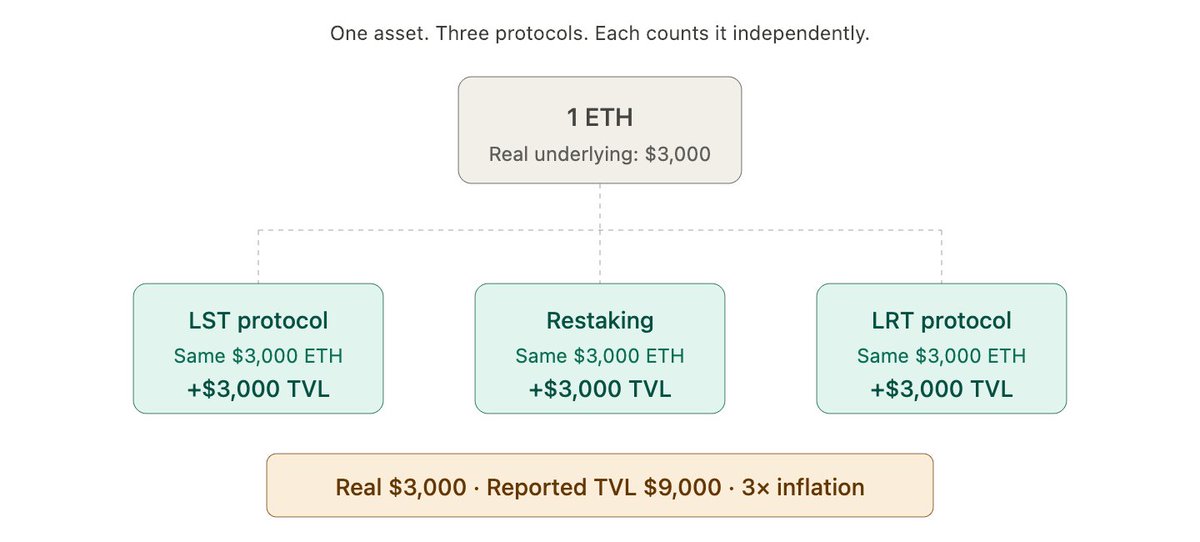
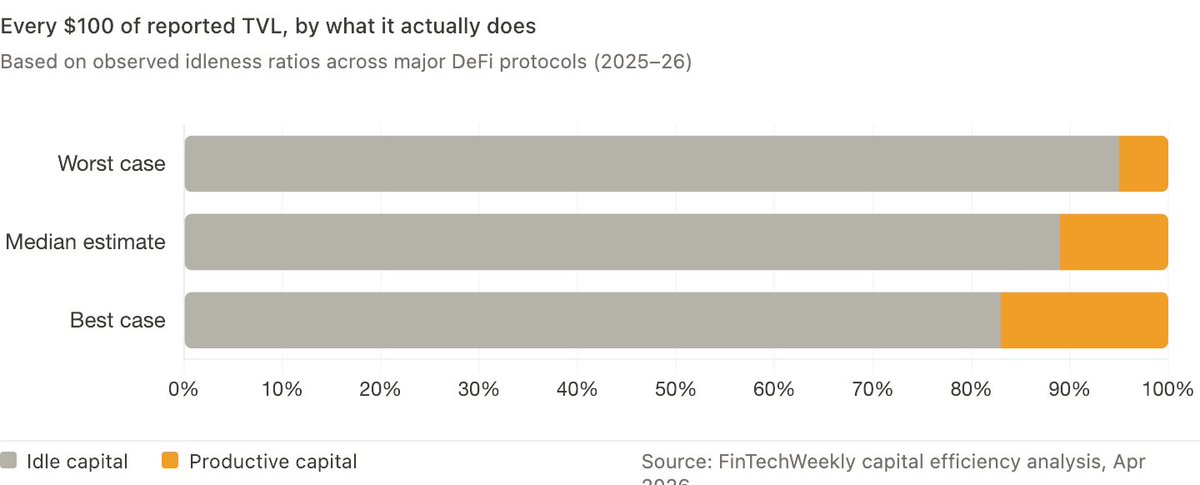
1/ DeFi TVL fell from $120B to $105B in early 2026. Most read this as a bear signal. The more interesting question: why do we still treat this number as a scoreboard at all? TVL measures what entered a protocol, not what it's doing once there. A dollar deposited and a dollar working are not the same asset. 2/ The idleness gap is enormous. Recent analysis puts unused liquidity across major DeFi protocols at 83–95%. On concentrated liquidity DEXs, billions sit in ranges so wide they rarely generate fees. A protocol doing $10M annual revenue on $200M of active liquidity is structurally different from one doing $3M on $2B in deposits. TVL flattens them into the same line on a leaderboard. 3/ Second flaw: double counting. Peer-reviewed work (Piercing the Veil of TVL, 2024) formalized this. At peak DeFi activity in Dec 2021, the gap between TVL and TVR (total value redeemable) hit $139.87B. The ratio was nearly 2:1. One ETH staked → LST → restaked → LRT. Each hop counts the same underlying asset. The capital didn't multiply. The number did. 4/ Third flaw: price sensitivity. MakerDAO's TVL went from a $20B peak in late 2021 to $8.22B by late 2022. Most of that drop wasn't users leaving — it was ETH falling from $4,500 to $1,500. TVL moves with asset prices. Protocol health doesn't. Tracking growth by TVL is like tracking a company's employee count by weighing the office. 5/ Fourth flaw: exposure is not strength. Ronin had $1.2B in TVL before its 2022 bridge exploit. $15M after. The number never measured defended capital. It measured what was sitting there, right up until it wasn't. A high TVL with thin security guarantees looks identical on a dashboard to a high TVL with robust ones. 6/ The disconnect is measurable in real protocol data. A widely cited comparison: Uniswap generated ~$111M in annualized fees against Balancer's ~$30.8M — despite Balancer carrying 33% more TVL. Same category. Same chain. Deposits pointing one way, revenue pointing the other. This is why Messari, Artemis, and Token Terminal have demoted TVL to a supplemental metric. Blockworks introduced Real Economic Value as a replacement frame. The metrics converging into consensus all measure capital productivity, not deposits: — Revenue per unit of active liquidity — Volume-to-TVL ratio — Organic vs incentivized volume — Fee revenue per wallet — Protocol-owned vs mercenary liquidity None of these can be gamed by recursive loops or inflated by token emissions. 7/ TVL isn't useless. It was a reasonable bootstrap metric when the question was "will people move capital onchain at all." That question is settled. A metric that tells you nothing about revenue, solvency, or security — and can be inflated by the stack's own architecture — isn't a scoreboard anymore. It's a press release with a dollar sign. The protocols still leading with it in 2027 are telling you which numbers they'd rather you didn't look at.

Share


Source:Show original
Disclaimer: The information on this page may have been obtained from third parties and does not necessarily reflect the views or opinions of KuCoin. This content is provided for general informational purposes only, without any representation or warranty of any kind, nor shall it be construed as financial or investment advice. KuCoin shall not be liable for any errors or omissions, or for any outcomes resulting from the use of this information.
Investments in digital assets can be risky. Please carefully evaluate the risks of a product and your risk tolerance based on your own financial circumstances. For more information, please refer to our Terms of Use and Risk Disclosure.