


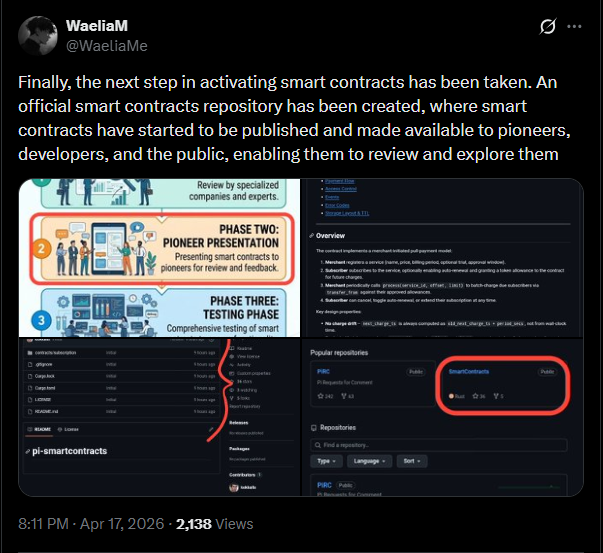
Pi Network advances smart contract activation as its official smart contract repository is publicly unveiled for developers and the community. Pi Network has launched its official smart contract repository, granting public access to developers and pioneers to review, explore, and build Web3 applications. Pi Network is drawing closer to smart contract activation as the official repository is now open for public access. The Pi Network has garnered significant attention within the blockchain and Web3 communities following reports that its official smart contract repository has been created and made public. This development marks a crucial step toward enabling broader participation from developers, pioneers, and the public in examining and interacting with the network’s smart contract infrastructure. The creation of a dedicated repository for smart contracts signifies a structural shift toward transparency and developer engagement. By making smart contract code publicly accessible, the ecosystem is opening the door to scrutiny, collaboration, and potential contributions from a wider technical community. According to community updates, smart contracts have already begun appearing in this repository. This indicates the system is transitioning from an internal development phase to a more open and interactive stage, where source code can be reviewed and tested by external developers. In the blockchain ecosystem, the introduction of an official smart contract repository is widely regarded as a key milestone. It enables developers to understand how the underlying system operates, identify integration opportunities, and build decentralized applications aligned with the network’s architecture. This move also plays a vital role in enhancing transparency. In decentralized systems, transparency is a foundational principle that fosters trust without reliance on centralized oversight. By granting access to smart contract code, Pi Network allows participants to independently verify logic, examine deployment details, and assess system behavior. Enabling pioneers and developers to directly explore smart contracts is especially critical for ecosystem growth. Developers are often the primary drivers of innovation in blockchain environments, building applications that expand utility and introduce new use cases for digital assets. With the public release of smart contracts, developers can now begin testing decentralized applications—including financial tools, automated services, and blockchain-based platforms powered by programmable logic. This could significantly accelerate ecosystem development if widely adopted. The activation of the smart contract repository also marks progress toward full blockchain functionality. Smart contracts are essential components of Web3 systems, enabling automated execution of agreements without intermediaries. This capability supports numerous applications—from decentralized finance to digital identity systems. In practice, smart contracts can power services such as automated payments, registration systems, escrow mechanisms, and decentralized marketplaces. By making these contracts public, Pi Network is laying the foundation for building and testing such applications. From a technical standpoint, public repositories also serve as collaborative environments. Developers can inspect code, propose improvements, and identify potential vulnerabilities. This collective review process typically leads to stronger, more secure systems over time. Security auditing is another key benefit of open repositories. When smart contract code is made public, it can be examined by independent experts who can detect bugs or inefficiencies before large-scale deployment. This reduces risk and enhances system reliability. The decision to open access to smart contracts aligns with broader trends in blockchain development. Many successful Web3 ecosystems rely heavily on open-source principles, where transparency and collaboration drive innovation. Projects like Ethereum have demonstrated how open developer ecosystems can fuel rapid growth and diverse application development. However, expanding access to smart contracts also presents challenges. Managing contributions, maintaining code quality, and ensuring consistency across updates require a structured governance system. Without proper coordination, open systems can become fragmented or inconsistent. Despite these challenges, the potential benefits of a publicly accessible smart contract repository are substantial. It can attract developers, strengthen ecosystem engagement, and accelerate the creation of practical applications that deliver real value to the network. For Pi Network, this step may represent a pivotal transition from closed development to ecosystem expansion. By enabling external parties to interact with core infrastructure, the project is demonstrating its readiness for broader developer participation.This development also holds significant meaning for the maturity of the ecosystem. In blockchain systems, the transition from private development to public open-source access is often closely tied to readiness for scaling and external integration. This indicates that core components have reached sufficient stability to be examined and built upon. The presence of smart contracts in a public repository also helps bridge the gap between theory and application. While conceptual discussions about blockchain’s utility are common, having actual, accessible source code enables developers to move from discussion to deployment. As developers begin exploring the repository, initial testing phases may focus on understanding contract structure, verifying functionality, and identifying potential use cases. Over time, this can evolve into large-scale application development within the ecosystem. User participation is another critical factor. While developers build applications, end users ultimately determine adoption levels through their interaction with decentralized services. A robust developer ecosystem combined with active user engagement is essential for long-term sustainability. The release of a public repository also enhances educational opportunities. New developers can learn from real-world smart contract implementations, gaining deeper insight into blockchain structure and logic execution. This can help expand the overall talent pool within the ecosystem. From a strategic perspective, this move may also help position Pi Network within the broader competitive landscape of Web3 platforms. As the blockchain ecosystem continues to grow, transparency and developer accessibility are becoming key differentiators. Projects that prioritize open development often benefit from faster innovation cycles, as external contributors can introduce new ideas and improvements more rapidly than closed teams. In summary, the official launch of the smart contract repository marks a significant milestone in Pi Network’s development journey. By opening its smart contracts, the ecosystem is unlocking greater transparency, developer participation, and collaborative innovation. While the full impact of this development will depend on adoption, execution, and ecosystem growth, it is clearly a step toward a more open and highly programmable blockchain environment. As developers begin exploring and building upon this foundation, the next phase of Pi Network’s Web3 evolution may begin to take shape. — Victoria Hale

Share


Source:Show original
Disclaimer: The information on this page may have been obtained from third parties and does not necessarily reflect the views or opinions of KuCoin. This content is provided for general informational purposes only, without any representation or warranty of any kind, nor shall it be construed as financial or investment advice. KuCoin shall not be liable for any errors or omissions, or for any outcomes resulting from the use of this information.
Investments in digital assets can be risky. Please carefully evaluate the risks of a product and your risk tolerance based on your own financial circumstances. For more information, please refer to our Terms of Use and Risk Disclosure.