


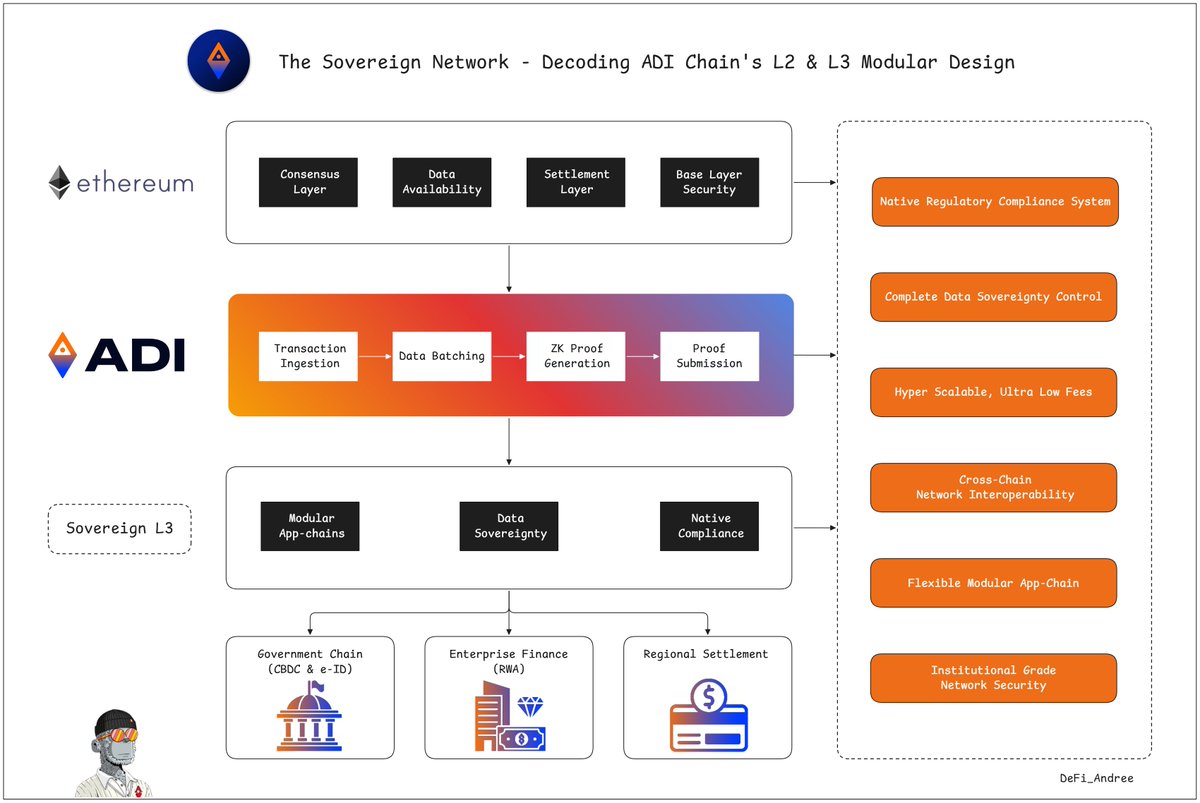
The Sovereign Network - Decoding ADI Chain's L2 & L3 Modular Design @ADIChain_ is positioning itself as the infrastructure for governments, institutions, and regulated capital The biggest bottlenecks preventing TradFi from entering Web3 are: ▸ Regulatory compliance ▸ Data sovereignty ▸ Scalability ADI Chain’s architecture is specifically built to solve these 3 constraints --- Most current blockchains are optimized for open markets (fast, cheap, user-friendly). ADI optimizes for a different demographic: Governments and Enterprises Therefore, the system requires a much more premium standard: ▸ Legal compliance right at the network layer ▸ Sovereign control over sensitive data ▸ Large-scale settlement without sacrificing security ADI utilizes a 3-layer design to clearly separate roles: Layer 1 (Ethereum): The trust anchor. ADI doesn't build trust from scratch; it inherits consensus, settlement, and security from the world's strongest decentralized network Layer 2 (ADI): The execution engine. This layer focuses on performance: high-throughput transaction processing, data batching, and cost optimization Layer 3 (Sovereign L3): The customizable network. Instead of forcing everyone to share a public chain, L3 allows nations/institutions to create their own chains (app-chains) with localized compliance rules and data control, while still benefiting from the shared security of L1/L2 --- Governments and institutions do not wonder, Can blockchain scale? They care about: Where does the data live? Who has access? How do we enforce risk management and legal compliance? Sovereign L3 fully resolves this by delivering: ▸ Internal data ownership ▸ Customizable compliance rule sets per jurisdiction ▸ Risk isolation between systems ADI is designed for macro systems rather than retail DApps: Government Chain: Ideal for Central Bank Digital Currencies (CBDCs), electronic Identity (e-ID), and public databases Enterprise Finance (RWA): Tokenizing illiquid assets like bonds, equities, and real estate into on-chain tradable assets Regional Settlement: Replacing outdated cross-border payment systems with a real-time, low-cost, and cross-chain interoperable settlement network --- The value of ADI Chain lies in 6 core elements: > Native regulatory compliance: Integrated directly into the core architecture, bypassing middleware > Data sovereignty control: A strict prerequisite for nations to protect their information > Hyper-scalability & Ultra-low fees: A mandatory condition for operating national-level payment systems > Cross-chain interoperability: The ability to connect seamlessly with other ecosystems and capital markets > Flexible modular design: Reduces the time and technical overhead for enterprises building a blockchain from scratch > Institutional-grade security: The mandatory admission ticket to attract institutional capital --- Their architectural model is crystal clear: Use Ethereum for security, use L2 for scale, and use Sovereign L3 for data/compliance control ➥ ADI Chain is building regulated Web3. This is a highly difficult puzzle: preserving the efficiency of blockchain while satisfying the strict demands of TradFi.

Share


Source:Show original
Disclaimer: The information on this page may have been obtained from third parties and does not necessarily reflect the views or opinions of KuCoin. This content is provided for general informational purposes only, without any representation or warranty of any kind, nor shall it be construed as financial or investment advice. KuCoin shall not be liable for any errors or omissions, or for any outcomes resulting from the use of this information.
Investments in digital assets can be risky. Please carefully evaluate the risks of a product and your risk tolerance based on your own financial circumstances. For more information, please refer to our Terms of Use and Risk Disclosure.