


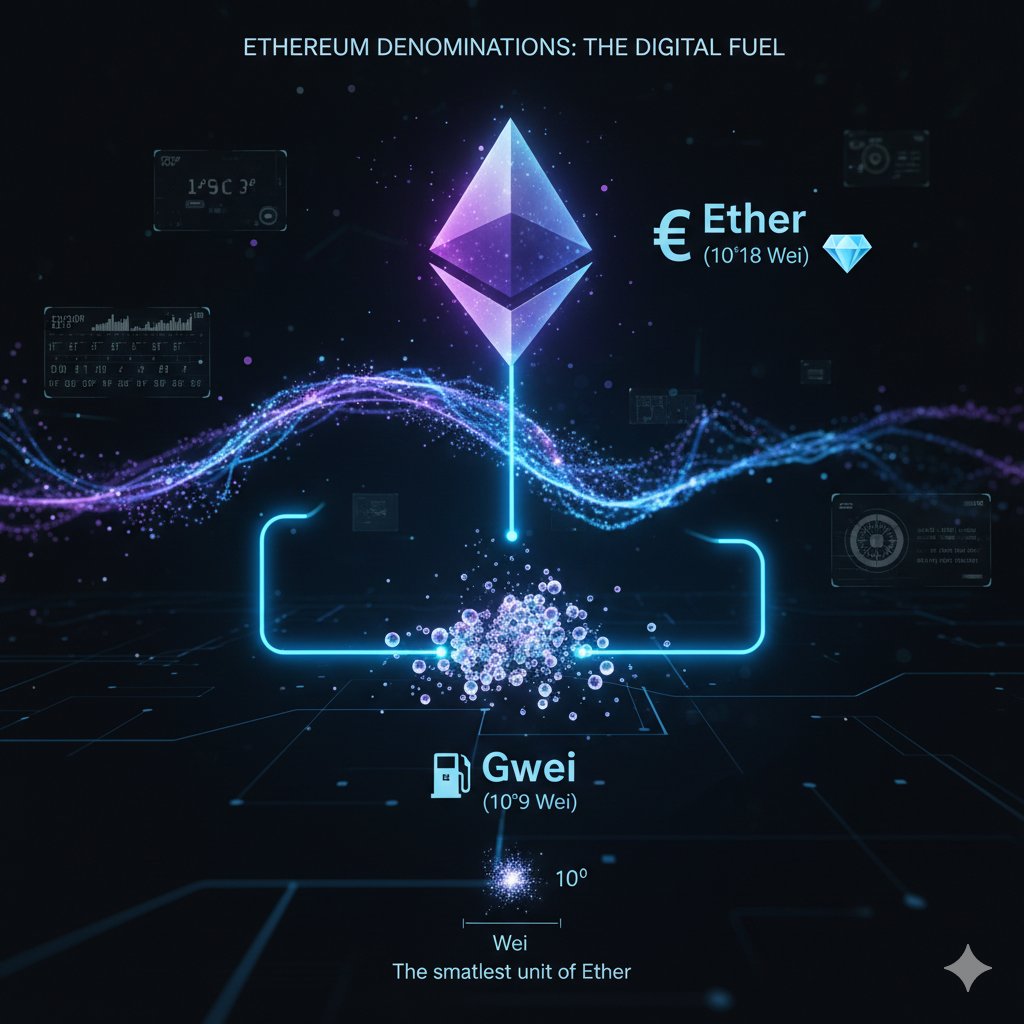
𝗗𝗮𝘆 𝟯: Ether (ETH) If Ethereum is the "World Computer," Ether is the fuel that keeps the engine running. Ether is defined as the native cryptocurrency of the Ethereum ecosystem. But for builders, it’s much more than just money. it is a utility token used to pay for computational resources. The Unit of Measurement (Precision matters) In Ethereum development, we rarely work with just 1 ETH, Because smart contracts need to be incredibly precise, Ether is divisible down to 18 decimal places. The most important units you'll use in code are: - Wei: The smallest possible unit (1 \text{ Ether} = 10^{18} \text{ Wei}). Everything in the EVM is actually calculated in Wei. - Gwei: Used mostly for gas fees (1 \text{ Gwei} = 10^9 \text{ Wei}). When you hear "Gas is 20," they mean 20 Gwei. Ether is The unit we see in our wallets. Why Builders Care: - Staking: Ether is used by validators to secure the network. - Gas: Every line of code you write costs a tiny bit of Ether to execute. - Value Transfer: It’s the default way to move value between accounts and contracts. - The Main Key Note: Ether isn't just a currency, it’s a meter tool. It prevents people from spamming the network with infinite loops and ensures every computation is paid for. - Tomorrow, we look at the unit that specifically measures that work: → Gas.

Share


Source:Show original
Disclaimer: The information on this page may have been obtained from third parties and does not necessarily reflect the views or opinions of KuCoin. This content is provided for general informational purposes only, without any representation or warranty of any kind, nor shall it be construed as financial or investment advice. KuCoin shall not be liable for any errors or omissions, or for any outcomes resulting from the use of this information.
Investments in digital assets can be risky. Please carefully evaluate the risks of a product and your risk tolerance based on your own financial circumstances. For more information, please refer to our Terms of Use and Risk Disclosure.