


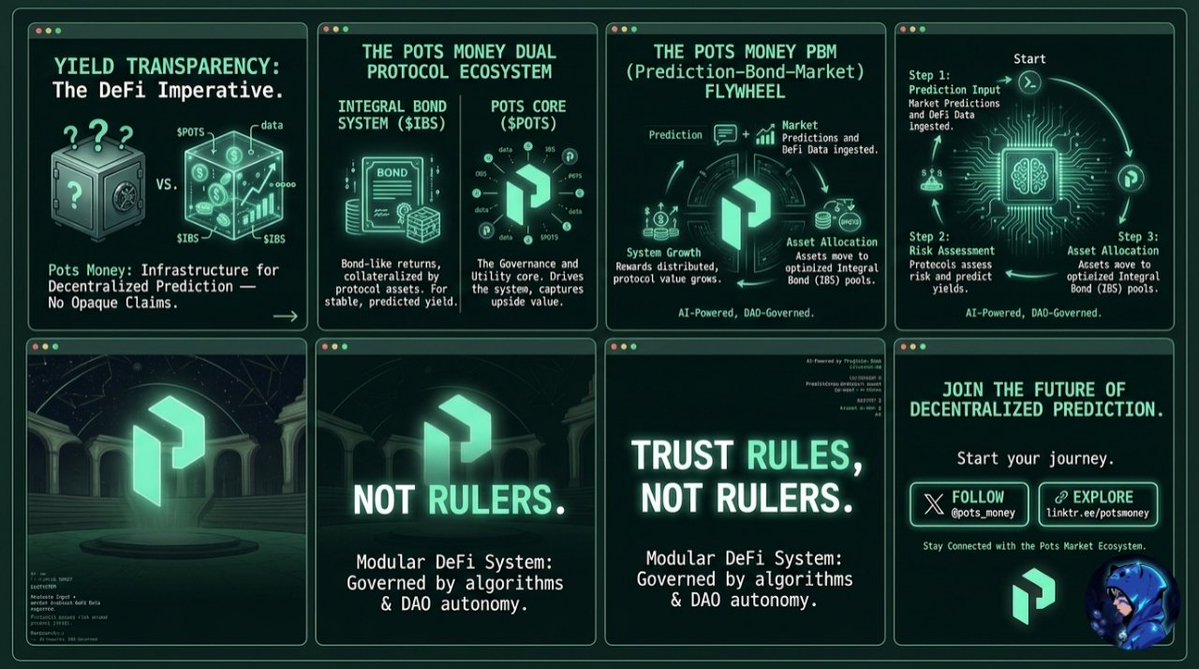
Most DeFi projects promise you yield. Very few tell you where that yield actually comes from. That's the problem @pots_money set out to fix - and honestly, the more I dug into how they built this, the more I understood why it matters. Let me break it down 🧵 We've all been there. You stake into some protocol. APY looks clean. Then six months later, emissions dry up, token tanks, and your "yield" was just inflation wearing a suit. The house of cards collapses because there was never a real engine underneath - just vibes and a pretty dashboard. @pots_money approaches this differently. It's a dual-protocol system: Pots Money handles decentralized bond issuance. @pots_market handles prediction markets. These two aren't just co-existing - they're feeding each other through something called the POTS Bidding Module (PBM). Here's what actually clicked for me: The revenue flowing into @pots_money stakers ($IBS holders) doesn't come from thin air. It comes from auction proceeds in @pots_market -real competitive bids for $POTS. That's not inflationary yield. That's a market creating actual demand, which flows back as real returns. Think about what that means structurally. As the prediction market grows → more demand for $POTS → more competitive auctions → higher returns for bond stakers. The growth flywheel isn't marketing language here. It's literally baked into how the two protocols interact. And on the flip side The stable capital sitting in @pots_money becomes a natural feeder for @pots_market. Conservative users who would never touch a prediction market end up funding one - without taking on the risk themselves. Both sides benefit. Neither cannibalizes the other. What I respect most is the philosophical foundation behind this. "Trust rules, not rulers." Every mechanism - AEM, RBS, YRF, POL, MCL - runs through immutable smart contracts. Publicly auditable. No backroom decisions. No team discretion. In a space full of anonymous multisigs and vague "governance," that sentence hits different. We've normalized trusting teams in crypto. @pots_money is asking us to trust logic instead. That's a harder thing to build. It's also the only kind of system that actually scales globally without requiring faith in any individual. $IBS gives you stability and predictable returns. $POTS gives you market exposure and governance. You don't have to pick one side of the risk curve. You can hold both and participate in an ecosystem where the two tokens actively reinforce each other's value. DeFi has been trying to solve the stability vs. speculation tension since 2020. Most solutions just separate them - park your safe money here, gamble over there. @pots_money and @pots_market are the first architecture I've seen that makes them structurally interdependent. That's not a small thing. If you're building a position in DeFi that you actually want to hold through a full cycle Something with transparent mechanics, verifiable logic, and a real economic engine behind the yield @pots_money deserves a serious look. Not financial advice. Just a builder who reads whitepapers so you don't have to. https://t.co/cM0KElIzPw

Share


Source:Show original
Disclaimer: The information on this page may have been obtained from third parties and does not necessarily reflect the views or opinions of KuCoin. This content is provided for general informational purposes only, without any representation or warranty of any kind, nor shall it be construed as financial or investment advice. KuCoin shall not be liable for any errors or omissions, or for any outcomes resulting from the use of this information.
Investments in digital assets can be risky. Please carefully evaluate the risks of a product and your risk tolerance based on your own financial circumstances. For more information, please refer to our Terms of Use and Risk Disclosure.