


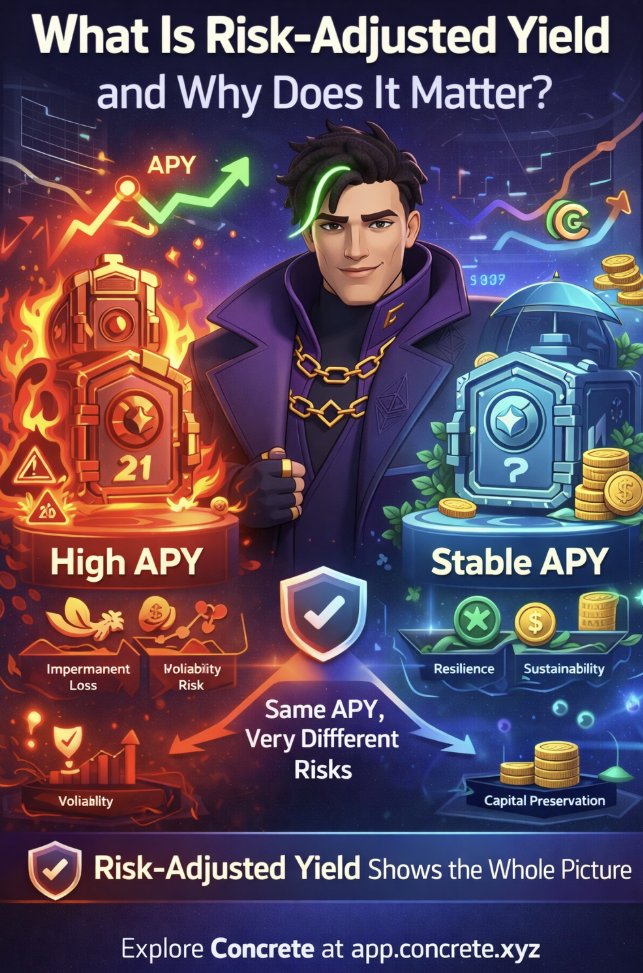
What Is Risk-Adjusted Yield and Why Does It Matter? In the early days of DeFi, yield was treated like a scoreboard. Protocol dashboards looked like arcade leaderboards flashing ever bigger APY numbers. Liquidity flowed wherever the number was highest, and strategies were often judged by a single metric: how large the return looked on paper. But as the ecosystem matures, a deeper question emerges. What if the most important number isn’t the highest yield, but the most reliable one? This is where risk-adjusted yield enters the conversation. Instead of focusing only on raw returns, it asks a more sophisticated question: how much risk was taken to achieve that return? As capital in DeFi grows more sophisticated, this perspective may reshape how onchain capital allocation works across the entire ecosystem. The Problem With Yield Comparisons Most DeFi users compare opportunities using a very simple method. They open dashboards, scan the APY column, and move their liquidity toward the highest number. Protocols compete aggressively for attention by advertising large yields, often driven by token emissions or temporary incentives. Liquidity providers respond quickly, hopping from pool to pool in pursuit of the next peak on the chart. On the surface, this seems rational. A higher APY suggests a better opportunity. The problem is that two strategies with the same APY can carry radically different levels of risk. A 20% yield generated from volatile assets and leveraged exposure is not the same as a 20% yield generated from stable lending markets. Yet dashboards often present these returns side by side as if they were equivalent. The raw number hides the complexity underneath. In reality, yield without context is only part of the picture. The Risks Behind DeFi Yield Every DeFi yield strategy carries a collection of risks that influence the true value of its returns. Understanding these risks is essential for evaluating whether a yield opportunity is actually attractive. One of the most obvious factors is asset volatility. Strategies involving volatile tokens can produce impressive returns during favorable market conditions, but those returns may evaporate quickly during price swings. Another major factor is liquidity risk. During periods of market stress, liquidity can disappear from pools faster than expected, making exits costly or difficult. For liquidity providers, impermanent loss can quietly erode profits when asset prices diverge. What initially appears as strong yield can end up underperforming simple holding strategies. Market conditions also introduce slippage risk, especially when large amounts of capital attempt to move simultaneously. Finally, many high APY opportunities rely heavily on token emissions. These incentives can temporarily inflate yields but may decline as reward programs change or as token prices fluctuate. Each of these risks affects the sustainability and reliability of a yield strategy. When ignored, they can turn an attractive APY into a misleading signal. High Yield vs Stable Yield To understand why risk-adjusted yield matters, consider a simple comparison. One strategy offers 20% APY, but it depends on volatile assets and fluctuating incentive programs. Another strategy offers 8–10% APY, generated from more stable sources with lower volatility and stronger liquidity. At first glance, the 20% opportunity looks superior. But over time, the outcome may be very different. High-volatility strategies can experience sharp drawdowns that erase months of gains. Incentive-driven yields may decline once rewards are reduced. What begins as the highest APY can quickly become unstable or unpredictable. Meanwhile, a more stable strategy may deliver steady returns with fewer disruptions. For many investors, especially larger pools of capital, consistency becomes more valuable than short bursts of high yield. Preserving capital and compounding stable returns can produce stronger long-term outcomes than chasing the top number on a dashboard. The Rise of Risk-Adjusted Thinking This is why mature financial systems evaluate returns using risk-adjusted metrics rather than simple yield comparisons. Instead of asking “What has the highest APY?”, investors ask more nuanced questions: How consistent are the returns over time? How resilient is the strategy during market downturns? Are the revenues sustainable or dependent on short-term incentives? Does the strategy prioritize capital preservation? This mindset shifts the focus from pure yield to risk-adjusted yield. In a risk-aware framework, the best opportunity is not necessarily the one with the highest return, but the one that delivers the strongest return relative to the risks involved. As DeFi grows and attracts more sophisticated participants, this approach to evaluating yield may become the standard. How DeFi Vaults Improve Risk-Adjusted Outcomes This evolution is closely connected to the rise of DeFi vaults and managed DeFi infrastructure. Vaults change how capital is deployed onchain by introducing automation, diversification, and structured risk management. Instead of requiring individual users to constantly rebalance positions and analyze complex strategies, DeFi vaults manage these processes automatically. Strategies can be diversified across multiple opportunities, reducing exposure to any single risk factor. Systems like Concrete vaults are designed to optimize onchain capital allocation through automation and structured strategy design. Vault infrastructure can enforce risk parameters, rebalance allocations, and perform automated compounding over time. This model shifts the focus away from manual yield chasing and toward long-term capital optimization. In other words, vaults allow DeFi users to participate in more disciplined, risk-aware strategies without needing to manage every detail themselves. Concrete DeFi USDT as a Real-World Example A practical example of this approach is Concrete DeFi USDT, which offers approximately 8.5% stable yield. At first glance, this number might appear modest compared to the headline APYs sometimes advertised across DeFi dashboards. But the important factor is not just the percentage. It is the stability and sustainability of the yield. Consistent returns can outperform volatile strategies over time, particularly when markets become turbulent. Stable yield combined with automated compounding can steadily grow capital while reducing exposure to sudden drawdowns. For larger investors and long-term participants, this type of reliability becomes extremely valuable. In many ways, the appeal of institutional DeFi lies precisely here: predictable returns supported by strong infrastructure rather than temporary yield spikes. Those interested in exploring this model can Explore Concrete at https://t.co/465iAaNOKB. The Bigger Picture for DeFi The evolution of DeFi may follow a path similar to traditional finance. In the beginning, experimentation dominates. High yields attract attention, and rapid innovation drives liquidity from one opportunity to another. But as the ecosystem matures, capital allocation becomes more disciplined. Investors begin prioritizing sustainability, resilience, and long-term performance. Infrastructure improves, automation increases, and vaults may become the default interface for yield generation. In that future, comparing protocols purely by APY may feel outdated. Instead, the key metric could become risk-adjusted yield. Because in the long run, the most successful DeFi systems will not necessarily be the ones offering the highest returns. They will be the ones delivering the most reliable ones.

Share


Source:Show original
Disclaimer: The information on this page may have been obtained from third parties and does not necessarily reflect the views or opinions of KuCoin. This content is provided for general informational purposes only, without any representation or warranty of any kind, nor shall it be construed as financial or investment advice. KuCoin shall not be liable for any errors or omissions, or for any outcomes resulting from the use of this information.
Investments in digital assets can be risky. Please carefully evaluate the risks of a product and your risk tolerance based on your own financial circumstances. For more information, please refer to our Terms of Use and Risk Disclosure.