


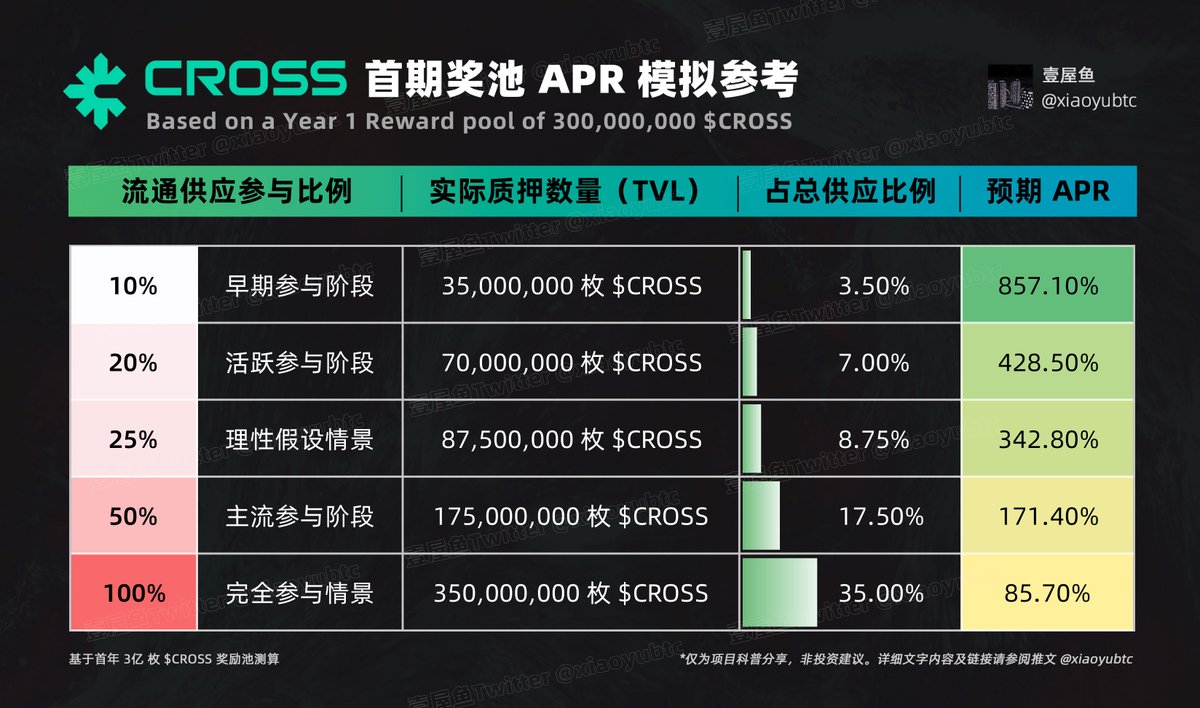
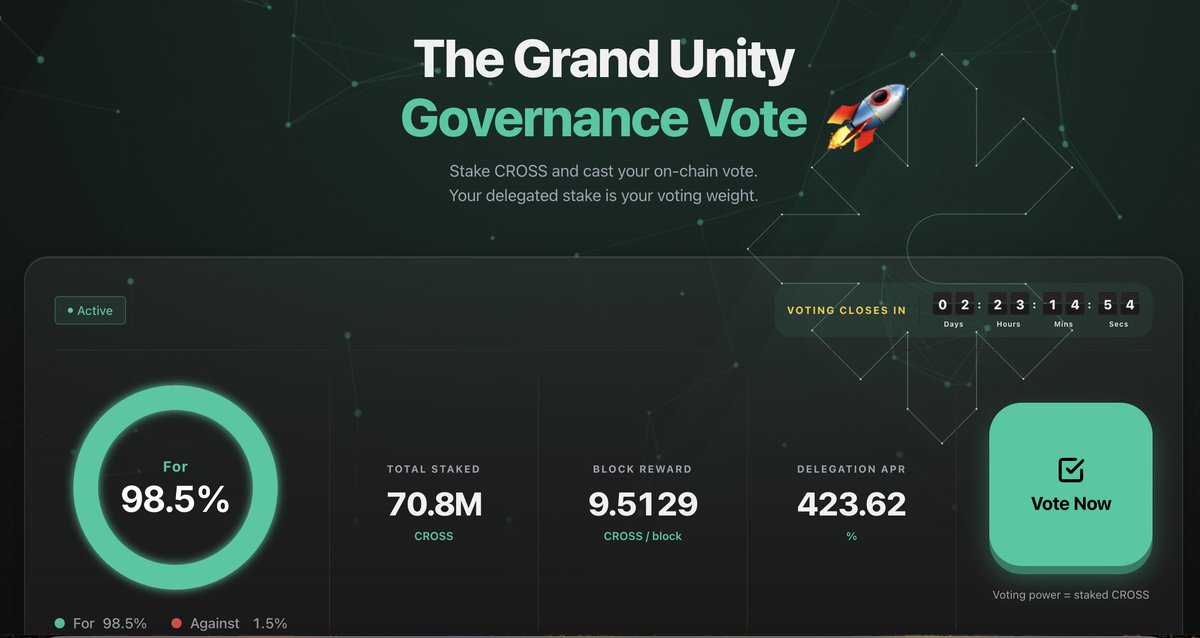
In a bear market, the top priority for project teams is simple: survive. For teams that have already completed their TGE, survival isn’t just about telling stories—it requires reducing circulating supply, easing selling pressure, and retaining long-term token holders. As a result, more projects are revisiting their tokenomics, with staking emerging as one of the most common solutions. @CROSS_gamechain recently announced adjustments to its token economic model, with voting opening today. The most significant aspect of this upgrade is the formal introduction of a staking mechanism. Additionally, project founder @henrychang10000 recently publicly stated his intention to continue accumulating, committing to purchase $1 million worth of CROSS this year—a strong signal to the market. According to official disclosures, the initial 300 million CROSS reward pool is not a token minting event; instead, it is reallocated from the existing 65% reserve to users who actively participate in the network. Many projects currently offering high yields are effectively relying on high inflation. While early APRs appear attractive, they often lead to direct and substantial selling pressure down the line. In contrast, CROSS’s upgrade avoids inflation and focuses on redistributing existing supply. From a market perspective, this design represents an optimization of the allocation structure—not merely a short-term stimulus. From an opportunity standpoint, early staking may offer a temporary yield window. Based on official simulated data: - If only 10% of the circulating supply participates, the corresponding APR reaches 857.1%; - At 20% participation, APR is 428.5%; - Even at a relatively conservative 25% participation rate, APR still stands at 342.8%. Before participation scales up, the fixed reward pool will be distributed across a smaller staking base, meaning early participants can theoretically enjoy significantly higher yields. Moreover, this model includes a 100% Base Fee Burn—meaning all base transaction fees are permanently destroyed. This creates a dual mechanism: front-end incentives attract users to stake, while back-end network activity continuously drives deflation through fee burns. If on-chain usage and ecosystem activity genuinely increase over time, this mechanism could prove more sustainable than models relying solely on high APRs. It doesn’t just offer financial incentives—it ties network activity, token scarcity, and user participation together into a cohesive system. Overall, this CROSS upgrade is not merely a parameter adjustment—it represents a strategic shift from passive holding to active participation. In the short term, it offers the market a clear early-yield opportunity; In the medium term, it redefines internal value distribution: those who remain on-chain and actively contribute to the network stand to receive greater allocations. Of course, whether this model ultimately succeeds depends on real-world data. If staking volume, on-chain activity, and ecosystem adoption can form a positive feedback loop, this upgrade may not just spark discussions around APR—it could fundamentally reprice the entire value proposition of the CROSS ecosystem.

Share


Source:Show original
Disclaimer: The information on this page may have been obtained from third parties and does not necessarily reflect the views or opinions of KuCoin. This content is provided for general informational purposes only, without any representation or warranty of any kind, nor shall it be construed as financial or investment advice. KuCoin shall not be liable for any errors or omissions, or for any outcomes resulting from the use of this information.
Investments in digital assets can be risky. Please carefully evaluate the risks of a product and your risk tolerance based on your own financial circumstances. For more information, please refer to our Terms of Use and Risk Disclosure.