


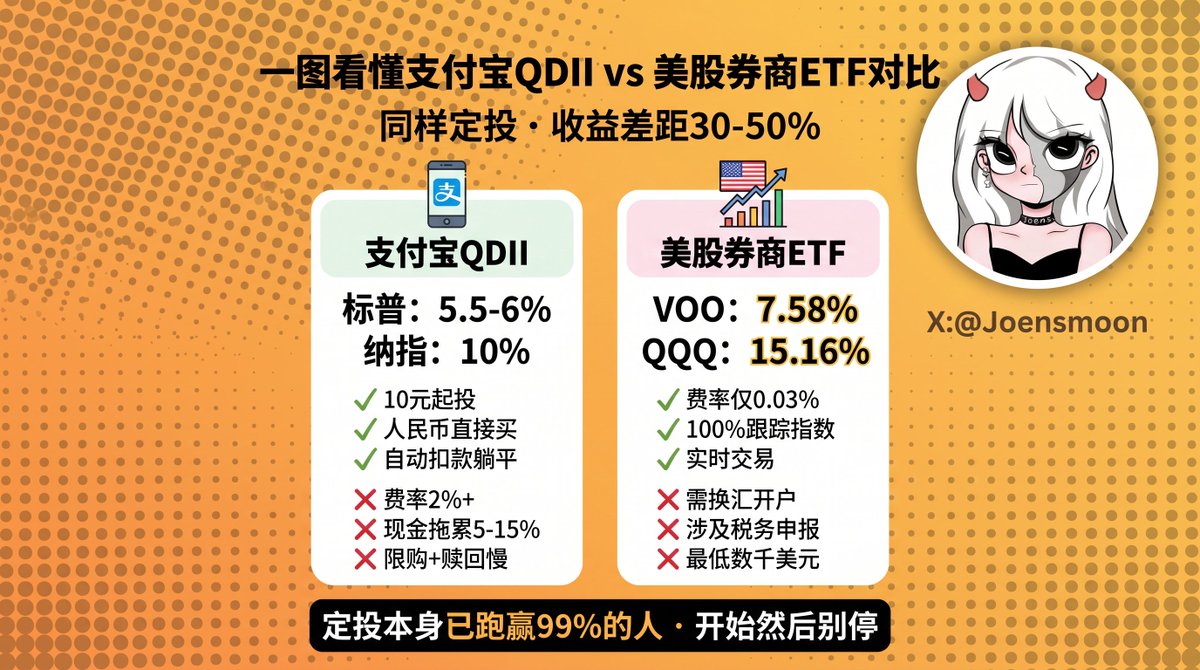
Alipay QDII Dollar-Cost Averaging vs. U.S. Brokerage Purchases of Nasdaq ETFs: A Comprehensive Comparison Many people are unclear about the differences between these two approaches. Recently, I compared their performance over the same period—and the gap was much larger than expected: From January 12 to May 8, investing the same amount daily: - S&P 500 QDII: 5.5%–6% - VOO: 7.58% - Nasdaq-100 QDII: 10% - QQQ: 15.16% With the same capital and time horizon, returns differed by 30–50%. Why is the gap so large? I. Hidden Costs of QDII Funds 1⃣ Cash Drag QDII funds hold 5–15% cash to handle redemptions—in a bull market, this portion misses out entirely. For example, JPMorgan’s S&P 500 Class A still holds 6.65% in cash. 2⃣ Fee Disparity (20x Difference) QDII Annual Fees: Management fee 0.8–1.05% + Custody fee 0.15% + Subscription fee 1.5% + Redemption fee 0.5% VOO Annual Fee: Just 0.03%—that’s it. 3⃣ Currency Drag This year, the U.S. dollar depreciated nearly 3% against the RMB, averaging a 1.5% drag on returns. Conversely, when the dollar appreciates, QDII gains an extra edge. 4⃣ Time Lag Net asset value (NAV) is published T+1; no trading on Chinese holidays. If U.S. markets rise, you won’t see it until next week. 5⃣ Purchase Limits QDII quotas are capped by China’s State Administration of Foreign Exchange (SAFE). Popular funds often limit purchases to ¥100/day—or suspend them entirely—making it impossible to add more. 6⃣ Slow Redemption Redemption settlements take 4–7 business days—leaving you helpless if you need cash urgently. II. But QDII Has Irreplaceable Advantages ✅ Start with just ¥10—zero entry barrier ✅ Buy directly in RMB—no currency conversion needed ✅ No overseas bank account required ✅ No U.S. tax filing (W-8BEN form) ✅ No CRS information exchange ✅ No risk of bank account freezes due to compliance concerns ✅ Fully legal and regulated with clear oversight ✅ Set up automatic deductions—completely hands-off 📷 ✅ When the dollar strengthens, currency appreciation boosts returns III. Advantages and Barriers of U.S. Brokerages Advantages: • Extremely low fees (VOO at 0.03%/year) • 100% tracking with no cash drag • Real-time trading with high liquidity • No purchase limits—buy as much as you want • Access to leveraged ETFs like TQQQ • Dividends credited directly to your account Barriers: • Requires an overseas brokerage (Futu, Tiger, IBKR, Charles Schwab, etc.) • Requires foreign exchange conversion (annual limit: $50,000 per person) • Complex deposit processes that may trigger compliance alerts • Subject to 30% U.S. dividend withholding tax • Subject to CRS information exchange—assets are tax-transparent • Minimum investment typically starts at several thousand U.S. dollars IV. How to Choose Small capital / Prefer simplicity / Want to “set it and forget it” → Use Alipay QDII: Set up auto-debit and don’t worry about it. Larger capital / Focused on maximizing returns / Already have an overseas account → Buy VOO and QQQ directly. The two aren’t mutually exclusive → Use small amounts via QDII to build the habit; use larger sums via ETFs to capture better returns. Ultimately, simply starting a dollar-cost averaging strategy on the Nasdaq or S&P 500 already puts you ahead of 99% of people. The choice of platform is just a refinement—it matters far less than this: Start. Then let compounding work.

Share


Source:Show original
Disclaimer: The information on this page may have been obtained from third parties and does not necessarily reflect the views or opinions of KuCoin. This content is provided for general informational purposes only, without any representation or warranty of any kind, nor shall it be construed as financial or investment advice. KuCoin shall not be liable for any errors or omissions, or for any outcomes resulting from the use of this information.
Investments in digital assets can be risky. Please carefully evaluate the risks of a product and your risk tolerance based on your own financial circumstances. For more information, please refer to our Terms of Use and Risk Disclosure.