

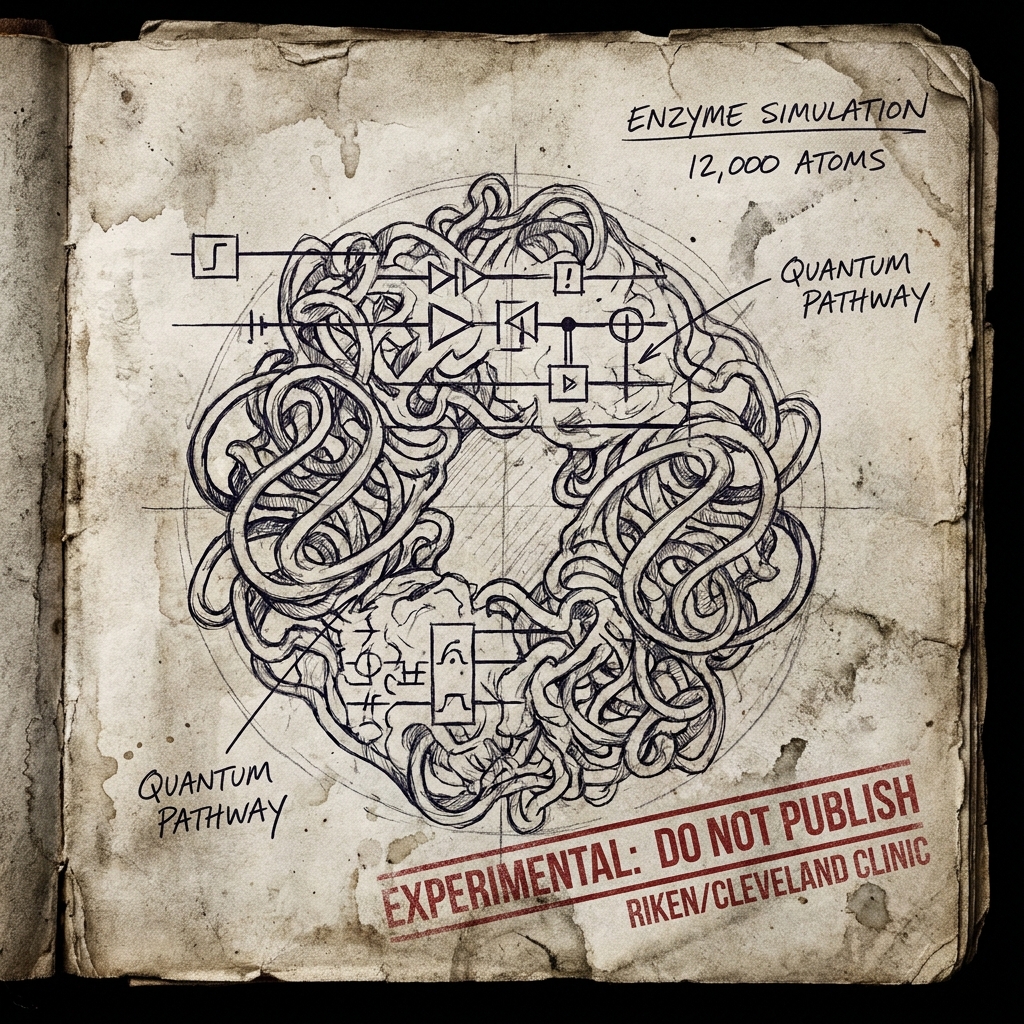
Quantum computers just modeled their largest biological molecules yet, and the implications for drug discovery are hard to overstate. A collaboration between Cleveland Clinic, IBM, and Japan's Riken successfully simulated how two enzymes interact with potential drugs. Each enzyme contains roughly 12,000 atoms, making them the largest biological molecules modeled with the help of quantum computers to date. The timing matters. Wellcome Leap's $50 million Quantum for Bio challenge just released results from six finalist teams, and the picture emerging is increasingly concrete. The top-rated project demonstrated a provably better simulation of how a cancer therapy drug is activated by light, measurably outperforming classical methods. Another team successfully loaded an actual viral genome onto a quantum computer, encoding real hepatitis D DNA in a format quantum algorithms can process. Three things stand out from these developments: First, the hybrid approach is working. Quantum machines paired with classical computers are finding a productive middle ground well before full fault-tolerant hardware arrives. Second, scalability signals are encouraging. At least one team demonstrated that as molecular complexity increases, the advantage of their quantum method grows with it. That is exactly the scaling relationship the field needs. Third, biology is becoming quantum computing's proving ground. Five of the six Wellcome Leap finalists independently converged on the same hardware platform, suggesting the ecosystem is maturing enough for researchers to make pragmatic choices rather than theoretical bets. No one has achieved real-world quantum advantage beyond carefully constructed demonstrations yet, and the early 2030s remains the realistic timeline for large-scale practical applications in chemistry and life sciences. But the gap between laboratory proof-of-concept and genuine utility is narrowing faster than many expected, and venture capital is noticing. The molecules are getting bigger, the methods are getting sharper, and the path from quantum circuit to clinic is starting to look less like science fiction and more like a roadmap #QuantumComputing
 QubitValue
Share
Source:Show original
Disclaimer: The information on this page may have been obtained from third parties and does not necessarily reflect the views or opinions of KuCoin. This content is provided for general informational purposes only, without any representation or warranty of any kind, nor shall it be construed as financial or investment advice. KuCoin shall not be liable for any errors or omissions, or for any outcomes resulting from the use of this information.
Investments in digital assets can be risky. Please carefully evaluate the risks of a product and your risk tolerance based on your own financial circumstances. For more information, please refer to our Terms of Use and Risk Disclosure.