


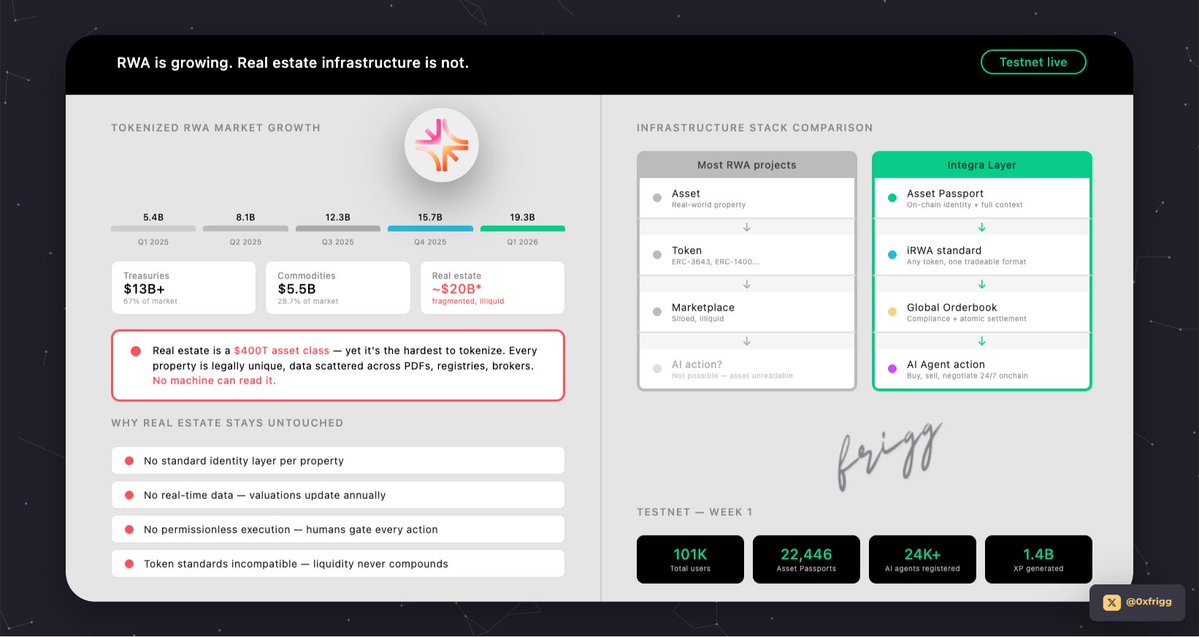
Most RWA projects follow the same arc. Asset. Token. Marketplace. Done. And that works for treasuries, bonds, private credit. Assets that already have clean data, standard legal structures, predictable cash flows. A machine can parse those without much help. Real estate is a different problem entirely. Every property is legally unique. Jurisdiction-specific. Underdescribed. The data lives across registries, PDFs, brokers, lawyers, in different languages, different formats, with no standard schema. You can slap a token on top of that and call it RWA. But the token doesn't make the asset readable. It just wraps the mess in a new package. That's what most projects are actually doing. And that's why real estate has stayed the hardest part of the RWA stack to crack. What made me stop on @integra_layer wasn't the "real estate tokenization" pitch. It was the stack underneath it. asset ➛ identity ➛ compliance ➛ liquidity ➛ AI agent action That's a different framing. They're not trying to tokenize real estate. They're trying to make real estate legible to a machine. Context and all. The Asset Passport is where this gets concrete. Every verified property builds an onchain identity that carries the actual context: title, valuation, jurisdiction, lease status, inspection history, compliance standing. Not just "this property exists as a token" but "here is everything a counterparty needs to understand and act on this asset." That distinction matters because of where AI agents are heading. An agent that can hold a wallet is table stakes at this point. The real question is what that agent can actually do with real-world assets. To buy, negotiate, or manage a property onchain, the agent needs to read the asset, understand its legal context, verify compliance, and execute within a permissioned framework. None of that works if the asset is just a token with no readable structure underneath. The infrastructure Integra is building is essentially the answer to that question. Testnet launched last week. 101K users, 22K Asset Passports minted, 24K+ AI agents registered in week one. I'm not going to oversell what testnet numbers mean. But that's not airdrop behavior either. Minting a passport, deploying an agent, listing an asset, these require understanding what you're doing. RWA is a strong narrative. AI agents is a strong narrative. Most projects are playing one or the other. The actual gap, AI agents operating on real-world assets through compliant, readable infrastructure, is still largely unoccupied. That's what I'm watching here.

Share


Source:Show original
Disclaimer: The information on this page may have been obtained from third parties and does not necessarily reflect the views or opinions of KuCoin. This content is provided for general informational purposes only, without any representation or warranty of any kind, nor shall it be construed as financial or investment advice. KuCoin shall not be liable for any errors or omissions, or for any outcomes resulting from the use of this information.
Investments in digital assets can be risky. Please carefully evaluate the risks of a product and your risk tolerance based on your own financial circumstances. For more information, please refer to our Terms of Use and Risk Disclosure.