


The AI infrastructure trade is very much alive. For a few months, mr. market tried to convince us that the AI capex cycle was “too much, too fast" But the last few weeks, capital has begun rotating back across the AI supply chain aggressively! The obvious beneficiaries are large-cap semi/infra names like $AMD, $INTC $AVGO $ARM, $TSM, $ASML, etc. Think about them as first-order winners because every AI model, inference workload, data center, and compute cluster ultimately starts with them. What's become more interesting is how quickly the market is beginning to reprice the rest of the stack. Power, land, interconnection, DC development, high-density compute, $BTC miners with grid-connected infrastructure, and companies that can actually deliver capacity into a market that is structurally short of it. Market spent the last 2 years obsessing over GPUs (and for good reason). GPUs were the visible bottleneck but the bottleneck is no longer just chips, it's power, it's substations, transmission, land near fiber, cooling. List goes on. It's the ability to take a site from “we have a few MWs” to “we can deliver contracted capacity to an investment-grade customer.” Very few companies actually control the physical inputs required to build it. X via mining mafia was really the only place where this has been discussed for ~3-4 years @BitcoinAIGuy @BTC_Bella69420 @mikealfred That is why the BTC miner / HPC pivot is so important. Some of these companies are really power infra operators that happened to monetize their assets through Bitcoin first. They already understand energy markets, curtailment, power procurement, substation work, uptime, large-scale electrical infra, site ops. That skillset is suddenly much more valuable in a world where hyperscalers and AI cloud companies need capacity faster than the traditional data center market can deliver it and why the recent deal activities validate what we've been saying for a long time. The world needs more compute, and compute needs power. Its also not just about AI anymore. Hyperscalers are legit funding these buildouts with real capex from real businesses producing real cash flow. It makes this infrastructure cycle very different from prior infrastructure cycles. These customers (Oracle, MEta, Amazon, Microsoft, Google) are among the most profitable companies in the world. They can afford to overbuild, and in many cases, they may have no choice. If you believe AI demand continues (which it will) you should be asking where does the capital flow after the most obvious winners have already been repriced? Semis have already moved aggressively. Some of those moves are justified. Some are probably ahead of themselves. But the market is now starting to look further down the value chain. Bitcoin crossing back above $80k+ also adds another layer to this. A stronger Bitcoin market brings life back into the miners at the same time the market is beginning to appreciate their AI/HPC optionality. It creates a unique dual tailwind (mining economics slightly improve while the AI infra optionality gets re-underwritten Market will do a good job separating who has real power assets and development capability but last few weeks message is clear that the AI infra trade is broadening toward the physical infrastructure layer (power, data centers, behind-the-meter assets, and developers who can actually bring capacity online)

Share


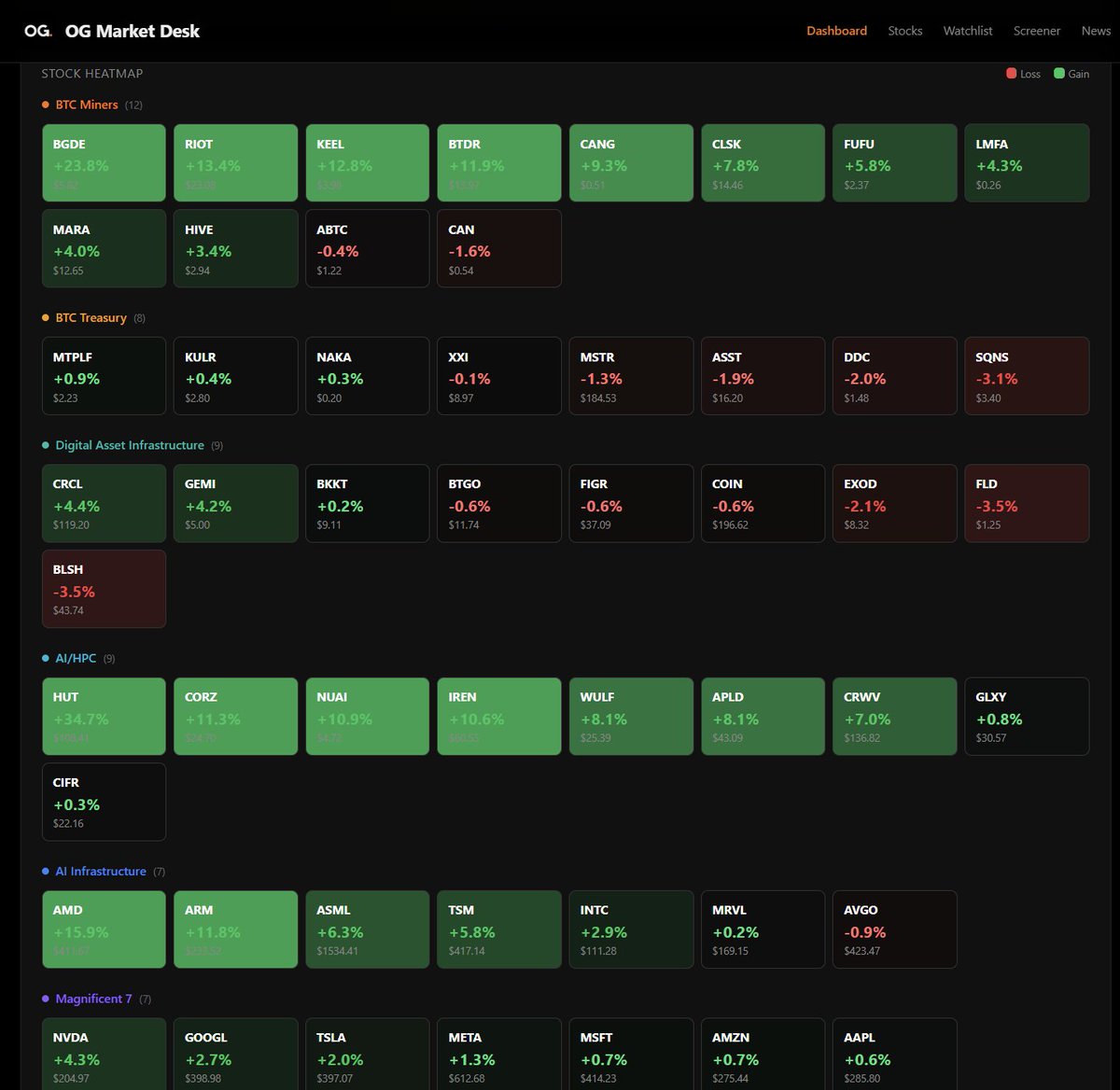
Source:Show original
Disclaimer: The information on this page may have been obtained from third parties and does not necessarily reflect the views or opinions of KuCoin. This content is provided for general informational purposes only, without any representation or warranty of any kind, nor shall it be construed as financial or investment advice. KuCoin shall not be liable for any errors or omissions, or for any outcomes resulting from the use of this information.
Investments in digital assets can be risky. Please carefully evaluate the risks of a product and your risk tolerance based on your own financial circumstances. For more information, please refer to our Terms of Use and Risk Disclosure.