


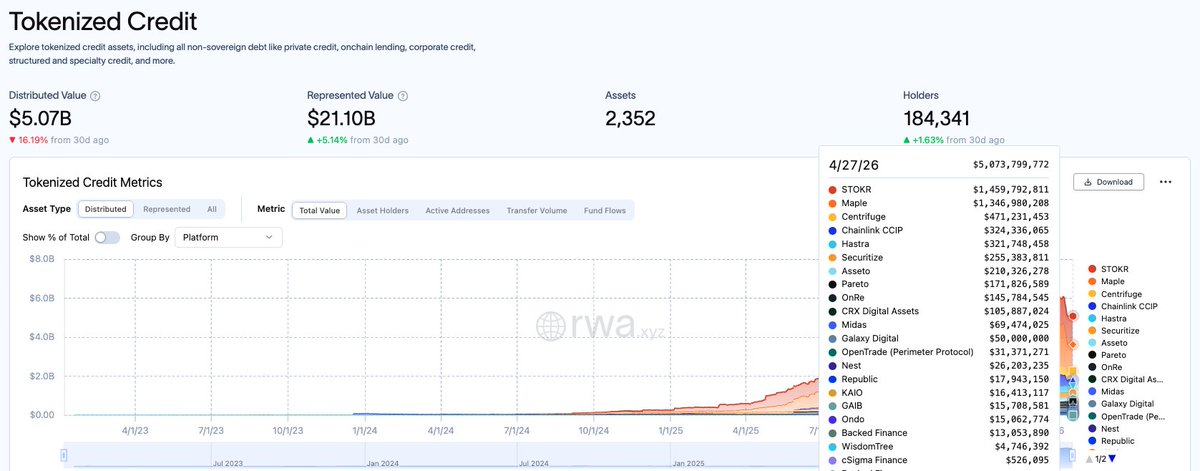
DeFi lending is shifting from collateral-based lending (crypto-native) → cash flow-based credit (real-world loans) The research from @Solofunk makes this explicit. Why is this transition necessary for DeFi? DeFi today acts as a leverage engine. You deposit $150 → borrow $100 → loop → farm yield Through all these, no new capital is actually created. For example, though @aave has ~$14B TVL, most of it is leverage loops, arbitrage flow, and delta-neutral strategies, not real credit formation. DeFi yield is structurally mispriced. With smart contract, oracle, and liquidation risk, base yields should clear >12.5%, as @dunleavy89 outlined in his recent article. Instead, they’re pricing below the risk-free rate. That gap exists because DeFi lacks access to real yield. This is where DeFi x TradFi starts to matter. Tokenized credit is already scaling on-chain, with ~$21B+ in represented assets: > @Figure + @HastraFi have originated $16B+ in HELOCs (Home Equity Line of Credit), with $610M deposits in 4 months and $6.5M+ interest distributed. > @kamino RWA has scaled to ~$1.3B, with $PRIME at ~$600M and yields in the ~7–10% range. This is the convergence of DeFi and Tradfi. DeFi → capital allocator TradFi → credit originator RWAs → core collateral layer Yield → sourced from real economic activity DeFi is becoming a distribution layer for real-world credit. (Data: @RWA_xyz)

Share


Source:Show original
Disclaimer: The information on this page may have been obtained from third parties and does not necessarily reflect the views or opinions of KuCoin. This content is provided for general informational purposes only, without any representation or warranty of any kind, nor shall it be construed as financial or investment advice. KuCoin shall not be liable for any errors or omissions, or for any outcomes resulting from the use of this information.
Investments in digital assets can be risky. Please carefully evaluate the risks of a product and your risk tolerance based on your own financial circumstances. For more information, please refer to our Terms of Use and Risk Disclosure.