


Analyzing the Hearing for New Fed Chair Candidate Warsh: Is Bitcoin Facing Headwinds or Entering an Accumulation Phase? ◆ Short Video Bitcoin in Trouble? The Chair of the U.S. Bank Is Changing [XWIN Capital / Bitcoin Research] https://t.co/11w3gxJonI Is Bitcoin Actually Not Being Sold? Understanding Today’s Market Through Charts [XWIN Capital / Bitcoin Research] https://t.co/bzSCg4jupX ◆ Analysis Summary • Warsh’s hearing signaled a tightening policy focused on reducing the amount of money circulating in the market—this reduction in liquidity itself, not just interest rates, is critical. • Rising long-term interest rates and shrinking dollar liquidity typically create short-term headwinds for Bitcoin. • Meanwhile, long-term holders are holding onto their coins, leading to a declining supply. The market is now in a state of “macro bearish, supply-demand bullish.” ◆ Main Text The hearing for Kevin Warsh, a candidate for Fed Chair, has drawn strong market interest in the future direction of monetary policy. Until now, markets have viewed monetary policy through a simple lens: whether rates would rise or fall. But this discussion operates at a deeper layer. The key focus is the concept of “structural tightening centered on balance sheet reduction.” This is not merely a policy adjustment—it may fundamentally alter the foundation of financial markets, making it an essential theme for understanding future asset prices. To simplify, “structural tightening” means reducing the amount of money circulating in the market. The Fed has previously supported the economy and markets by purchasing assets like Treasury bonds, injecting liquidity. But Warsh believes this scale has become excessive and seeks to gradually shrink it to normalize financial conditions. In other words, he aims to tighten markets not only by adjusting interest rates—the “price” of money—but also by reducing the “quantity” of money itself. What makes Warsh’s approach particularly interesting is that it is not simply “hawkish” (tightening). He also believes there may be room to lower short-term rates depending on economic conditions. As a result, we may face a complex scenario: short-term rates could decline while long-term rates rise, leading to a “twisted” environment where overall market liquidity tightens despite lower short-term borrowing costs. This environment carries significant implications for Bitcoin. Generally, risk assets like Bitcoin and equities tend to rise when liquidity increases and struggle when liquidity decreases. Thus, Warsh’s policy is likely to exert downward pressure on Bitcoin’s upside in the short term—especially if long-term rates rise and the dollar strengthens, drawing capital toward safer assets and creating headwinds for crypto markets. However, when we examine on-chain data, a different picture emerges. While price charts may obscure it, blockchain data reveals who is selling and who is holding. A key indicator here is SOPR (Realized Profit/Loss Ratio) for long-term holders (LTH). Currently, LTH-SOPR is hovering near 1.0, indicating that long-term holders are not engaging in significant profit-taking sales. In other words, many are choosing to hold despite having unrealized gains. Historical cycles show that this condition typically coincides with periods of reduced Bitcoin supply entering the market. Crucially, macro conditions and supply-demand dynamics are now diverging. Normally, deteriorating financial conditions lead to increased selling—but that’s not happening here. Instead, long-term holders are actively withholding supply from the market. The result is a new equilibrium: “less money in circulation, but also less selling.” In such an environment, price movements may remain subdued in the short term, with range-bound consolidation likely to persist. However, because supply is constrained, any new inflow of capital could trigger a sharp price increase. If institutional capital re-enters via ETFs or similar channels, upward momentum could accelerate significantly due to limited sell pressure. In the medium term, if Warsh succeeds in establishing a stable financial environment with low inflation and rule-based policy frameworks, Bitcoin’s status could evolve. It may be increasingly viewed not as a speculative asset but as a more institutionalized one. However, any price appreciation under this scenario would likely be sustained and demand-driven—not a liquidity-fueled surge as seen in past cycles. In conclusion, the current Bitcoin market is characterized by “weak external conditions but strong internal fundamentals.” While short-term patience may be required, the limited supply means substantial upside potential exists once capital returns. We are likely entering a “quiet preparation phase.” ◆ How to Interpret On-Chain Indicators The SOPR (Realized Profit/Loss Ratio) for Long-Term Holders (LTH) measures whether long-term Bitcoin investors are selling at a profit or at a loss. A value above 1.0 indicates more profit-taking sales; below 1.0 indicates more loss-based selling. When SOPR hovers near 1.0, it signals reduced selling pressure and a high proportion of holders choosing to retain their positions. Thus, LTH-SOPR serves as a critical signal for identifying market bottoms or trend reversals.

Share


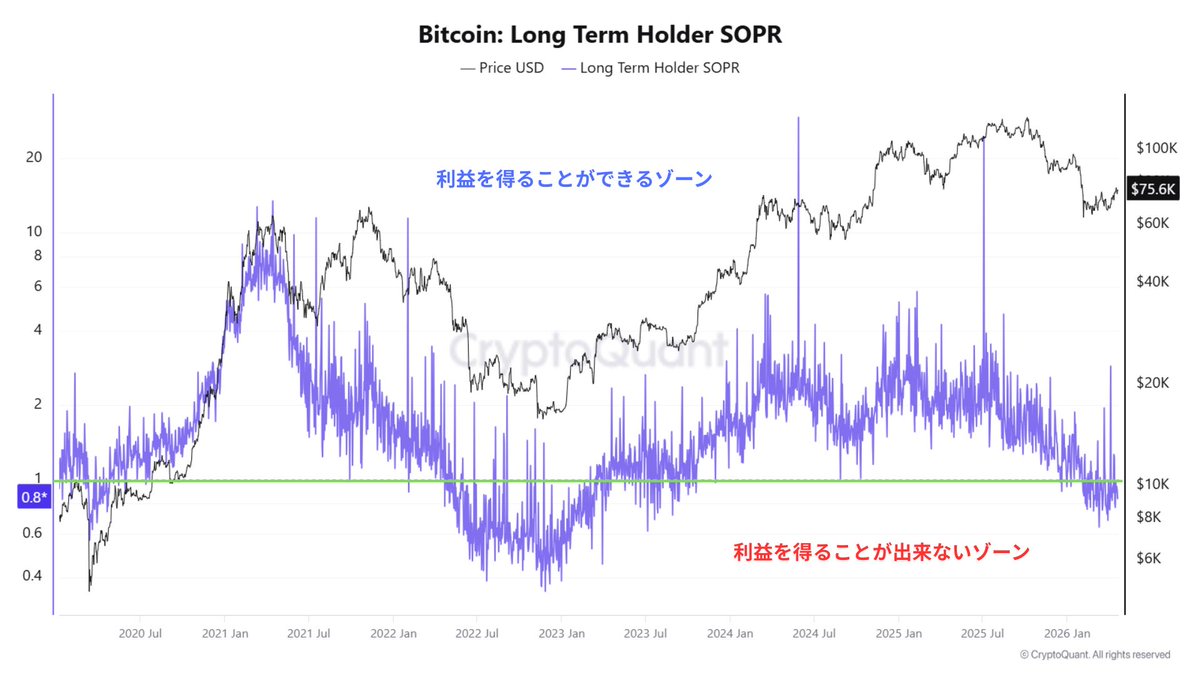
Source:Show original
Disclaimer: The information on this page may have been obtained from third parties and does not necessarily reflect the views or opinions of KuCoin. This content is provided for general informational purposes only, without any representation or warranty of any kind, nor shall it be construed as financial or investment advice. KuCoin shall not be liable for any errors or omissions, or for any outcomes resulting from the use of this information.
Investments in digital assets can be risky. Please carefully evaluate the risks of a product and your risk tolerance based on your own financial circumstances. For more information, please refer to our Terms of Use and Risk Disclosure.