


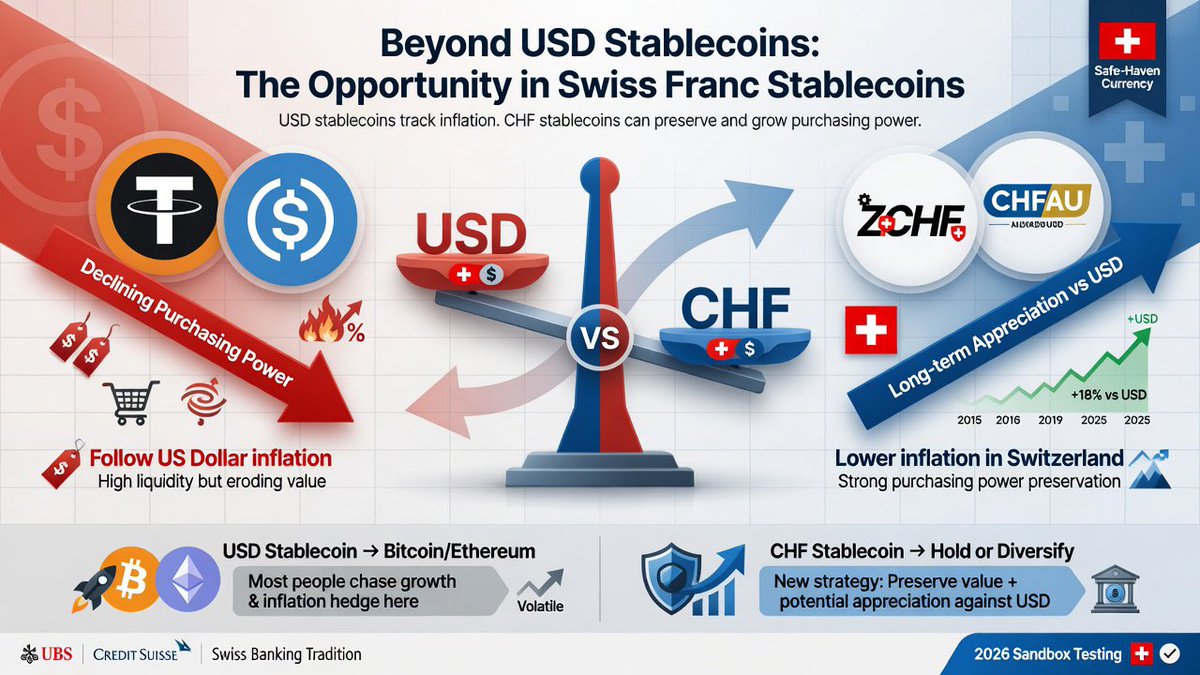
As you mentioned, Dubai, we’ve mostly been focused on dollar-stablecoins like USDT and USDC—simply because they’re convenient and highly liquid. But we’ve been overlooking one crucial point: dollar-stablecoins directly track the declining purchasing power of the dollar. As long as U.S. inflation persists, even a stablecoin pegged to $1 will gradually lose its real purchasing power year after year!! So what if we held a stablecoin pegged to the Swiss Franc (CHF)? The Swiss Franc has long been regarded as a safe-haven asset and has historically appreciated against the dollar. Over recent years, the CHF has maintained strength against the USD, thanks to Switzerland’s low inflation rate (typically 0–2%), making it one of the most reliable currencies for preserving purchasing power. From this perspective, a CHF-backed stablecoin doesn’t just serve as a “stable store of value”—it may also represent a legitimate investment opportunity in its own right. So far, we’ve primarily viewed stablecoins as mere bridges to move funds into growth assets like Bitcoin or Ethereum. But holding a stablecoin backed by a strong currency like the CHF could itself be a meaningful strategy. 😊 This is precisely why continuous learning is so essential. The total market cap of all CHF stablecoins is currently around $44.6 million—tiny compared to dollar-stablecoins, which operate at a trillion-dollar scale. But given its early stage, there’s significant growth potential. Of course, real limitations exist: liquidity is still low, making it impractical to move large sums; and the DeFi ecosystem remains heavily USD-centric, with very limited CHF trading pairs. There are also classic stablecoin risks—such as peg maintenance and trust in underlying collateral—that still apply. Moreover, most retail investors tend to avoid active currency speculation, preferring the familiar pattern of holding dollar-stablecoins before moving directly into Bitcoin or Ethereum. Bitcoin and Ethereum have long been viewed as inflation hedges. Bitcoin, with its fixed supply, is often called “digital gold” and has been widely anticipated as a hedge against monetary inflation. Ethereum, too, could become deflationary if usage grows enough for burn rates to exceed issuance. But even these assets haven’t consistently served as perfect inflation hedges—recently, for example, their prices have dropped even when inflation expectations rose sharply in the short term. Ultimately, they still carry strong growth potential and speculative risk. Synthesizing all of this: As the crypto market matures, currency choice itself may become a strategic decision. Diversifying part of your portfolio into stablecoins backed by strong, stable currencies like the CHF—rather than relying solely on USD—could be a highly rational long-term approach. Though still in its early stages with limited liquidity and options, there’s ample potential for new opportunities if Swiss banks begin actively entering this space. Let’s move beyond simply using stablecoins as mere gateways to buy Ethereum—and start reconsidering the intrinsic value of the stablecoin itself. Thank you, @xymon7777777, for such an insightful post that broadens our perspective!

Share


Source:Show original
Disclaimer: The information on this page may have been obtained from third parties and does not necessarily reflect the views or opinions of KuCoin. This content is provided for general informational purposes only, without any representation or warranty of any kind, nor shall it be construed as financial or investment advice. KuCoin shall not be liable for any errors or omissions, or for any outcomes resulting from the use of this information.
Investments in digital assets can be risky. Please carefully evaluate the risks of a product and your risk tolerance based on your own financial circumstances. For more information, please refer to our Terms of Use and Risk Disclosure.