


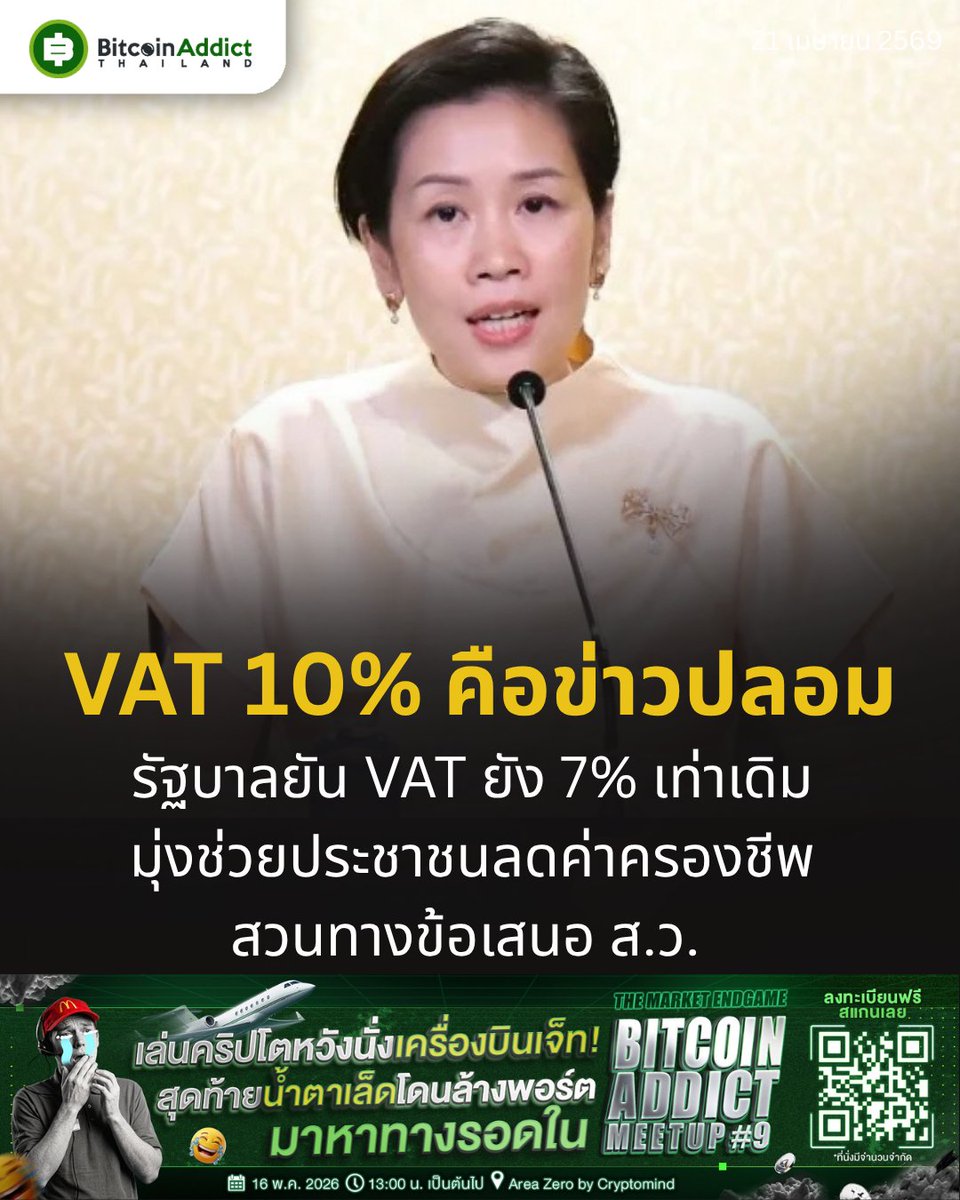
The government confirms no 10% VAT increase, but cash reserves are low, prompting consideration of a 500-billion-baht emergency borrowing bill. Over the past week, everyone on social media discussed the same topic: rumors that the government planned to raise Value Added Tax (VAT) from 7% to 10%. Market vendors talked about it, accountants in offices asked their clients, and restaurants began considering how to adjust their menu prices. But on the morning of April 21, 2026, the government spokesperson delivered a single, brief statement: “False news.” The problem? On the very same day, the Deputy Prime Minister for Legal Affairs made a different statement that left listeners puzzled. 🏛️ Overview of What Happened This situation involves three key figures: First: Ms. Rachada Dhnadirek, Government Spokesperson, tasked with quelling the rumor. Second: Mr. Pakorn Nilprapund, Deputy Prime Minister for Legal Affairs, who ignited another fire by revealing plans for a 500-billion-baht emergency borrowing bill. Third: The Senate Economic Committee, which first proposed raising VAT to 10% earlier this year. The big question everyone wants answered: If the government has firmly denied any VAT increase, why is it preparing such a large borrowing package? What is the true state of the nation’s cash reserves? 📅 Timeline of Events 1) February 2026: The Senate’s Sub-Committee on Finance held a seminar on tax reform, proposing to raise VAT to 10% to generate an additional 400 billion baht in state revenue. The rationale cited was Thailand’s entrapment in a “boiling frog” economic trap. 2) February 23, 2026: Mr. Siripong Angkasakulkit, Deputy Leader of the Bhumjaithai Party, publicly opposed the idea, affirming that there were no plans to raise VAT to 10% over the next two to three years, emphasizing economic recovery first. 3) April 20, 2026 (afternoon): At Parliament, Senator Wutthipong Pongsuwan stated that adjusting VAT is not the Senate’s responsibility—it falls under the government’s jurisdiction. 4) April 20, 2026 (same day): At Impact City, Muang Thong Thani, Mr. Pakorn Nilprapund disclosed that the government is considering issuing a 500-billion-baht emergency borrowing bill to prepare for potential crises. 5) April 20, 2026 (evening): Mr. Korn Jatikwanich, Deputy Leader of the Democrat Party, posted that the Permanent Secretary of Finance was unaware of the plan, calling it an unprecedented case of political officials making unilateral decisions without consulting civil servants. 6) April 21, 2026 (morning): Ms. Rachada Dhnadirek, Government Spokesperson, held a press briefing at Government House stating that rumors of a VAT increase were false and that the emergency borrowing bill was merely a legal opinion—not a finalized decision made over the heads of civil servants. 💰 The Deputy Prime Minister explained that the reason for borrowing is that current cash reserves are low and strained, as the country faces multifaceted risks—including foreign conflicts and environmental crises triggered by a super El Niño event that will severely impact agriculture. The term “Royal Decree” (or “Phor Ror Khor”) refers to emergency legislation issued directly by the government under Article 172 of the Constitution—bypassing parliamentary approval—only in urgent situations threatening economic security, as previously used during the COVID-19 pandemic.🗣️ Public Feedback: When reviewing social media comments, many people are questioning why the government needs to borrow 500 billion baht if the economy isn’t truly in crisis—and if it is, why officials are only saying they’ll “alleviate burdens” without clarity. Many are drawing comparisons to the pandemic period, when a similar loan was previously approved. Another perspective notes that it’s unusual for the Deputy Finance Minister to speak publicly before the Finance Secretary, signaling possible internal discord within the government. 💡 Thought-Provoking Observations What’s interesting is how VAT and the borrowing bill are interconnected issues: the government is seeking to increase revenue, either by raising taxes or by taking on more debt—both of which ultimately become burdens on citizens, whether through higher product prices or increased public debt. For those holding assets like Bitcoin or gold, this development warrants close attention, as rising public debt and monetary expansion often exert long-term downward pressure on currency value. 🔎 What to Watch Next This issue is far from resolved: the borrowing bill has not yet been formally submitted to the Cabinet, and the Senate’s proposed VAT increase remains pending. The Treasury’s final ceiling on public debt has yet to be determined—and remains unanswered. #BitcoinAddict #VAT #BorrowingBill #ThaiEconomy

Share


Source:Show original
Disclaimer: The information on this page may have been obtained from third parties and does not necessarily reflect the views or opinions of KuCoin. This content is provided for general informational purposes only, without any representation or warranty of any kind, nor shall it be construed as financial or investment advice. KuCoin shall not be liable for any errors or omissions, or for any outcomes resulting from the use of this information.
Investments in digital assets can be risky. Please carefully evaluate the risks of a product and your risk tolerance based on your own financial circumstances. For more information, please refer to our Terms of Use and Risk Disclosure.