


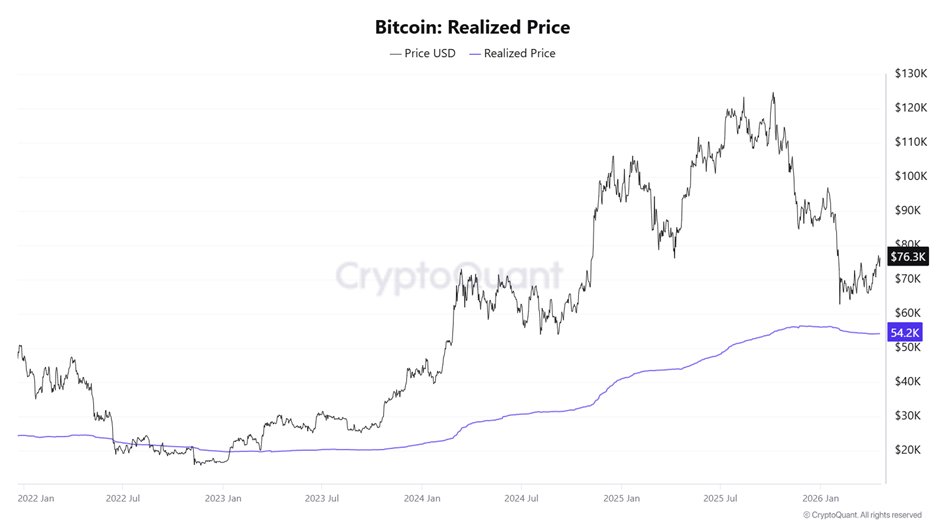
The Bitcoin market in the ETF era: From short-term trading to asset allocation (Analysis Report No. 266) ◆ Short Videos Why is Bitcoin going up? Money is flowing in via ETFs [XWIN Capital / Bitcoin Research] https://t.co/S62wRNAIE1 Why is Bitcoin hard to push down? Understanding through average price [XWIN Capital / Bitcoin Research] https://t.co/dIZ4hQohHe ◆ Analysis Summary ・Capital inflows into spot Bitcoin ETFs are accelerating, totaling roughly USD 1 billion over the past week ・Cumulative net inflows are approximately USD 57.7 billion, with total assets reaching about USD 101.4 billion ・As indicated by the rise in Realized Price, the market is transitioning into an “accumulation phase” ◆ Main Text The Bitcoin market is currently at a structural turning point, with spot Bitcoin ETFs at the center of this shift. ETFs (Exchange-Traded Funds) are financial products that trade on securities markets like stocks, and spot ETFs hold actual Bitcoin as collateral. Through this structure, investors can gain exposure to BTC without going through a crypto asset exchange, establishing a direct channel for capital from traditional finance to flow into the market. At present, the impact is clearly visible. Net inflows into spot Bitcoin ETFs over the last week have reached about USD 996 million, marking three consecutive weeks of capital inflows. In particular, on April 17, net inflows totaled around USD 664 million, a level that ranks among the highest year-to-date across multiple data sources. Cumulative net inflows now stand at approximately USD 57.7 billion, and total net assets have reached about USD 101.4 billion, expanding to a scale equivalent to roughly 6.5% of Bitcoin’s market capitalization. The inflows are being led by traditional financial players such as BlackRock and Fidelity. Steady capital inflows continue to concentrate in products like IBIT and FBTC, and this movement is characterized less by short-term speculation and more as part of long-term asset allocation. Financial institutions, including Morgan Stanley, are also entering the space, and Bitcoin is gradually shifting in status from a mere “investment target” to a fully recognized “asset class.” Viewed from an on-chain and market structure perspective, the underlying balance of supply and demand becomes clearer. Bitcoin’s Realized Price is currently rising to around USD 54,000, indicating that the market-wide average acquisition cost is steadily moving higher. Meanwhile, the current market price is about USD 76,000, still significantly above this cost range, meaning long-term holders in particular are sitting on substantial unrealized gains. Compared to past cycles, this points to a market structure where selling pressure is less likely to emerge. Continuous capital inflows via ETFs are pushing up the market’s overall cost basis through the rise in Realized Price, suggesting that accumulation as part of “asset allocation” is progressing independently of short-term price fluctuations. On the supply-demand front, the impact of supply compression cannot be ignored. Because ETFs continuously absorb spot BTC from the market, the liquid supply on exchanges tends to decrease. While this acts as a factor supporting prices, it also means that when capital inflows and outflows become concentrated, price movements are more easily amplified. In other words, we are at a stage where volatility should not be viewed as simply declining, but rather as undergoing a “structural change.” What about the impact on the Japanese market? At this point, spot Bitcoin ETFs have not been approved in Japan, and a clear framework for them as financial products is still in development. However, from a tax perspective, discussions on separate taxation are progressing, and institutional arrangements are steadily advancing. If ETFs were to be approved, it is highly likely that participation by retail and institutional investors via securities accounts would accelerate, forming a capital inflow structure similar to that of the United States. Overall, the current Bitcoin market is shifting from one “driven by short-term trading” to one “driven by asset allocation.” Rather than focusing only on price movements, it is crucial to ask: whose capital is flowing in, and on what time horizon? That perspective is the key to deciphering the next trend. With the emergence of ETFs as new infrastructure, Bitcoin is now quietly beginning to be integrated into the core of the financial markets. ◆ How to interpret on-chain metrics Realized Price is a metric derived by dividing the Realized Cap (Realized Market Capitalization) by total supply, and is an on-chain indicator that shows the average acquisition cost of all market participants. Rather than reflecting just the current price, it functions as the average of the “prices investors actually paid,” incorporating all past transaction prices. Generally, when the market price is above the Realized Price, the market as a whole is in a state of unrealized profit, and when it is below, the market is in a state of unrealized loss. Accordingly, this metric functions as on-chain support and resistance, and is an important benchmark for judging whether the market is in an accumulation phase or a distribution phase. ------------------------------------------------------------ XWIN Research is a Japan-based Web3 and crypto asset research organization. Focusing on DeFi portfolio management (https://t.co/6GgtqcFWWE), stablecoins, and on-chain data analysis, it provides insights grounded in practical operations. On its proprietary platform, it operates the “XWIN Research Fund,” which aims to generate returns surpassing simple BTC holding. Drawing on this practical expertise, it explains regulatory developments and market trends in Japan and abroad. ------------------------------------------------------------

Share


Source:Show original
Disclaimer: The information on this page may have been obtained from third parties and does not necessarily reflect the views or opinions of KuCoin. This content is provided for general informational purposes only, without any representation or warranty of any kind, nor shall it be construed as financial or investment advice. KuCoin shall not be liable for any errors or omissions, or for any outcomes resulting from the use of this information.
Investments in digital assets can be risky. Please carefully evaluate the risks of a product and your risk tolerance based on your own financial circumstances. For more information, please refer to our Terms of Use and Risk Disclosure.