


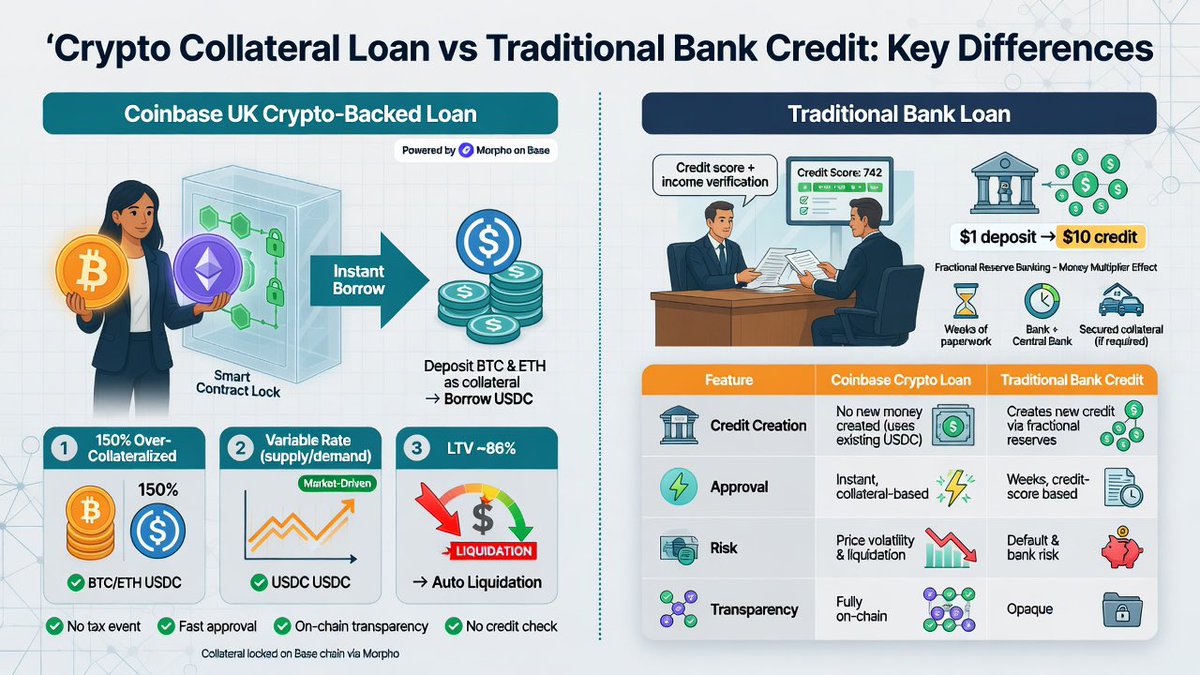
[🚨 Crypto-Collateralized Liquidity — How Does It Differ from Traditional Bank Credit?] Coinbase’s recently launched crypto-collateralized loan service in the UK has attracted significant attention from investors. Users can now lock up their Bitcoin (BTC), Ethereum (ETH), or cbETH as collateral and instantly borrow USDC — without needing to sell their assets, thereby avoiding taxable events while gaining practical liquidity. This service operates on-chain via the Morpho protocol, applying variable interest rates based on market demand. It features an automatic liquidation mechanism: if the loan-to-value (LTV) ratio exceeds a set threshold (approximately 86%, the liquidation trigger), a portion of the collateral is automatically sold. This design helps maintain loan stability in the highly volatile crypto market. ⚠️ So, how does this crypto-collateralized lending differ from traditional bank credit? The most fundamental difference lies in how credit is created. Traditional banks extend loans using customer deposits under a fractional reserve system, effectively generating new money in the process. In other words, banks can lend more than the total amount of deposits they hold, expanding overall credit supply in the economy. Loan approvals typically involve lengthy evaluations of credit scores, income verification, and financial health. In contrast, Coinbase’s crypto-collateralized loans operate on an over-collateralized model using existing assets. Users lock their BTC or ETH (internally converted to assets like cbBTC and held in smart contracts) as collateral to borrow USDC deposited by other users. No new currency is created here; instead, previously idle crypto assets are efficiently mobilized to supply liquidity to the market. Loan approval depends solely on collateral value — not creditworthiness — making the process fast and straightforward. Another key distinction is risk management and transparency. While traditional banks manage their own credit risk, this on-chain lending system relies on smart contracts to automatically monitor LTV ratios and execute liquidations. All transactions are recorded on the blockchain, offering high transparency accessible to anyone — but this also means unexpected liquidations can occur during sharp crypto price declines. Interest rates are not set by central banks or financial institutions; instead, they fluctuate in real time based on supply and demand within the on-chain market. Ultimately, while this service does not create new money like traditional banking, it delivers tangible credit expansion within the crypto economy. By enabling users to access liquidity without selling their assets, it allows investors to maintain their HODL strategies while still deploying capital for daily expenses or additional investments — making it an attractive option for many. As crypto and traditional finance continue to converge, it will be fascinating to observe how these on-chain credit products evolve and shape the future of finance. Until the Flippening! 🔥 ETH > BTC $ETH $BMNR #Flippening #LeanEthereum

Share


Source:Show original
Disclaimer: The information on this page may have been obtained from third parties and does not necessarily reflect the views or opinions of KuCoin. This content is provided for general informational purposes only, without any representation or warranty of any kind, nor shall it be construed as financial or investment advice. KuCoin shall not be liable for any errors or omissions, or for any outcomes resulting from the use of this information.
Investments in digital assets can be risky. Please carefully evaluate the risks of a product and your risk tolerance based on your own financial circumstances. For more information, please refer to our Terms of Use and Risk Disclosure.