


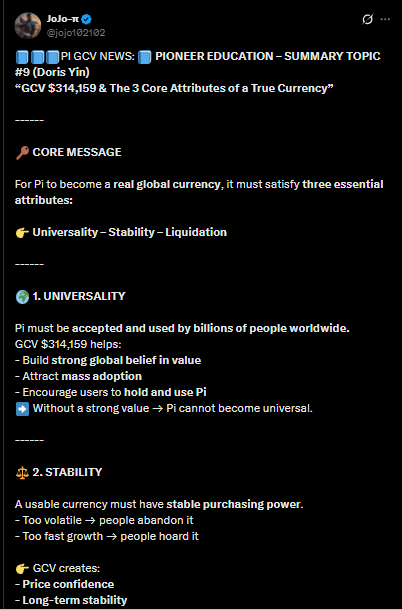
Can Pi Network Become a Global Currency? Three Core Principles Driving the Debate. An analysis of Pi Network’s path toward becoming a global currency through universality, stability, and liquidity—the key pillars shaping Picoin’s future. Three core principles outline the network’s journey toward its ambition of global currency status. The evolution of digital assets continues to spark debate over which projects can transition from speculative instruments to fully functional global currencies. In this context, Pi Network has emerged as an increasingly discussed topic, particularly regarding the fundamental requirements necessary for its native asset, Picoin, to achieve genuine monetary status. A recent wave of community-led analysis has focused on three essential attributes that define a true currency: universality, stability, and liquidity. These principles are widely recognized in both traditional economics and modern cryptocurrency theory as the foundation of any system aiming for global-scale operation. Although Pi Network has made significant progress in building a large user base, the current challenge lies in aligning this growth with the core characteristics needed to create a sustainable and widely accepted financial ecosystem. Understanding Universality in the Digital Economy Universality refers to a currency’s ability to be widely accepted and used across diverse regions, industries, and use cases. For an asset to function as a global medium of exchange, it must be accessible and recognized by a broad population. Pi Network has taken steps in this direction by prioritizing accessibility. Their mobile-first approach enables users from various economic backgrounds to participate without requiring specialized hardware or significant financial investment. This inclusivity has contributed to the rapid expansion of its user base, making Pi Network one of the most widely distributed communities in the cryptocurrency space. However, universality does not end at user registration—it requires active usage in real-world transactions, from everyday purchases to business operations. Achieving this level of adoption depends on the network’s ability to integrate with retailers, service providers, and digital platforms. Without practical applications, even a large user base may fail to translate into meaningful economic activity. The Challenge of Stability Stability is another critical pillar in developing an effective currency. In traditional financial systems, stability ensures that a currency can reliably store value and facilitate transactions without significant fluctuations. For cryptocurrencies, this remains one of the most difficult challenges. Market volatility, speculative trading, and external factors can cause rapid shifts in value, limiting their effectiveness as everyday money. For Picoin, establishing stability will require a combination of technical, economic, and behavioral factors. This could include mechanisms to manage supply and demand, consistent development of use cases, and building user trust. A stable currency encourages participation by reducing uncertainty. Businesses are more likely to accept it as a payment method, and individuals are more likely to use it for transactions rather than merely holding it as an investment. For Pi Network, achieving stability is closely tied to the broader development of its ecosystem. As utility increases and adoption expands, factors contributing to volatility may gradually diminish. Liquidity as the Foundation for Growth Liquidity—the third core attribute—refers to how easily a currency can be exchanged or converted without significantly affecting its value. This is a fundamental component of any financial system, enabling efficient transactions and supporting market confidence. In the cryptocurrency space, liquidity is often associated with exchange listings, trading volume, and market participation. For Pi Network, building sufficient liquidity will be essential to drive broader adoption. Without adequate liquidity, users may struggle to use Picoin for transactions or convert it into other assets. This limitation could hinder the overall functionality of the ecosystem and reduce its appeal to potential participants. Developing liquidity involves multiple steps, including expanding market access, encouraging active usage, and establishing partnerships that support economic activity within the network. As liquidity improves, it can create a positive feedback loop, attracting more users and increasing the currency’s overall utility. Balancing Vision with Reality The ambition to position Picoin as a global currency reflects a broader trend within the Web3 movement.Decentralized systems aim to redefine how value is created and exchanged, offering alternatives to traditional financial structures. However, the transition from concept to reality is highly complex. Each of these three core attributes presents unique challenges, and achieving them simultaneously requires careful coordination and sustained effort. Pi Network has demonstrated its ability to attract a large and active community. The next phase will be transforming this platform into practical outcomes aligned with the principles of universality, stability, and liquidity. Industry experts argue that success in this field often depends more on execution than vision alone. While theoretical frameworks are important, real-world implementation is the decisive factor in determining ultimate feasibility. The Role of Community and Ecosystem Development One of Pi Network’s standout features is its emphasis on community participation. Unlike many traditional financial systems, where control is centralized, Pi Network relies on a decentralized network of users to drive growth and innovation. This approach aligns with the core values of Web3, which prioritize decentralization and user empowerment. By engaging users in the development process, the network aims to build a more comprehensive and sustainable ecosystem. Community participation also plays a critical role in achieving universality. As users adopt and promote this currency, they contribute to its recognition and acceptance. This organic growth can be a powerful driver in expanding its reach. At the same time, ecosystem development remains pivotal. Creating decentralized applications, marketplaces, and services will provide the necessary infrastructure to support real-world usage. Comparison with Established Cryptocurrencies Discussions about Pi Network’s potential often involve comparisons with established cryptocurrencies such as Bitcoin and Ethereum. These platforms have achieved varying degrees of success in addressing the three core attributes. For example, Bitcoin is widely recognized as a store of value but faces challenges related to scalability and transaction efficiency. Ethereum has built a vast ecosystem of decentralized applications but continues to grapple with issues of cost and scalability. These examples illustrate that no single project has fully mastered every aspect of a global currency. Each has its own strengths and limitations, highlighting the complexity of this endeavor. For Pi Network, this presents both a challenge and an opportunity. By learning from existing models and addressing their shortcomings, the network can carve out a distinct position in the market. Looking Ahead The path to becoming a global currency is both ambitious and uncertain. For Pi Network, the principles of universality, stability, and liquidity provide a clear framework for measuring progress and guiding future development. Although much remains to be done, the ongoing discourse around these attributes reflects growing maturity within the community. This signals a shift from initial growth phases toward a more focused effort to build an efficient and sustainable economic system. As the Web3 landscape continues to evolve, the success of projects like Pi Network will depend on their ability to balance innovation with practicality. Widespread adoption will require not only technological advancement but also trust, ease of use, and real-world applicability. Currently, whether PiCoin can become a global currency remains an open question. However, it is clear that the journey toward this goal is shaping the next phase of Pi Network’s development—and the expanding global community around it. By Victoria Hale

Share


Source:Show original
Disclaimer: The information on this page may have been obtained from third parties and does not necessarily reflect the views or opinions of KuCoin. This content is provided for general informational purposes only, without any representation or warranty of any kind, nor shall it be construed as financial or investment advice. KuCoin shall not be liable for any errors or omissions, or for any outcomes resulting from the use of this information.
Investments in digital assets can be risky. Please carefully evaluate the risks of a product and your risk tolerance based on your own financial circumstances. For more information, please refer to our Terms of Use and Risk Disclosure.